
BURMA
BURMA — Giant statue of Belooma in local stone, in the jungle near Jaungtha.
In April 1937, it was constituted as a British colony, subdivided into Lower and Upper Burma; the latter included several protected states (Shan and Kerenni). By the Treaty of London of 17 October 1947, Burma’s right to independence was recognized. The capital, Rangoon, on the Irrawaddy delta, is a major centre (500,000 inhabitants) and the country’s principal port. In Upper Burma is Mandalay (150,000 inhabitants).
Of the present 17 million inhabitants, the vast majority profess Buddhism; slightly less than one million, in the interior of the country, adhere to animistic cults, and over half a million to Islam. Catholics are estimated at about 150,000.
II. EVANGELIZATION OF BURMA — The evangelization of Burma before its division in 1866 into three vicariates may be divided into five periods. The first, dating from about 1555 to 1721, was a period of occasional evangelization, limited to major centres and directed mainly at European settlers and Portuguese troops. Secular and regular clergy (Dominicans, Franciscans, Jesuits), mostly Portuguese, were involved. At various times (1648 Capuchins, 1704 Paris missionaries) the Sacred Congregation of Propaganda sought to establish a proper mission, succeeding only in the second period (1721–1830) with the Barnabites, and almost by chance, as an appendix to the failed legation of Carlambrogio Mezzabarba in China. From Canton, Mezzabarba sent Sigismondo Calchi, a Barnabite, with powers (without the title) of Apostolic Vicar of Ava, Pegu, and Martaban, accompanied by a secular priest, Giuseppe Vittoni (1721). Opposed by the Padroado missionaries (see PADROADO) but well received by the people and the King of Ava, who granted them freedom to preach, the Barnabite mission began auspiciously. Despite their zeal and intelligent efforts, however, the mission suffered a series of severe setbacks. In 1741 and 1746, during internal conflicts between Burmese and Peguan forces, the first two Apostolic Vicars, Mons. Pio Gallizia and Paolo M. Nerini, were killed. A brief period of relative calm followed under the Apostolic Vicar G. M. Percoto (d. 1776), but soon revolutions, civil wars, and persecutions resumed, culminating in the Anglo-Burmese War of the first quarter of the 19th century. The last Apostolic Vicar able to work was G. M. Mantegazza (d. 1794). His successor, Corbenonis, died before receiving his appointment, and L. Grondona was unable to be consecrated bishop. The last Barnabite missionaries were Fr. G. d’Amato and Fr. Vincenzo Sangermano. In 1830, the Barnabite Congregation, finding it impossible to continue supporting the Burmese mission, was forced to abandon II. They had made the first serious and sustained attempt to evangelize the Burmese and the Karen tribes and produced the first indigenous linguistic literature.
The Scolopi (Piarists) followed in the third period (1830–39), with the Apostolic Vicar Federico Cao and a few priests and religious gathered together, among whom Don Tarolli of Trent stood out. The Propaganda then entrusted the mission to the Oblates of Mary Immaculate of Turin (fourth period: 1839–1856), who worked zealously under their two Apostolic Vicars, Cerretti (1842–47) and Balma (1848–56). Their work was soon destroyed, and the fathers imprisoned following the Second Anglo-Burmese War of 1851–52. The last of their missionaries was Fr. Abbona. The mission (fifth period: from 1856 onward) then passed to the Paris Foreign Mission Society, with the first Apostolic Vicar, Bignard, who, benefiting from the freedom established by the British and the peace following the occupation, was able after a study tour of the region to begin implementing his apostolic program (especially in the educational sector) with such success that, ten years later, he was able to propose to the Sacred Congregation of Propaganda the division of the entire territory of the single mission into three vicariates (1866), namely those of Northern, Eastern, Central, and South-Western Burma, all entrusted to the same Paris Society and definitively reorganized in 1870 with the transfer of the Eastern Vicariate to the Seminary of the Foreign Missions of Milan. From then on, the individual jurisdictions began their separate existence (see the relevant entries). At present, there are the following missions in Burma: three Apostolic Prefectures: Akyab (see), Bhamo (see), and Kengtung (see), and three Apostolic Vicariates: Southern Burma (see), Mandalay (see), and Toungoo (see), with a total of nearly 150,000 Catholics. The missions in Burma, as regards organization, depend on the Apostolic Internunciature of India, with its seat in New Delhi.
Protestant missions are numerous and active in Burma. The first to arrive were the English Baptists in 1808, who came from Bengal, followed (1815)...
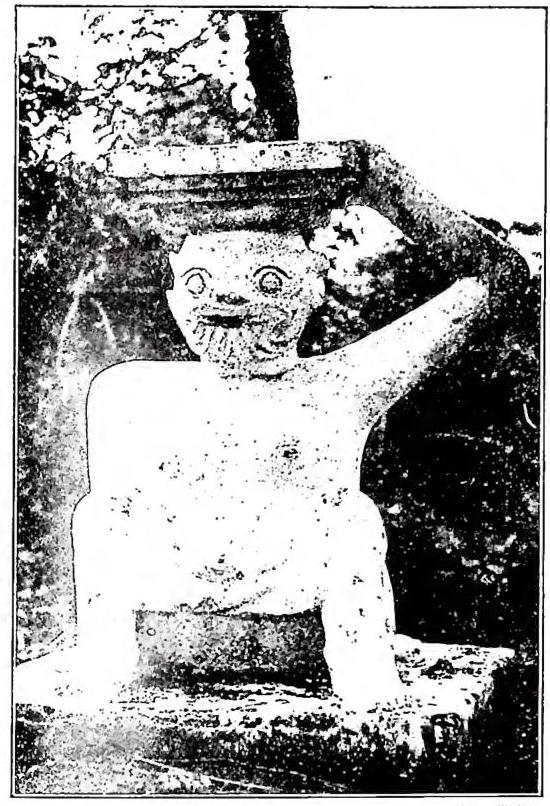
Burmese — Giant statue of Belooma in local stone, in the jungle near Jeongtha.