
maṇa to the Sāmaveda the Pañcaviṇṇa- and the Jaiminīya-brāhmaṇa; to the Black Yajurveda the Taittirīya-brāhmaṇa and to the White Yajurveda the Satapatha-brāhmaṇa, which is the most important of all both in content and in extent: 100 chapters, divided into 10 books. The Atharvaveda originally lacked a liturgical treatise, but toward the end of the Vedic age the late Gopatha-brāhmaṇa was attributed to it so that the fourth Veda too might have its ritual.
already belongs to Yoga, an exceedingly ancient ascetic doctrine dating back to the eighth century B.C. The theory of the avatāra, « descents » or incarnations of a divinity upon earth, then offered the masses, avid for divine love, a means of deifying their heroes, and offered the brahmani the opportunity to assimilate non-Aryan cults. Brahmanic tolerance was in fact unlimited, provided that the dogma that the veda was not a human work but revelation was respected. Belief in the avatāra and devotion are the characteristics of Hinduism, the modern phase of the Indian religions, also called neobrahmanism because, in the religious syncretism from which it originated, the brahmanic element always succeeded in prevailing.
KARMA-MARGA. — Already in the black Yajurveda there are found, intermingled with prayers and formulas, those “ritual explanations” (brāhmaṇa) that were later collected in the liturgical treatises bearing the same name, the most important of which is the Brāhmaṇa called, because of its one hundred chapters, “of the hundred paths” (Satapatha-brāhmaṇa). Brahmanic religion revolves around sacrifice (yajña), which is no longer understood as intended to propitiate the gods so that they may grant human beings prosperity on earth and bliss in heaven. These goods are produced by the sacrifice itself, by its mysterious power, which is magical in nature. The gods are summoned to contribute to the sacrificial rite only as instruments; they too made use of sacrifice to obtain immortality (Sat. Br., X, 4, 3, 3, 8). The yajña resembles a mechanism, of which the gods, the officiating priests with their implements, the sacred fires, the offerings, and the ritual acts and words represent the constituent parts. If these parts perform their function exactly, the brahman is produced, the mystical power that the magician-priest knows how to put to the benefit of the wealthy patron at whose expense the ceremony is performed. In the Rgveda, III, 53, 12, the priestly family of the Viśvāmitra boasts of protecting the Bhārata with its brahman. Sacrifice exists ab aeterno, and is an emanation of the Father of creatures (Prajāpati), the supreme Being of priestly speculation. The most orthodox theologians of the Vedic age, the Mīmāṃsāka, maintain that the sole purpose of revelation was to teach the doctrine of sacrifice.
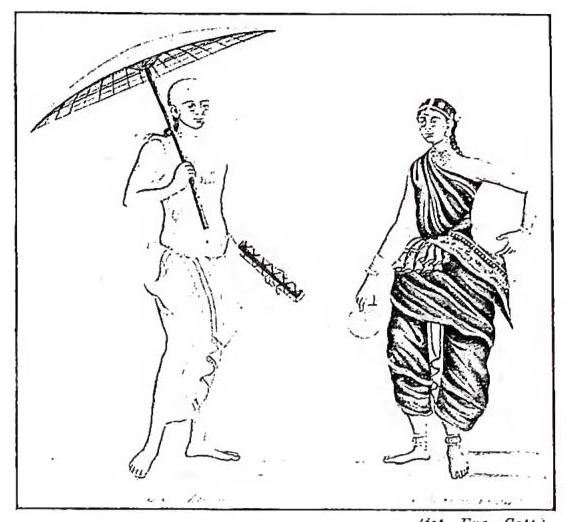
(phot. Enc. Cati.)
BRAHMANESIMO - Couple belonging to the brahmaṇa caste. Seventeenth-century miniature - Rome, Pontifical Lateran Missionary Ethnological Museum.
The anacoretic texts, which belong to the first three Vedas, are like the link between the Brāhmaṇa and the Upaniṣad, also called Vedānta, “the end of the Veda,” because they are the final product of the Vedic tradition. Through comparisons between the microcosm of man and the macrocosm of the universe, the philosophers of the Upaniṣad arrive at a new doctrine: that of the unity of the cosmic principle (brahman) with the subject of knowledge within us, the Self, the ātman. The cosmic powers correspond to the psychophysical powers; but both are manifestations of the immanent divinity, of the One-All, which cannot be known because, being the subject, it cannot at the same time be the object of knowledge. The mutual relations between the world and the Absolute, conceived at the same time as immanent and transcendent, are the subject of the Upaniṣadic speculations. Since princes and kings also appear in the Upaniṣad as teachers of the new doctrine, it was thought that philosophical speculation had originated in the military caste, in opposition to Brahmanic sacrificial science. But we have no sufficient evidence for this. In any case, the credit for its elaboration belongs to the brahmins, the authors of the Upaniṣad.
ESCATOLOGICAL DOCTRINES. — In former times it was believed that, upon dying, the good ascended to heaven to feast in the company of Yama beneath leafy trees, while the wicked were plunged into the darkness of deep abysses. No return from the other world to this one was envisaged. But the Brāhmaṇa of a hundred paths speaks of a “new death” in the hereafter, once the religious merit acquired during life has been exhausted. It seeks escape from dying again either in ceremonies of extraordinary power, capable of rendering sacrifices and good works inexhaustible, or in various notions intended to protect one from the second death. The belief in death in the hereafter and in the dependence of the fate of the deceased upon the deeds performed during life constituted the premises of the pan-Indian doctrine of the transmigration of souls, which already appears fully formed in the most ancient Upaniṣads. Life is no longer conceived as a brief journey from birth to death, but as a passing (saṃsāra) from one existence to another through infinite births and deaths, until liberation (mokṣa) from the long ordeal. With death the psyche dissolves, but the transcendent force of merit and demerit reconnects its elements in a new psychic organism, capable of receiving, in another existence, human or animal, the recompense for its deeds in the form of joy or suffering. After a period of uncertainty regarding the way to attain liberation from rebirth, the authors of the Upaniṣads ultimately came to identify this means with the union of the ātman with brahman, the cosmic principle. Whether, in this theocracy, the individuality of the liberated person continues to subsist or is lost is a question that was resolved only later by the philosophers of the Vedānta. The former view was held by Rāmānuja (11th–12th century), who seems to have professed the more ancient opinion; the latter by Śaṅkara (9th century).
RITES. — Ancient India had no public worship, unlike ancient Rome. Priests offered their services to wealthy private individuals, princes, and kings, celebrating complicated ceremonies called śrauta, that is, founded on revelation, whether periodic or extraordinary. The sacrifice of Soma, which involved preparing the sacred beverage and required the use of three sacrificial fires and the presence of sixteen priests, was an annual spring rite. Among the extraordinary ceremonies were the consecration of a king and the sacrifice of the horse. The priests officiating at the major sacrifices are: the Hotar, or invoker, who at the beginning of the ceremony recites the laudatory verses of the Rgveda; the Udgātar, the chanter, who accompanies the rites with song; the Adhvaryu, or performer of the sacrifice, who mutters exorcisms and prayers intended to ensure the success of the undertaking; and the Brahman, the inspector of the sacrifice, whose duty it is to remedy any errors through appropriate expiations. For the completion of the household sacrifices, performed by the head of the family, a single fire is sufficient, the domestic fire, which receives obligatory offerings of milk, morning and evening, and at midday offerings of food for the Manes and all the gods. The principal sacraments, or saṃskāra, which consecrate the passage from one condition of life to another, number about ten; but it will suffice to recall, without describing them, the most important, beginning with the rites of birth, the last of which is the imposition of the name. The upanayana, or initiation into spiritual life, is invested with particular solemnity; it was conferred upon the Aryan castes between the ages of eight and twelve, after which the initiate wore the sacred girdle and took the name dvija, “twice-born.” The period of pupilship then began, particularly arduous for future priests, who had to learn the veda by heart, devoting nine or more years to this study. Women and non-Aryan castes were excluded from the upanayana. Once his pupilship was completed, the young man entered, through marriage, the state of the householder and assumed its burdensome duties. In old age, the contemplative life was appropriate; hence the Brahmanical theory of the āśrama, or “stages” of the perfect life, sanctioned by the code of Manu (v. DHARMA-SĀSTRA), prescribed abandoning one’s family and home and withdrawing into the forest once one had seen one’s children’s children. This was the third stage, following pupilship and marriage. The fourth was that of “renunciation of everything,” in order to devote oneself to a wandering life and live on alms so as to attain union with the brahman. This theory, whose extent of actual practice is unknown, was an evident compromise between adherence to the Vedic religion, founded on sacrificial rites, and the life of the ascetic.
MYTHOLOGY. — The gods of the Rgveda are personifications of natural phenomena or of the mysterious forces that determine them. The sun god is called Sūrya, “sun,” and the Vedic seer celebrates his splendor and power; dawn reddens the sky, dispelling the darkness, and is invoked as Uṣas, the goddess “dawn.” But in the Brā-