
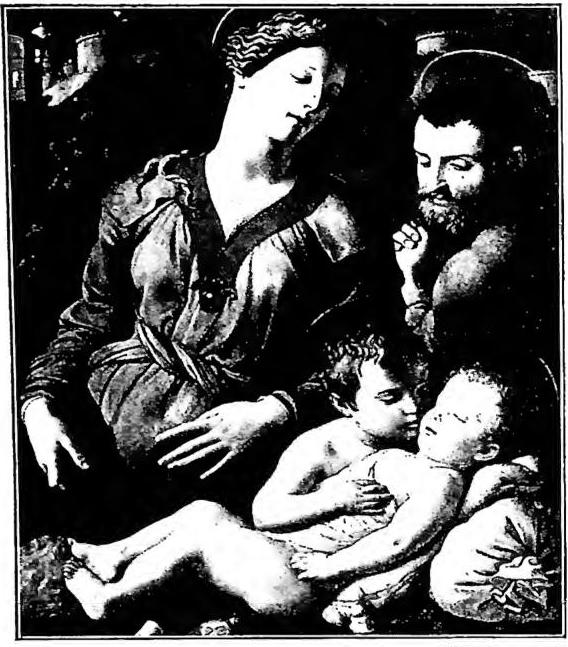
BRONZINO, Angelo (AgnoIo TORI). — Painter and poet, b. at Monticelli (Florence) on 17 Nov. 1503, d. 23 Nov. 1563. While still very young he worked under Raffaellino del Garbo, but soon collaborated with Pontormo in the Certosa of Florence (1522–25) and in the Capponi Chapel of S. Felicità (1524–26). After a sojourn at Pesaro (frescoes in the villa called l’Imperiale) he returned to Florence (1533) where, again with Pontormo, he painted for the Medici in the villas of Poggio a Cajano, Careggi (1536), Castello (1537–42) and in the Palazzo Medici in Via Larga (1539); these frescoes are almost entirely lost. In 1540 he was appointed court painter by Duke Cosimo.
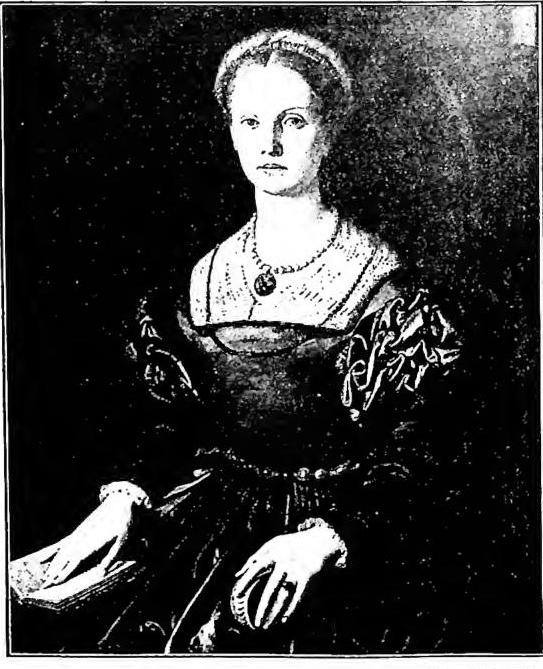
The portraits to which Bronzino’s fame is chiefly bound were painted mainly after 1540; the most notable, in which his style is best characterized by clear draughtsmanship, firm tone and abstract geometrical composition, are those of Eleonora of Toledo with her son, of the young Garcia, of Maria de’ Medici and of Cosimo I in the Uffizi; the Portrait of a Young Man in the Agnew collection, New York; and that of Stefano Colonna in the Galleria Nazionale, Rome. Earlier in this series (1534–40) are the portraits of Ugo Martelli in Berlin (Kaiser-Friedrich-Museum), and of Bartolomeo and Lucrezia Panciatichi (Florence, Uffizi).
Called to decorate the chapel of Eleonora of Toledo (1545–54) in the Palazzo Vecchio, he painted there the splendid Deposition now at Besançon, and some biblical scenes (Crossing of the Red Sea, the Gushing of Water, and the Manna from Heaven), in which certain Raffaellesque and Michelangelesque mannerisms are profitably assimilated by the painter, who lends to these compositions a sense of movement and complex arrangement that are developed in his warm secular works, such as the allegories in London, Rome and Budapest. Probable Flemish influences contributed to this gradual departure from clear relief and sculptural forms; the pictorial quality of his later sacred subjects is inferior to that of his portraits, since in them spontaneity is lacking (Deposition in the Museum of S. Marco, Sacrifice of Abraham, Limbo, the Pietà in the Uffizi; Noli me tangere in the Louvre), or reveal too external an influence of Michelangelo (Resurrection in the church of the Santissima Annunziata, Florence; Nativity in the church of S. Stefano, Pisa), or even, though with his usual refinement, border on the artificial (Martyrdom of the Saint in the church of S. Lorenzo, Florence).