
CALLISTO, POPE, saint — Dejunti in beatitudine, fresco in the cubiculum called of the five Saints (296–304) — Rome.
the ground in which the darnel grows mixed with the wheat (Mt. 13:29–30), or Noah’s area into which clean and unclean animals took refuge (Gen. 6:19 ff.). Whoever does not grant forgiveness to the sincerely repentant sinner betrays the word of the Lord, who came into the world not to condemn, but to redeem and forgive (cf. Philosophumena, 11). It has been thought that Tertullian’s allusions to an « episcopus episcoporum » and to a « summus pontifex », mordant allusions, were also aimed at C. (v. il De Pudicitia, 21). Indeed, it has even been believed that the idea of the predominant authority of the Church of Rome in disciplinary matters originated in the controversies of the Callistan period. But these ideas must be rejected. The phrase: « omnem ecclesiam Petri propinquum » (De Pud., 21, 9), alludes generically to a Church that preserves the tradition of the faith taught by Peter. And nothing demonstrates to us that the bishop of the Church whom Tertullian had in mind was the bishop of Rome. It seems rather that he was the local African bishop,
that is, Agrippinus. The relatively late urban hagiographical legends speak of the origins of the « titulus Callisti » in Trastevere, recounting that C. had gathered Christians in his poor house in Trastevere, where the old priest Calepodius was also said to have been found. The author of the Passio had Calepodius, that is, the eponym of the suburban cemetery, buried by C., and had C. buried by a martyr from Oatia, Asterius, whose « dies natalis » fell a few days after that of C. In any case, it is highly probable that a memorial to Pope C. existed in Trastevere, analogous to the « Memoria Hippolyt » near the vico Patricio. Beside this monumental memorial, Pope Julius I, in the fourth century, erected a basilica, which was called « titulus Iuli et Callisti ». The Depositio martyrum (certainly earlier than 354) records: « pridie idus Octob. (depositio) Callisti in via Aurelia miliario III ». He was therefore regarded as a martyr from a very early time. And the fact that he was buried in a cemetery in Trastevere, rather than in the burial ground on the Appian Way that he had overseen, suggests that his sacrifice had been consummated in Trastevere and that there had not even been the possibility of placing his body in the Trastevere cemetery.
For the so-called edict of C., V. DISCIPLINA.
was sealed by that series of monumental discoveries which De Rossi himself devoted to its illustration in the three volumes of his Roma sotterranea (1864-77); Pius IX ordered that the entire area above it be acquired by the Holy See. Like all the other great Christian cemeteries of Rome, the cemetery of C. consists of above-ground cemetery areas with their corresponding hypogea, originally excavated separately, each with its own access, and only later connected with one another.
Above ground stood the mausoleum of Pope Zefirinus (217); the protomartyr of the Eucharist, Tarsicius, was also buried there; and there, on 6 August 258, the massacre of Sixtus II and four of his deacons took place. In the underground cemetery various regions can be distinguished.
Region of the Popes and of s. Cecilia. — This region consists of two sections, originally separate from one another, each with its own access; the first consisting of a gallery with niches for sarcophagi, later extended for loculus burials and deepened; the second with its own staircase leading to a cubiculum and a gallery, later deepened, along which a series of cubicula was excavated, called by De Rossi the Sacraments cubicula, because of the symbolic representations they contained, dated between the end of the 2nd and the beginning of the 3rd century. Beside the staircase, in a deepened gallery, is the cubiculum where the following popes were buried: Pontianus, Anterus, Fabianus, Lucius, Stephanus, Sixtus II, Dionysius, Felix, Eutychianus, and several bishops, such as Urbanus, Numidianus, Manitus, Polycarpus, Julianus, Laodiceus, and Optatus. The Greek funerary inscriptions of the martyr popes Pontianus and Fabianus, of the popes Anterus, Lucius, and Eutychianus, and of the bishops Numidianus and Optatus of Biskra (Numidia) have been found.
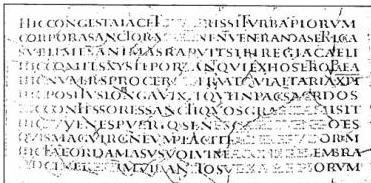
The plaster at the entrance to the chapel is covered with pilgrims’ graffiti, including frequent invocations to s. Sixtus; the interior was embellished with columns, with a poem by Damasus, and with a commemorative inscription of Sixtus III, and contained an altar, traces of which remain. Adjacent is the tomb of s. Cecilia, decorated with paintings from the beginning of the 9th century.
Another section, also dating from the end of the 2nd century, is the one nearest to the Appian Way, with an open-air area and an underground cemetery, called by De Rossi the crypt of Lucina, after the Lucina mentioned in the biography of Pope Cornelius in the Lib. Pont.; she is said to have buried that pope in one of her areas. But the area predates Pope Cornelius (253), who was buried in a deepened section representing the final period of burial. The pope’s inscription is the only one in Latin, and De Rossi found a fragment of it in a farmhouse as early as 1849. The tomb is embellished with a poem by Damasus and with 6th-century paintings representing the popes Cornelius and Sixtus II and the bishops Optatus and Cyprian, who had been commemorated in C. since the 4th century. In the oldest part of this region there is a double cubiculum with frescoes from the end of the 2nd century representing the Baptism of Christ in the Jordan, Daniel among the lions, the cycle of Jonah, Good Shepherds, Orants, genii, and the symbols of the seasons.
A third region is that called the region of Eusebius; it too had its own staircase. It contains the crypt of the martyrs Calocerus and Parthenius, in which nothing remains but a graffito with their names; the tomb of Pope Caius, with the Greek funerary inscription indicating his burial on 22 April (283); the tomb of Pope Eusebius (311), with fragments of the poem composed by Damasus in his honor
(from De Rossi: Roma Sott., II: photograph. Pont. comm. di Arch. sacra) CALLISTO, PAPA, santo - Poem of Pope Damasus, in the crypt of the Popes, in honor of the faithful buried in the cemetery of C. - Rome.
Finally, farther north is the region called Liberiana because of an inscription concerning a deceased woman buried sub Liberio papa (352-366). It too had its own staircase. There De Rossi found a fragment of the funerary poem of the deacon Redemptus, while the syllogae have preserved the complete text.
A series of painted arcosolia dates from the second half of the 4th century; one of them contains the bust of Christ with a halo and the Orant represented twice; a second contains Adam and Eve, and a third a herb seller.
One region was called by De Rossi that of the Labyrinth or of the Arenarium of Hippolytus, and there he sought the memorials of that group of martyrs mentioned by the itinerary inserted in the Gesta regum Anglorum and identified by De Rossi with the confessores quam Graecia misit of Damasus, which Marucchi instead mistakenly wished to seek outside the Callistian area. - Vedi Tav. XXVI.