
While still young, she founded a monastery in Constantinople, which took its name from her and in which she withdrew in order to spend there, having become a nun, the remainder of her years. The poetic compositions preserved from her were written during this second period of her life and naturally fall into two classes: secular poems, or Sentences, and liturgical poems: Idiomela, Heirmoi, and an entire Canon for the dead. In the former, the verses are iambic trimeters; the subject matter is highly varied; the style is simple, without ornament or pretension: they reveal the work of a woman of advanced age. The religious poems are, in literary merit, superior to the secular ones, and C.’s poetic inspiration develops more freely in them. In the Idiomela, C. is also the author of the musical part. Some of these poems have entered the official hymnography of the Greek Church. Besides the episode that was supposed to have made her empress, other episodes are also recounted which turn C.’s life into a romance, so that, especially in the last century, it attracted the pens of several novelists and poets.
RUB.: Poems by C. are found in Christ-Paranikas, Anthologia graeca carminum christianorum, Leipzig 1871, p. 103 ff. Krumbacher, p. 715 ff.; id., Katia, in Abhandl. der bayer. Akademie der Wissenschaften, Munich 1897, pp. 305–70; B. A. Mystakides, in Ogulobbia, 1 (1926), pp. 247–51, 314–19. V. S. Pétridès, C., in Revue de l'Orient chrétien, 7 (1902), pp. 218–44; J. Psicharis, C. et la pomme d'or, in Annuaire de l'École des hautes études, Paris 1910–11, pp. 1–54. Graziella Miot
CASSIANO, GIOVANNI. — G. C., natione Scyta (Gennadius), according to an opinion now fairly common, was born in Dobrugia of well-to-do parents around 360. Having received a good education in the classical studies, he became a monk at Bethlehem while still young; then, from about 385, he stayed in Egypt for seven years in order to learn to know the monastic life, which was flourishing there; after another, very brief stay at the monastery of Bethlehem, he returned once more to Egypt for several years, among the monks. Around 399 he went to Constantinople, because of the Origenist disturbances; here he was ordained a deacon by St. Giov. Crisostomo, for whose cause we find him active in Rome in 405. From 415 he withdrew to Marseille, as a priest, founder and head of the monastery of S. Vittore, and also founder of a monastery for nuns in the same region. He died around 435.
G. C.’s literary output is extensive:
1) De institutis coenobiorum et de octo principalium vitiorum remediis libri XII, written around 420. Book I deals with monastic dress, Books II and III with the hours of prayer (“canonical”) in the monastery, Book IV with the novitiate and profession; the remaining books, V through XII, concern the principal passions (eight) and the corresponding virtues. The work reveals C.’s conception of the coenobitic life, whose duties are presented in depth, especially in Book IV. The ideas of this book dominate the entire work.
2) Collationes XXIV, published in three stages: I–X around 420, XI–XVII before 426, XVIII–XXIV before 429. The work is essentially devoted to the ideas of the eremitical life.
3) De incarnatione Domini contra Nestorium libri VII. Written before the summer of 430 at the request of the Roman archdeacon who later became Pope Leo I. The work is considerably inferior to C.’s monastic writings.
C. is wholly a monk: only from this standpoint should his two principal works be considered. His monastic doctrine rests on these fundamental concepts: the goal of the monastic life is contemplatio; the condition for contemplation is the actualis life. From these principles, applied to life, two consequences follow for C.: 1) the contemplative life, understood as contemplatio relative iugis, is possible only in the eremitical life; 2) the actualis life constitutes the essential task of the coenobium, which is therefore regarded as a preparatory school for the eremitical life (Coll. XVII and XIX: De tribus generibus monachorum; De fine coenobiotae et heremitae).
Coll. I contains the fundamental lines of the entire doctrine of our author, so that understanding them gives us the key to understanding C. The actualis life consists in the “correctio morum et consummatio vitae perfectae” (De inst., prooenium). And these cannot be achieved without struggle—a struggle taught in the second part of De inst., from Book V through Book XII, in Coll. IV–VI, VIII, and in other passages of the two works (v. for example, the symbolism of monastic dress in De inst., II. II–IV).
The profession, abrenuntiatio, described in De inst., I. IV, obliges the coenobite to total renunciation, in complete poverty after the example of Christ, in Christ’s humility, in his obedience and patience, and in the other virtues (on this, V. also Coll. III: De tribus abrenuntiationibus and Coll. XXIV: De mortificatione). All these virtues are the fruit of conformity to the life and passion of Christ and to his cross, in which, for C. (as already for Pachomius), the entire life of the coenobite is concentrated. And this conformity also leads to life in Christ (De inst., I. IV).
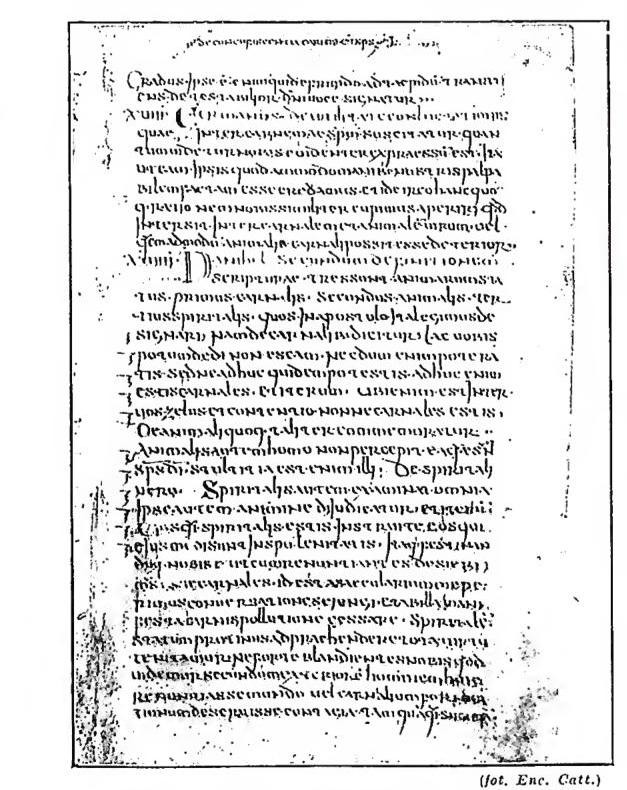
(Ist. Eur. Catt.)
CASSIANO - Collatio, IV, 19. Eighth-century manuscript. Vatican Library, cod. Vat. lat. 3766, f. 4.
fear (concerning which cf. especially Coll. XI; De perfectione). It constitutes the proper goal of the cenobium, and the monk who has attained it now finds himself at the open door of the contemplative life.
For the realization of the actualis and contemplative (theoretica) life, discretio is of capital importance, in order to distinguish what promotes the good from what is contrary to it, what comes from God from what comes from man or the devil (this is treated especially in Coll. II). Man cannot attain complete impeccability (Coll. XXIII: De anamarteto). To do good, the grace of God is unceasingly necessary: C. insists on this point with the greatest vigor. Yet, in opposition to Augustine, he believes that, in order to safeguard the freedom of the will, a minimal initiative wholly independent must be admitted in free choice. Thus C. became the representative of semi-Pelagianism: without this error, he might have been called a «doctor gratiae».