
CELESTINO III - C. III grants autonomy to the hospital of S. Maria della Scala. Fresco by Domenico di Bartolo (1443-44) - Siena.
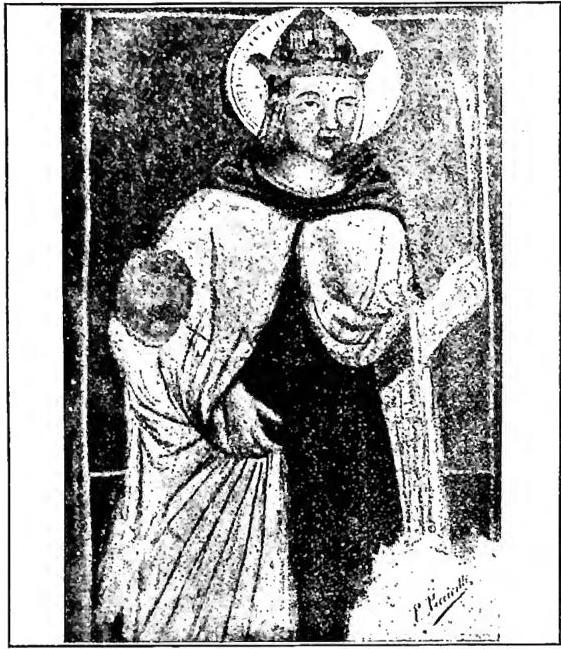
The choice of the poor hermit after a troubled period, due principally to the rivalry between the Colonna and the Orsini, both represented in the Sacred College, has always been an enigma for historians. Recent studies have clarified the background: Charles II, king of Naples, with his son Charles Martel in the spring of 1294, came to Perugia and met with the eleven elector cardinals. From there he went to Sulmona where he granted privileges to the Celestines and almost certainly also saw the holy hermit, who shortly afterwards wrote a letter to the cardinals exhorting them to finally give a Shepherd to the Church. Latino Malabranca, cardinal dean, was the first to name the pious hermit and gave him his vote; others followed him, and the remaining ones decided to accede. Other circumstances and spiritual currents (Angelique Pope) may have influenced the election of the inexperienced hermit. Having accepted the election, he went to L'Aquila, where in the presence of a few cardinals, Charles II, and a large crowd, he was crowned on August 29, 1294.
On September 18, he created 12 cardinals, of whom 7 were French and 5 Italian, all agreeable to King Charles, to whose son St. Louis of Anjou, still very young and a hostage for his father in Spain, he later entrusted (October 7 or 9) the administration of the archdiocese of Lyon (Bull. Franc., IV, p. 332). He granted many privileges to the Celestine monks, two of whom were among the twelve cardinals created in L'Aquila. Accompanied by King Charles himself, C. went to Naples, passing through Sulmona and Montecassino, where he obliged the monks to embrace the institute of the Celestines,
a command abrogated, like so many others, by his successor Boniface VIII. In Naples a residence was prepared for him in Castelnuovo, but he was not slow to realize that he was not equal to the sublime dignity; he was badgered by the wranglings of the curialists, and yearned for the solitude of his cell. At the beginning of Advent he wanted to entrust the government of the Church to three cardinals and retire to an isolated cell. Opposed by a cardinal and tormented by scruples, he began to think about abdication. He consulted some cardinals, among whom was Benedetto Caetani (the future Boniface VIII), who at first advised against it, but then declared that it was possible.
Around December 10, C. issued a constitution stating that a Pope can renounce his high dignity (v. SOMMO PONTEFICE), and on December 13, before the cardinals, he read the formula of his own free and spontaneous abdication. He had put the rigid norm of the Conclave back into force, and Boniface VIII (December 24) emerged immediately elected from it, having his predecessor led towards Rome. The latter, however, eluding the vigilance of the papal guards, fled and hid in Apulia, from where he vainly tried to cross the Adriatic. Boniface VIII, fearing that ill-intentioned people would take advantage of C.'s great simplicity, had him searched for and, found at Viesti, had him brought and guarded in the castle of Fumone, near Alatri, where he lived until his death. It is a slander that Boniface VIII resorted to machinations to obtain his resignation and accelerate his end. St. Peter Celestine, whose body was buried at Ferentino, and then in 1327 transported to Collemaggio (L'Aquila), was canonized by Clement V on May 5, 1313. His feast is celebrated on May 19.
The unusual resignation of C. immediately provoked a literature on the subject, in which Olivi, Giles of Rome, and John Quidort took part. Well known are the verses of Dante (Inf., III, 59-60), which, ever since the earliest commentators, have been considered as alluding to C. - See Pl. LXXVI.
Célestin V et l'opinion théologique en France du vivant de Boniface VIII, in Revue d'histoire de l'Église de France, 25 (1939), pp. 183-92; S. Garcias Palou, El beato Ramón Llull y la cuestión de la renunciabilidad de la sede romana, in Aurora Sacra Tarraconensia, 17 (1944), pp. 67-96. Livario Oliger