
CELTES, CONRAD — Tomb — Vienna, church of S. Stefano.
ccc.) spans a period of several centuries, making it exceedingly difficult to ascertain the origins of Celtic religious beliefs and trace their development. Moreover, the literary sources represent rather the “interpretatio romana” and the “interpretatio christiana” of Celtic religious life, so that, in many respects, our knowledge remains hypothetical.
The palæontological remains consist of megalithic structures, menhirs, cromlechs, and dolmens (sepulchral monuments of the later Stone Age), indices of an advanced religious life (cult of the dead, belief in the immortality of the soul, etc.), which did not fail to exert a considerable influence on the formation of Celtic civilization, so much so that some have believed that the druids (v.), the principal priests of the C., originated from pre-Celtic cultures.
The principal divinities, according to Caesar, were Mercury (the supreme god, bearded and accompanied by a paredra, Rosmerta); Apollo, with the prerogatives of savior and healer (as such he bore the epithet Bormo or Borvo), and a companion (Damona or Bormona); Mars, the warrior god, associated with a goddess; Jupiter, who in figurative monuments bears a wheel (the thunder?) and a double spiral (the lightning?), and is represented on horseback, victorious over a giant; Minerva, whose epithet, Belisama, connects her with the sun; and Dis Pater, regarded as the progenitor of the Gauls.
Besides these, which bear Roman names and can be distinguished by means of their attributes and epithets, the literary sources and, above all, epigraphy testify to divinities with Celtic names. Among them are Esus, Taranis (connected with thunder?), perhaps a sky god; Teutates, more an epithet than a proper name (from touta, tōta, teuta = tribe: hence, the god of the tribe); Ogmios, difficult to interpret, although already assimilated by Lucian to Hercules; and Epona, a goddess of horses. The female divinities must have enjoyed a particular cult, if one considers the large number of names of goddesses transmitted by epigraphy (approximately 500): among them are the Matres or Matronae (agricultural divinities) and nymphs protecting springs and rivers. This picture of a naturalistic religious life is completed by the cult of trees and that of animals, such as the boar, the horse, the bull, etc.
Temples were unknown originally and until the Roman conquest, and the cult, of which only a group of fertility festivals (precisely four) transmitted by Irish sources is known, was practiced beside consecrated trees or springs.
The body of eschatological beliefs (an afterlife reached by sea voyage, a place of wholly earthly delights), and faith in the immortality of the soul, were imparted by the more important of the two priestly groups, the druidic one, while the prerogatives of the gutuatri remain unknown.
III. EVANGELIZZAZIONE
v.: BRITANNIA; GALAZIA; GALLIA; IRLANDA.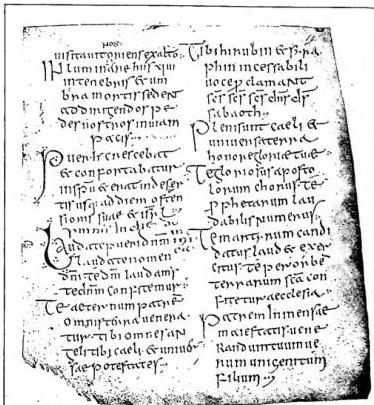
IV. LITURGY
By this name, first used by Mabillon, is designated the rite already in use among the populations of the British Isles and Armorica. The various liturgical centres of these islands developed separately; and the Celtic monks, famous travellers, far from intending to compose a new liturgy, limited themselves to taking from those already existing whatever suited them, harmonizing the individual elements and often giving them a personal character.1. The texts
The principal documents of this liturgical tradition are: a) the Stowe Missal (now in the library of the University of Dublin), a collection written for the use of some monastic church. It contains the Order of the Mass with the Canon, three special Masses, the order of Baptism, Communion, and Anointing of the Sick, all followed by an Irish treatise on the ceremonies of the Mass. Although it is not easy to assign a date to the manuscript, it is certain that it predates the ninth century. b) the Antiphonary of Bangor, originating from the abbey of Bangor (Ireland), where it was written at the end of the seventh century, and later transferred to Bobbio. Contrary to its title, it also contains hymns, prayers, parts of a psalter, canticles, and blessings, so that it appears to be an extract from various liturgical books made for the use of the abbot. It is now in the Ambrosian Library of Milan. c) the Fragments of Armagh (in the library of Trinity College, Dublin), a celebrated manuscript copied by Ferdomnach in 807 or 808, in which, among important liturgical passages, there appears the Hawc igitur of the Canon of the Mass with Gregory the Great’s addition diesque nostros. d) the Martyrology of Oengus, composed in Irish verse at the beginning of the ninth century, important for knowledge of the feasts and the cult of the saints in Celtic lands. To this list must be added various psalters, rituals, hymnals, penitentials, treatises, and a certain number of fragments of lesser importance. Not(from the edition of F. E. Warren, H. Bradshaw Society, London 1952)
CELTI - Antiphonary of Bangor, Benedictus and Te Deum. Codex written in the abbey of Bangor between 680 and 691 - Milan, Biblioteca Ambrosiana, C. 5 inf., f. 107.
Private devotional books must not be overlooked; first of all, e) the Book of Cerne (in the library of the University of Cambridge), written in the ninth century and originating from the abbey of Cerne, where the influence of liturgical prayers is very marked, so that it offers an exact idea of Celtic piety. A special place is occupied by f) the famous Bobbio Missal (now in the Bibliothèque Nationale of Paris). Whatever one may think of its origin and supposed Irish provenance, it contains a large number of Irish elements, or rather a combination of Roman, Gallican, Visigothic elements, redacted in Celtic style. Mabilon designated it by the name of Gallican Sacramentary, and, after repeated fluctuations and hypotheses on the part of liturgists, Wilmart essentially returned to this view; he was the last to devote a profound and exhaustive study to the manuscript (The Bobbio Missal. Notes and Studies [Henry Bradshaw Society, 61], London 1924).
2. Origins
With material so incomplete, it is exceedingly difficult to reconstruct an accurate picture of Celtic liturgy, and still more difficult to ascertain its origins. The fragments we possess are in reality little original, since they contain traces of the Roman, Gallican, Mozarabic, Milanese, and, in a certain sense,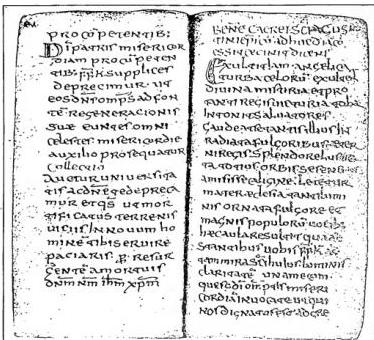
The distinctive character of Irish liturgical usages led certain Anglican theologians to seek their origin in the Eastern liturgies, and more precisely at Ephesus, among the immediate disciples of St. John, thus making Celtic liturgy an Ephesian liturgy in opposition to the Petrine. But this thesis has now been abandoned. Quite apart from the fact that relations between the British Isles and the East are for the most part legendary, it is impossible to know what the true liturgy of Ephesus was. In any case, Celtic formulas and rites as a whole are more Latin than Eastern. The view that presents the Celtic Christians as separatists, in opposition to Rome, or at least, from the doctrinal point of view, as independent of every influence of the City, is contradicted by the character of Celtic liturgy, so thoroughly permeated by Roman elements. The fact is, rather, that relations between the British Isles and the Christian world of the continent were more frequent than is ordinarily believed. In the fourth and fifth centuries St. Vitricius of Rouen and St. Germanus of Auxerre stayed for long periods in Britain; and it was under the latter that the apostle of Ireland, St. Patrick, began his ecclesiastical life and education. It was perhaps Pope Celestine I who sent Ireland its first bishop in the person of Palladius (431). The Breton St. Ninian, before evangelizing the Picts, received his training in Rome, and also had contacts with St. Martin of Tours. Faustine of Riez too, Breton by origin, maintained frequent relations with his homeland. The influence of these figures on the development of liturgical customs in the British Isles was certainly not secondary. Through this network of contacts and journeys, liturgical elements easily migrated across the sea; and only in this way can the presence in Ireland of the so-called Cursus of St. Mark be explained, an arrangement of the Divine Office which, brought from Egypt to Gaul through the work of Cassian and having gained acceptance at Lérins, passed from there into Hibernia under the auspices of St. Patrick. The Cursus of St. Mark, thus becoming the Cursus Scotorum, was later brought back to the continent at the end of the fourth century by St. Columban. Only a strong personality, such as that of St. Patrick, could impose a new liturgical discipline and preserve a certain unity of worship among the various customs introduced among the people. The an-
(from IACL, II, col. 2): 1-2
CELTI - Gallican-origin Bobbio Missal with Irish influences. Prayers for the Easter vigil and the Exsultet, attributed to s. Agostino. Paris, National Library, mss. lat. 13246, ff. 100°-10°.
The years after his death (461) saw the compactness of the liturgical structure slowly disintegrate and a series of separate cells come into being, with often considerable cultic particularities. It is interesting to follow this process of fragmentation in the Catalogus sanctorum Hiberniae secundum diversa tempora, compiled in the 8th century. Only from the middle of the 7th century onward, when southern Ireland adopted the Roman Easter, did the Celtic liturgy once again absorb Roman elements. The Antiphonary of Bangor, from the end of the 7th century, is still purely Gallican. Gaul therefore seems to have exerted a strong influence on the formation of the Irish rites. More difficult to explain, however, is the presence of Mozarabic elements in the Celtic liturgy. The opinions expressed thus far have not solved the problem and rest on hypothetical migrations of Christian C. from Ireland to Spanish Galicia.
3. The Mass
It is above all in the rite of the Mass that the influence of the continental liturgies is found. a) The preparation for Mass according to the Stowe Missal includes a confession of sins, a long litany in which all the national saints are recalled, and an apologia sacerdotis, that is, a formula in which the celebrant declares his unworthiness before approaching the altar. The preparation of the Oblates seems to have taken place, following the example of the Gallican rite, before the priest’s entrance, and involved certain prayers with special remembrance of the individual Persons of the Most Holy Trinity. This reference to the Trinity is frequently emphasized during the Eucharistic celebration and is a characteristic of the Celtic liturgies. The rest closely followed the Roman order. After the singing of the Alleluia at the Epistle, a solemn litany took place, the so-called Deprecatio s. Martini, of distinctly Eastern character, whose text, translated from the Greek, also appears in other Western liturgies. Particular importance was attached to the consecratory formula. The celebrant bowed three times at the words accepti Iesus panem, while the people lay prostrate.This prayer was called the periculosa oratio, and no one was to disturb its silence. The penitential of Cummean prescribes a penance of fifty blows for the priest who stumbled in pronouncing II. In the margin of some missals there was even written the warning: periculum. Communion was surrounded by rites and chants that gave it great solemnity. Among the latter must be placed the famous hymn «quando commonicarent sacerdotes» Sancti venite, Christi corpus sumite, preserved in the Antiphonary of Bangor, of such elevated inspiration as to make one regret the loss of other compositions of this kind. The texts of the «postcommunio» are taken from the Roman books, while the dismissal was announced with these words: Missa acta est. In pace.
4. The Sacraments. - The baptismal rites display the same composite character. The only ordo Baptismi preserved intact is that of Stowe. It includes a large number of prayers, derived both from Gallican and Milanese documents and from Roman documents, and combined in the strangest manner. Alongside ceremonies and prayers for the Baptism of adults, there appear formulas «ad catechizandos infantes» and others intended even for the Baptism of the sick. The blessing of the water likewise presents a no less curious mosaic. The formula of renunciation is repeated twice within the space of a few lines, confused and interspersed with a profession of faith, which anticipates the one that would later immediately precede the baptismal washing. The text of the latter is similar to the Gelasian, but the interrogations are addressed by the deacon rather than by the celebrant. There is no mention of the Trinitarian formula of Baptism, which was conferred, at choice, by immersion or by affusion. The rite concluded with a triple anointing with chrism, the handing over of the white garment by the deacon, and the washing of the feet of the neophytes, a ceremony unknown in the Roman Church but taken from the ancient Gallican liturgy.
5. The Divine Office. - As a whole, it was called cursus psalmonum, or simply cursus, and was regulated differently according to local customs. Great freedom prevailed in this matter, and the principal source of information is the monastic rules. The canonical hours, distinguished more or less by the names used today, corresponded to the traditional number of seven. Compline, however, does not seem to have been known; before retiring, the monks assembled simply to receive the abbot’s blessing. The Celtic monks were extraordinary reciters of psalms; it was almost general practice to recite the entire psalter every day, so that the arrangement of the office appears excessively burdensome. According to the Ordo of the Scottish monastery of Kil-Ros, certainly of Irish origin and earlier than the 8th century (PL 519, 561-68), the night office consisted of three vigils of twenty psalms each, with a prostration after every psalm. The other ninety psalms were to be distributed among the hours of the day, observato debito tempore. In the recitation of the psalms, both direct and alternating psalmody were used, sometimes in responsorial form. s. Colombano also prescribed a cursus for the office, described in abundant detail in his Regula monachorum (chap. 7).
(from the edition of G. F. Warner, part 2, II. Bradshaw Society, London 1861)
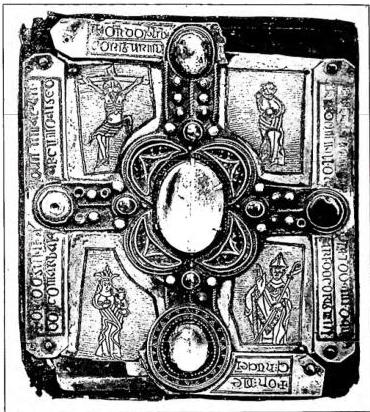
CELTS - Stowe Missal, Cumdach of the missal, that is, a wooden case of oak and silver sheet. Work executed between 1079 and 1105.
Vatican Library (ms. lat. 3325), contain the Masses of the Circumcision and of the vigil of the Epiphany. Pentecost, the Epiphany, and Easter were considered baptismal feasts, and on the latter the faithful were obliged to fulfill the Easter precept by receiving Communion. The rite of the new fire on Holy Saturday, unknown to the ancient Greek, Gallican, and Roman liturgical books, met with a favorable reception in Ireland as early as the middle of the eighth century. It is well known that the Celtic Churches long persisted in following a different calculation of Easter from that of the Roman Church, preserving precisely the ancient cycle of 84 years. S. Columbanus remained faithful to it even when he settled at Luxeuil, thus often finding himself in disagreement with the local Churches. Only gradually, and through disputes and struggles, did the C. finally adopt the universal practice, so that by the end of the eighth century unity in the celebration of Easter may be said to have been achieved. Easter was preceded by a very austere Lenten period, while in monastic circles fasting was almost continuous. Even among the ordinary faithful, the observance of fasting on Wednesday and Friday, of such venerable origin, was tenaciously maintained.
7. The decline. - The liturgical autonomy of the various Churches makes it impossible to follow the gradual abandonment of individual ritual particularities and the definitive transition to Roman forms. Already in the time of Louis the Pious (817), Armorican Brittany had accepted the rite of the City; Scotland probably adapted itself to it in the eleventh century, thanks to the zeal of Queen S. Margaret. In Ireland, another century had to pass before the Roman liturgy was introduced there by S. Malachy (d. 1148), archbishop of Armagh and friend of S. Bernard. After the conquest of the island by the English, the Synod of Cashel (1172) imposed the Anglo-Roman rite without further ado on all the Churches of Ireland.
V. ARTE dei C
The Celtic Christian art of Ireland has well-defined characteristics up to the twelfth century, while beginning to manifest itself on the other side in the seventh. Within this period, one distinctive feature is striking: the great fidelity to the artistic canons and motifs of the earlier pagan art, especially that of the prehistoric period of the Bronze Age commonly called La Tène art (named after a Swiss site methodically excavated, which has provided, so to speak, the standard for judging types found elsewhere). It is now known that under the name C. one must identify not a race, but a people of diverse origin who derived a common language from Indo-European sources. It seems that the first phase in the development of the Celtic nation must be located in southwestern Germany. It then migrated to the islands of Great Britain and Ireland and to Brittany (in French territory), where its purest remnants still exist today. La Tène art dates approximately from 500 B.C. to the Roman conquest, and indeed to the beginnings of the Christian era and beyond. But one must also take into account the artistic tendencies of the Goidel, or Celtic Gaels, who, descending the valley of the Rhine, crossed into England between 2000 and 1700 B.C., replacing the rectangular tombs of the native Neolithic peoples with their burial mounds (roundbarrows). Important megalithic constructions are attributable to them.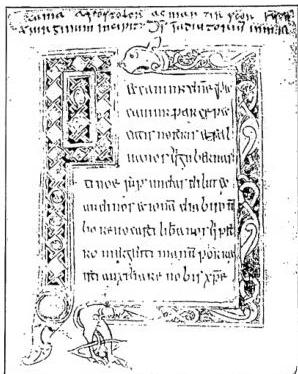
(from an edition by G. F. Warner, part in H. Bradshaw Society, London 1881)
CELTI - Stoke Missal. Confession of sins: “Peccavimus Dhe, peccavimus parce peccatis nostris...” Paleographically, the Missal belongs to the ninth–tenth centuries—Dublin, Royal Academy D. II, 3, fol. 12.
A major foundation of medieval literature; let us recall the well-known epic cycles of King Arthur, etc.—and anyone who takes into account that entire world of enchantment which still today holds sway in the Irish countryside and, to a lesser extent, in Brittany, will not be surprised by the profound mysticism and sense of the mysterious that emerge even from a modest monument. Ireland therefore developed a flourishing monasticism. Among the monastic buildings, the group of cells at Skellig Michael, on the western coast, deserves mention. It is an ideal setting for an ascetic. The small buildings, raised in a rocky landscape swept by the full force of the ocean, are made of roughly squared, unmortared stones. Were it not for the cross on the largest cell, one might swear that one was standing in a fortress from the pagan period, such as those of Dun Bec or Stague Fort. The little rectangular church of Eilean a Naoimh in Scotland might be mistaken for a prehistoric dwelling. At Kilmalkedar, likewise in this region, the problem of roofing a rectangular structure is solved by inclining the walls. The result is a shed resembling a modern hangar. The doors of these buildings, often with a large stone lintel (as at Mac Dara, St Brendan’s, Inisglora, etc.), are related to those of the Mediterranean megaliths. The window at Mac Dara consists merely of two stones resting at an angle above two uprights. Even when arches were introduced and Romanesque portals with recessed orders were produced, like those in France, the treatment of the blocks, the decorations with heads, interlacements, and geometric motifs would always constitute a reminiscence of pagan Celtic ornament, as it is known especially from work in bronze and other metals. Moreover, Henry observes, in Ireland the arts reacted upon one another. For example, the miniatures of the Book of Durrow continue certain ornaments of pre-Celtic enamels and bronzes; the sculptor of the cross at Ahenny imitated the friezes of a precious Christian reliquary; the sculptor of the cross at Kells was inspired by miniatures, etc. Curious is a head of Christ on a small plaque from Athlone (plate 20 of Henry), which has the form of those on the Scandinavian cauldron of Gundestrup. Characteristic monuments of Ireland are the crosses, stelae, and round towers. As regards the latter, it may be observed that they are not very ancient. They must have been built for defence against pirates between the ninth century and the beginning of the twelfth. As for the stelae, they continue the use of stones, whether placed near a church or marking the site of an ancient cemetery. The inscriptions are largely Latin and bear witness to the penetration of Latin culture from the time of St Patrick onward. There are also examples of the local script, the “oghamic” characters. Such is the rough stele from the tomb of St Monachan, at the south-western extremity of his oratory called Temple Geal, near Dingle. This stele bears only a deeply incised cross. On others, however, the decorative splendour is considerable. The stone of Aberlemno, for example, with its dense volutes and interlacements, resembles a work of goldsmithery. A simple stone with a fifth-century Latin inscription mentions the congeries lapidum in which a “Carnasius” was buried. The expression occurs in a passage by Nennius relating to the legend of King Arthur, in another contained in the biography of St Columba, and elsewhere. Also interesting is a funerary stone at Oidaca, near Fuerty, bearing a cross and the representation of the early Christian symbolic image of the fish. But greatest interest must be accorded to the stones shaped as crosses, which generally served votive purposes. They have recently been investigated by Henry through penetrating analysis and splendid graphic documentation. There are simple types, such as that at Carndonagh (plate 11; the site also has a stele: plate 12), or examples with braided relief and bosses, such as the beautiful one at Ahenny (plates 20–21). The form of these crosses resembles the looped types of a processional cross, but with the decorative splendour of a crux florida rendered in precious metal. The loops are rectangular panels and, as a novelty, there is a solar circle of glorification, never found in the artistic production known to us from the early Middle Ages (only in the later Middle Ages are there a few examples; here, however, it appears in the seventh or eighth century). There are also various examples with figures: they are childlike images; at times they resemble little dwarfs with large bodies and short feet. Figures in cloaks and hoods are often seen, all with pear-shaped, inverted faces, as in Lombard reliefs. An attempt is made to arrange these images in symmetrical decorative rhythms, parallels to which may be found in Germany and as far as eastern Russia, and then, tracing the forms back through time, within western Asia. The slenderness and stylization of the animals likewise reflect this comparison. The crosses of Moone (plates 44–49), Castledermot (83), Armagh (64), Monasterboice, and Muiredach (74–77), etc., are cited. As for the subjects, mention may be made of the First Parents, the sacrifice of Abraham, the young Hebrews in the furnace, the Massacre of the Innocents, the Flight into Egypt, the twelve Apostles, St Paul and St Anthony, the Crucifixion, Daniel in the lions’ den, etc.—all significant for the evangelization of these warlike and hunting peoples, steadfast in a heroic ideal, fearful of assaults by infernal forces, and generous and idealizing. It is known that Christianity spread peacefully among them, without persecutions. St Patrick was able freely to destroy twelve small idols which, on the plain of Mag Secht, surrounded Crom Cruach, the chief idol, which was entirely covered in gold.
The inscriptions on the stone crosses enable us to date them on the basis of the “annals” of the locality. At Ballin is the cross of the monk Tauthghall (plate 40), who was abbot of Clonmacnoise in 810–811 (Annals of Ulster, etc.). At Monasterboice (plate 75), the cross bears this Gaelic epigraph—ORDO MUIREDACH LAS (AN) DERNAD IN CHRO (SS) A (“Pray for Muiredach, who made this cross”). He was probably a personage of 924–925.
From the seventh to the twelfth century, interlace decoration is often combined with faunal ornament, as in the Scandinavian regions. In the Book of Durrow, the patient and skilful decoration has six interlaced bands, repeated in pairs in three different combinations of animals. In each, the beasts are incorporated into one another. In Irish art, one also finds bodies formed by long ribbons folded in different ways (these may be compared with the three styles of Nordic art identified by Selin). There is also curvilinear decoration consisting of tightly wound spirals and tendrils (a reminder of prehistoric themes), as well as angular decoration, composed of combinations of segments, such as may also be found on the bronzes of ancient China. Plant ornament is transformed into linear fantasies, while the animal ornament gradually dissolves. At times, ribbons, tendrils, and volutes spring from the mouths or tails of animals and from grotesque masks, then developing into delightful arabesques. The great initials of the Book of Kells, the Gospel Book of Mac Regol, and the Lindisfarne Gospels (eighth century) are marvellous. Also curious are pages begun with an initial, such as the example in the Gospel Book of the National Library of Turin, O IV, 20, in which a central, cloaked figure holds the cross amid an infinite number of other small figures of similar type. Also extraordinarily strange is a Gospel Book in the library of St Gall in which the Crucifixion is depicted; Christ’s garments are entirely composed of folds arranged in wholly unnatural coils, but these are explicable as the result of a tenacious striving for rhythm.
No less fanciful are the goldsmiths’ works, in which repoussé work and filigree combine to form splendid ornamentation. chalice (v.) of Ardagh is well known: a broad cup with studs, interlacing designs, and delicate volutes (the work is assigned to the eighth–twelfth century, but is probably of the ninth or tenth century; cf. Liam S. Gogan, The Ardagh chalice, Dublin 1932). Important are the cases in which books were kept. That of the Book of Durrow (now lost) bore a Gaelic inscription relating to King Flan Sinna, son of Malachy, who reigned between 877 and 916. The Book of Armagh had an inscription dated 937–38; the Book of Kells is from 1007. We still possess the cases of the Gospel of Molaise (a large braided cross, symbols of the evangelists [1001–25]), of the Stowe Missal (a codex containing a highly important liturgical text; a cross against a background of checkerboard and triangles [1023]), and of the Book of Dimma (a cross over interlacing designs [1150]). There are also croziers with finely worked metal applications (that of Dimma, that of the Edinburgh museum, that of Kells, that of Lismore, etc.). They range from the tenth to the twelfth century. In addition, there are cases for containing the little bells used to summon small communities of monks. The beautiful case of the cross of St. Patrick, entirely covered with multiple interlacing designs, is merely a thirteenth-century copy and replaced the original given to the church of Bos Glandae. The case of the bell of St. Culano, on the other hand, is primitive (here too there are interlacings, but simpler ones, together with masks combined with the forms of monsters; ninth–tenth century 7). As for the bell itself, mention should be made of that of Cumascach Mac Ailelio, which bears an inscription of a person who died in 908. A small reliquary case is the bronze case of St. Mogue, which is said to have served St. Molaise for preserving certain relics brought from Rome and given to his friend Moedoc, abbot of Fern. Various figures of old men with long, bifurcated beards and flowing hair can be seen against backgrounds on it (ninth century 7). Finally, there are the crosses, of which the most noteworthy is that of Cong (with interlacings of the miniature style, beginning of the twelfth century).
The constructions of the Norman barons caused many buildings to disappear. The Benedictine foundation of Millefont (1142) helped to spread other forms of art. But the transformation can already be perceived in the chapel of Cormac (1134). Thus, when the Anglo-Normans landed in Ireland in 1169, the development of local art had already been seriously compromised. As has been said, the end of the twelfth century may be regarded as the close of the cycle of this highly singular Celtic art. - [Vedi Tav. LXXVIII - LXXIX.