
FOOD, family. – A noble Genoese family. It began to gain notice in the first half of the 15th century with Abano C., who served the Aragonese of Naples and was a senator in Rome (1455). His son Giovanni Battista became pope in 1484 under the name Innocent VIII (q.v.).
Maurizio, the Pope’s brother (d. September 1490), played no significant role in the government of the State and lived modestly. Of the children Innocent VIII had before entering holy orders, Teobobina married the Genoese Gherardo Usodimare; Franceschetto married Maddalena, daughter of Lorenzo de’ Medici, thus entering the Medici political sphere.
The name of the Cibo was also assumed by Lorenzo de’ Marr, son of Domenico, a relative of Pope Innocent, who was appointed Archbishop of Benevento on 5 December 1485 and castellan of Castel Sant’Angelo. Created cardinal on 9 March 1498, he played some part in the events of those years. He died on 21 December 1503.
Lorenzo, son of Franceschetto, was commander-in-chief of the Papal States, born in Sampierdarena on 24 July 1500, died in Pisa on 14 March 1549. He spent some time at the French court of Francis I, then came to Rome, and in 1524 was appointed governor of Spoleto by Clement VII. In 1528 he was named captain of the Apostolic Palace guard and two years later commander-in-chief of the Papal States (Pastor, III, passim). His marriage in 1515 to Ricciarda Malaspina, heiress to the principality of Massa, led to the family continuing under the name Cibo-Malaspina, and their son Alberico I received the investiture of the duchy from Charles V in 1534.
Innocent, brother of Lorenzo, was a cardinal; born in Florence on 25 August 1491, died in Rome on 14 April 1550. As apostolic protonotary, on 23 September 1513, at the age of 22, he was created a cardinal by his uncle Leo X, with the title of SS. Cosma e Damiano. In 1516 he was given the administration of the church of Turin, which he exchanged on 11 May 1517 for that of Marseille, holding it until 1530. Meanwhile, on 11 March 1520, he was appointed Archbishop of Genoa, which he retained until his death; he also temporarily administered the sees of St Andrews in Scotland (1513), Aleria in Corsica (1518–20), Mariana in Corsica (1531), Tropea (1538), and Messina (1538–50). On 8 December 1515 he accompanied Leo X to Bologna to meet Francis I, victor at Marignano. During the war undertaken by the Pope for the recovery of Parma and Piacenza, he lent Leo X 35,000 ducats, receiving as security the office of camerlengo, which he was able to retain for only two months. After Leo X’s death, he became very influential at the court of Clement VII and was entrusted on 1 January 1524 with the legation of Bologna and Rome.
During the Sack of Rome and the imprisonment of Clement VII, though he remained free he succeeded in keeping many cities obedient to the Pope and pledged with the cardinals assembled at Piacenza not to transfer the Apostolic See to Avignon. He accompanied Clement VII to Bologna in 1529 when the Pope met Emperor Charles V and crowned him (24 February 1530). After the assassination of Duke Alessandro de’ Medici, he governed Florence until the arrival of Duke Cosimo I. The latter tactfully sidelined him, though in 1538 he sent him to the Truce of Nice. He was at odds with Paul III, thinking he might succeed him, but his efforts in 1549 were in vain. He lived, moreover, as if he were anything but an ecclesiastic and is remembered as one of the most worldly cardinals of his age (Pastor, IV, passim).
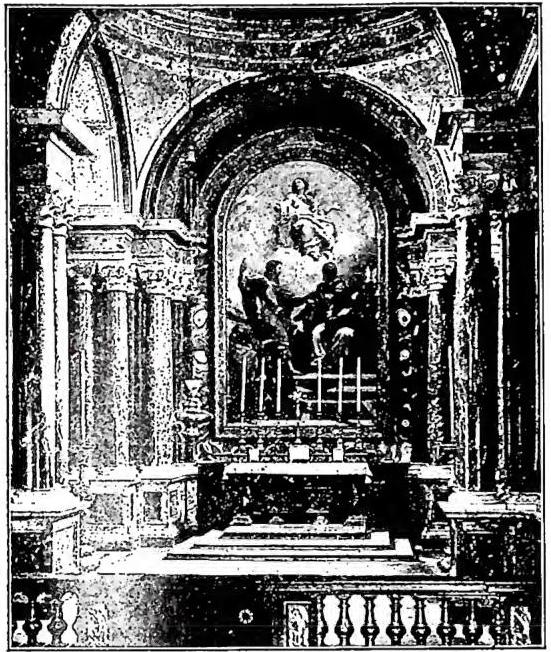
Members of the Cibo family are found in the high ecclesiastical hierarchy in the 17th century with Alderano, cardinal, born in Genoa on 16 July 1613, died in Rome on 22 July 1700. Son of Carlo, Duke of Massa and Carrara, and of Brigida Spinola, he embraced an ecclesiastical career in Rome at a very young age under Urban VIII. In 1644 he was appointed majordomo, and on 6 March 1645 Innocent X created him a cardinal at the age of thirty-two, with the title of S. Pudenziana. He was legate of Urbino (1646), Ravenna (1648), and Ferrara (1639), where he greatly promoted letters and the arts and strove to suppress the brigands who infested those regions. He was a member of the principal Roman congregations and on 24 April 1656 was appointed by Alexander VII Bishop of Jesi, where two years later he held a synod whose acts were later printed. He subsequently held the sees of Palestrina (6 February 1680), Porto, and finally that of Ostia on 10 November 1687. In 1698 he convened a synod at Velletri. Innocent XI, upon his accession to the papacy in 1676, chose Cibo as his Secretary of State; thus he was involved in all the events of those years, particularly the war against the Turks which culminated in 1683 with the liberation of Vienna, and in the resistance to Louis XIV and his ambassador the Marquis de Lavardin over the exaggerated rights of extraterritoriality in his quarter in Rome. Pier Matteo Petrucci dedicated to him the book *Contemplazione mistica acquistata* (printed in 1681), steeped in the errors of Molinos; it was Cibo who promoted Petrucci’s appointment as Bishop of Jesi and consecrated him. But on 15 February 1687 Cibo subscribed to the circular to the bishops of Italy against Molinos, and on 17 December 1687 Petrucci himself retracted before Cibo the errors he shared with Molinos. Cibo was moreover a very learned man and protected artists and men of letters. He commissioned works of restoration in churches, in particular building a sumptuous chapel at Santa Maria del Popolo in Rome, which he had adorned with splendid marbles under the direction of Carlo Fontana and painted by Carlo Maratta.
Camillo, son of Alberico III, Duke of Massa and Carrara, born on 25 April 1681, upon his father’s death (1715) renounced his rights to the duchy in favour of his brother Alderano III, to continue in an ecclesiastical career which he had begun as cleric of the Camera (1705) and then as auditor. In 1718 he was Patriarch of Jerusalem, majordomo of Benedict XIII in 1725, and resisted the encroachments of Coscia. He was created cardinal of S. Stefano al Celio on 23 March 1729. He died on 12–13 January 1743 (G. De Novaes, *Elementi della storia dei sommi pontefici*, XIII, Rome 1822, p. 149). His niece MARIA TERESA, the last descendant of the house, transmitted the principality of Massa to the House of Este in 1741 by marrying Ercole Raimondo, son of Francesco III, Duke of Modena. – See Pl. XCVIII.