
**COMPUNCTION** (Lat. *compunctio*, unknown to classical writers; Biblical Greek κατανύξεις). — A feeling of sorrow and confusion arising from the awareness of one’s moral unworthiness. The doctrine of compunction is one of the most important in the history of spirituality. The term is already found in Holy Scripture, used metaphorically to signify repentance and deep sorrow for the offense against God and sins committed (Acts 2:37; Rom 11:8, “spirit of compunction” is equivalent to “stupor”). This has remained the fundamental sense, but with time various nuances have been added, modifying II.
Thus, to the sadness and tears for one’s own sins were joined those provoked by the misery of this poor world, the “vale of tears,” stirring in the soul of the fervent Christian contempt for its false pleasures and also fear of straying from the path of true life. Hence, the fear of divine judgment and a lively desire for God, loved as the highest good and the source of all happiness. In this state, the thought of heaven and its true joys invades the soul and gathers it within itself, far from the concerns of this world. Sorrow, the pain of having offended so good and great a God, remains always the principal characteristic of Christian compunction, but the other ideas of contempt for the world, devotion and intense love of God, and desire for eternal life are easily united with it, so that in the development of spirituality in the early centuries, among the desert monks, the Fathers of the Church—such as St. John Chrysostom, St. Augustine, and above all St. Gregory the Great—and throughout the Middle Ages, compunction gathered within itself some of the essential ideas of Christian perfection.
From the 16th century onward, much less is spoken and written about compunction, probably, as Fr. Pegna observes, because with the development and systematization of theology, the various ideas grouped around the primitive notion of compunction from a practical standpoint have naturally disintegrated and formed new complexes. Finally, although the use of the term *compunction* has become rarer, the ancient ideas it once encompassed remain alive and even today find expression under other names (contrition, the idea of reparation, Christian humanism, etc.).
**
G. de Guibert, *La compunction du coeur*, in *Revue d'ascétique et de mystique*, 15 (1934), pp. 225-40;
P. Regamey, *La componction du coeur*, in *Souffle de la Vie spirituelle*, from Jan. 1935 to Dec. 1936;
I. Hausherr, *Penthos. La doctrine de la componction dans l'Orient chrétien*, Rome 1944;
J. Pegon, *Componction*, in *Dictionnaire de Spiritualité*, fasc. 12 (1949), cols. 1312-21.
Ferdinando Cavallera
---
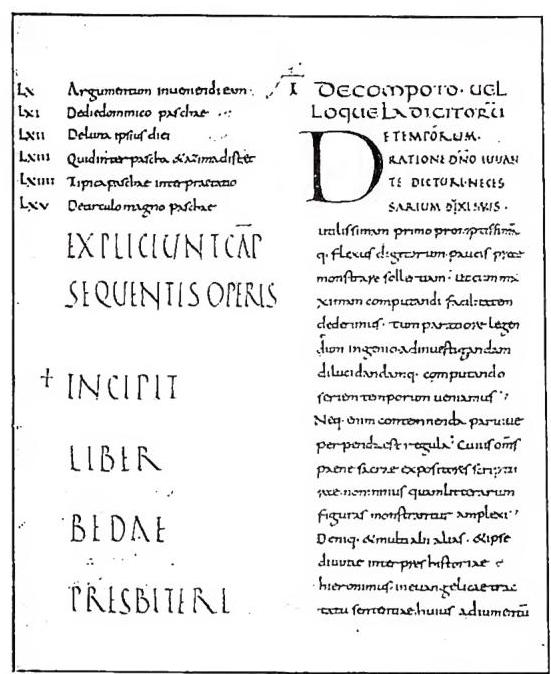
ECCLESIASTICAL COMPUTATION. — It is defined by writers as: “knowledge of the course of the moon and the calends, or the science of determining time according to the course of the moon and the sun.” It includes the notions necessary for determining Easter, namely the nineteen-year, lunar, and solar cycles, the *capita*, and the concurrents. It was imposed by Charlemagne as one of the subjects of instruction in schools. St. Bede the Venerable devoted two books of his didactic works to it (*De temporum ratione* and *De ratione computi*: PL 90, 295-578, 579-600).