
CONCLAVE. — The conclave consists of a solemn assembly of all the cardinals present in Rome, presided over by the pope, for the discussion of some of the most important matters relating to the government of the universal Church.
The term *conclave* has been used in this sense since the Middle Ages, and derives from the same term by which, in the last centuries of the Roman Empire, the assembly of imperial dignitaries presided over by the emperor was designated. Traditionally, conclaves are held in the palace where the Supreme Pontiff resides.
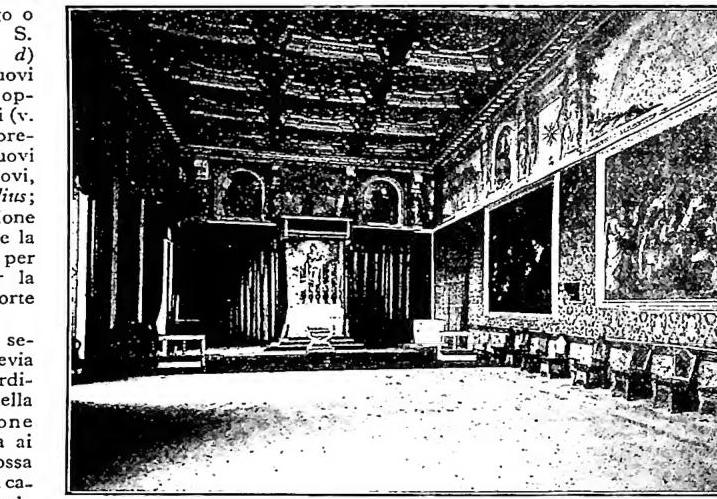
Three kinds of conclave are distinguished: the ordinary or secret conclave, which is usually held in the hall called the *sala del conclave*; the public conclave, which is usually held in a larger and more solemn setting (often the Sistine Chapel, or sometimes St. Peter’s); and the semi-public conclave, which is held in some hall of the Apostolic Palace. Today, conclaves are not held on fixed dates; in earlier times, however, they had a set periodicity (Innocent III, for instance, used to hold three each week), given the large number of matters discussed in them.
In the secret conclave, only the cardinals attend with the pope; before it begins, the order *extra omnes* is given, and all outsiders leave the hall, the doors are closed, and are reopened at the end of the conclave. If a cardinal is to be assigned or transferred to a bishopric, the cardinal remains outside during the time in which the pope makes the relevant proposal.
The secret conclave often begins with the reading, by the Supreme Pontiff, of an allocution (usually in Latin) on matters of great importance and current religious or ecclesiastical-political relevance; this allocution is almost always published (v. ALLOCUTION).
Among the matters usually discussed in secret conclave are: a) the pope’s announcement of any possible resignations by cardinals; b) the appointment of cardinal legates *a latere*; c) the appointment of the cardinal camerlengo or chancellor of the Holy Roman Church; d) the appointment of new cardinals; e) the options of cardinals (v. CARDINAL); f) the preconization of new archbishops, bishops, prelates, or abbots *nullius*; g) the proclamation of Holy Years and the appointment of legates for the opening or closing of the Holy Doors.
Also in the secret conclave, after a report by the cardinal prefect of the Sacred Congregation of Rites, the pope asks the cardinals whether it is possible to proceed with the canonization of any blessed whose cause has been previously examined by the Congregation of Rites. The cardinals, in response to the pope’s question (*quod vobis videtur?*), express their individual opinions on the matter.
It should be noted that in other matters the presence of the cardinals has no other function than to give greater solemnity to the ceremony; and even when (as in the appointment of new members of the Sacred College) the pope asks *quid vobis videtur?*, the response of the cardinals present in the conclave is given collectively and is always affirmative, thus reducing to a mere formality—a reminder of the time when matters were discussed in the conclave for long hours.
The metropolitans (v.), and other bishops having the privilege of the pallium (v.), must request the pallium from the pope: the relevant petition is made by the newly appointed either in person or through a proxy, at the end of the secret conclave.
It should be noted that when new cardinals are appointed, it is customary to hold two secret conclaves, one on Monday and the other on the following Thursday or Friday, with a public conclave in between (held on Thursday). The appointments of the new cardinals are published in the Monday conclave, and the newly appointed, if present in Rome, attend both the public conclave, in which the pope imposes the cardinal’s hat upon them, and the second secret conclave: at the beginning of which the pope closes their mouths, and reopens them (thus granting them the faculty to take part in all deliberations of cardinalial assemblies) at the end of the same conclave, giving each of them a ring and assigning them a title or deaconry.
In the public conclave, in addition to the pope and the cardinals, other ecclesiastical and lay dignitaries of the papal court and members of the diplomatic corps accredited to the Holy See take part.
In it, first comes the pleading (request for canonization) of the causes of saints discussed in the preceding secret conclave; the pleading is made, for each cause, by a concorsional advocate. Once the pleadings are concluded, it is customary for the Secretary of Briefs to Princes to respond on behalf of the pope, usually deferring the final decision to a semi-public conclave. Then the pope imposes the cardinal’s hat on the new cardinals. This is followed, if there are any, by the pleadings for causes of beatification (these pleadings are also made by a concorsional advocate).
In the semi-public conclave, in addition to the cardinals, all archbishops and bishops whose sees are less than 100 miles from Rome are summoned; all other patriarchs, archbishops, or bishops may also attend. All of these have the right to vote in such a conclave.
The pope asks whether it is possible to proceed with the canonizations discussed in the last secret and public conclaves (the semi-public conclave is held some days, or even some months, after them). Once the responses are received, the apostolic protonotaries are tasked with drawing up the relevant minutes. Vedi tav. VII.