
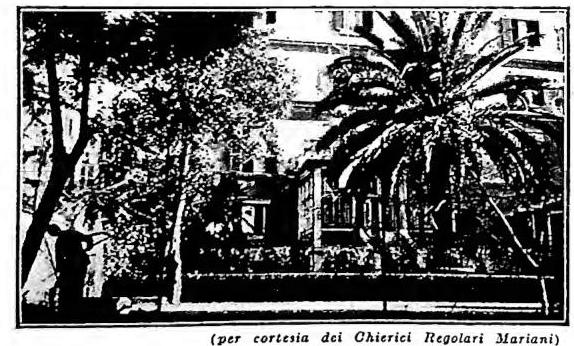
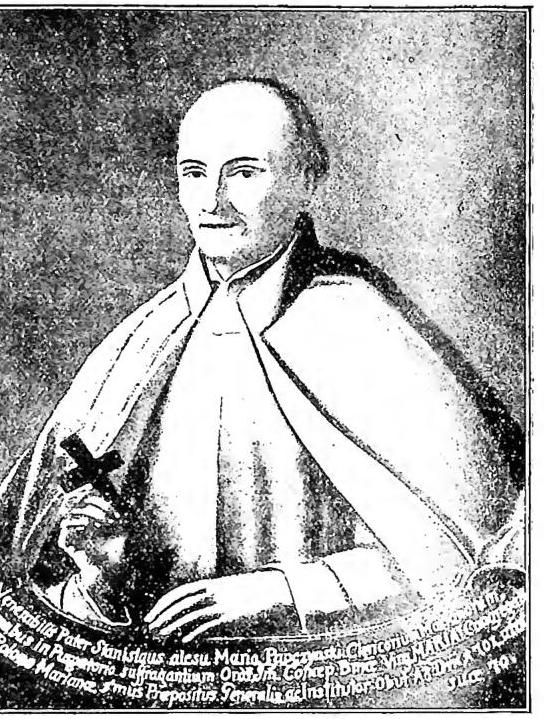
Congregation of the Clerics Regular Marian Fathers — Blessed Stanislaus of Jesus and Mary (Papczynski), Founder of the Congregation
R. W. Dale, *History of English Congregationalism*, London 1907; *Annual Report of the American Board of Commissioners for Foreign Missions*, Boston 1916–38; *The Congregational Quarterly*, 1915–35; United States Department of Commerce, *Religious Bodies*, 1926, Washington 1929; *Yearbook of Missions*, 1930–38; A. Peel, *These Hundred Years*, London 1931.
Camillo Crivelli
CONGREGATION OF THE CLERICS REGULAR MARIAN FATHERS UNDER THE TITLE OF THE IMMACULATE CONCEPTION (MARIANS)
A religious congregation founded in 1673 by Stanislaus Papczynski (v.), who, having left the Piarists, devoted himself to the education of poor Polish youth. Joining three noble lay hermits, he established the first Marian community in the forests of Puszcza Korabiewska, in the diocese of Poznań, adopting the white habit in honor of the Immaculate Conception, of whose dogma he became a herald. The congregation received approval from the Holy See in 1687 through the nuncio Bonvisi. During Papczynski’s lifetime, three houses were opened, and in 1691 the Minister General of the Friars Minor, by decree of Pope Innocent XII, assumed direction of the Marians and assigned them the Rule of the Ten Graces of the Blessed Virgin.
During the 18th century, the Marians spread to various regions of Poland and Lithuania.
In 1750, three houses were founded in Portugal with a mission in Cederin, later suppressed during the revolution of 1838. In 1779, a house was opened in Rome at the diaconia of Saints Vitus, Modestus, and Crescentia as the seat of the procuracy. During the generalship of Fr. Nowicki (1776–88), the congregation separated from the Order of Friars Minor and resumed autonomous life. In 1786, Pius VI approved the Constitutions and granted the Marians the privileges of religious orders.
With the partitions of Poland and Lithuania in 1795, the congregation suffered immense damage. In 1798, the Marians were expelled from Rome. The failed Polish insurrection of 1831 further worsened their condition, and that of 1863, also unsuccessful, marked the end of the congregation: the superior general was deported to Siberia, the fathers dispersed, and all houses suppressed except that of Marijampolė, where the surviving fathers were concentrated.
In 1893, Fr. Vincent Senkus-Sckowski was elected superior general, and from 1908 remained the sole member of the congregation. It was then that the man who would become, more than a reformer, the new founder, Fr. George Matulaitis (v.), arose. Recognizing the gravity of the situation, in agreement with Fr. Senkus and the auxiliary bishop of Warsaw, he restored the congregation’s fortunes and gave it new life. The white habit was abandoned, and the prerogative of being an “Order” was relinquished. The Constitutions were adapted to the times and place. Henceforth, the religious would dedicate themselves to the instruction and education of youth, ministry, missions, and would take particular care of Catholic publishing.
By September 1909, the renewed congregation had only two professed members and one novice. At the Chapter of 1911, Fr. Matulaitis was elected superior general and opened a novitiate in Fribourg, Switzerland, and in 1913 a second house in Chicago. After the war of 1915–18, the congregation experienced notable growth, so that by 1937 it had 23 houses with 451 religious. The recent war has grievously struck the Polish province, while those in Lithuania and Latvia, occupied by the communists, have had their houses closed, their goods confiscated, and their religious dispersed, with incalculable losses.