
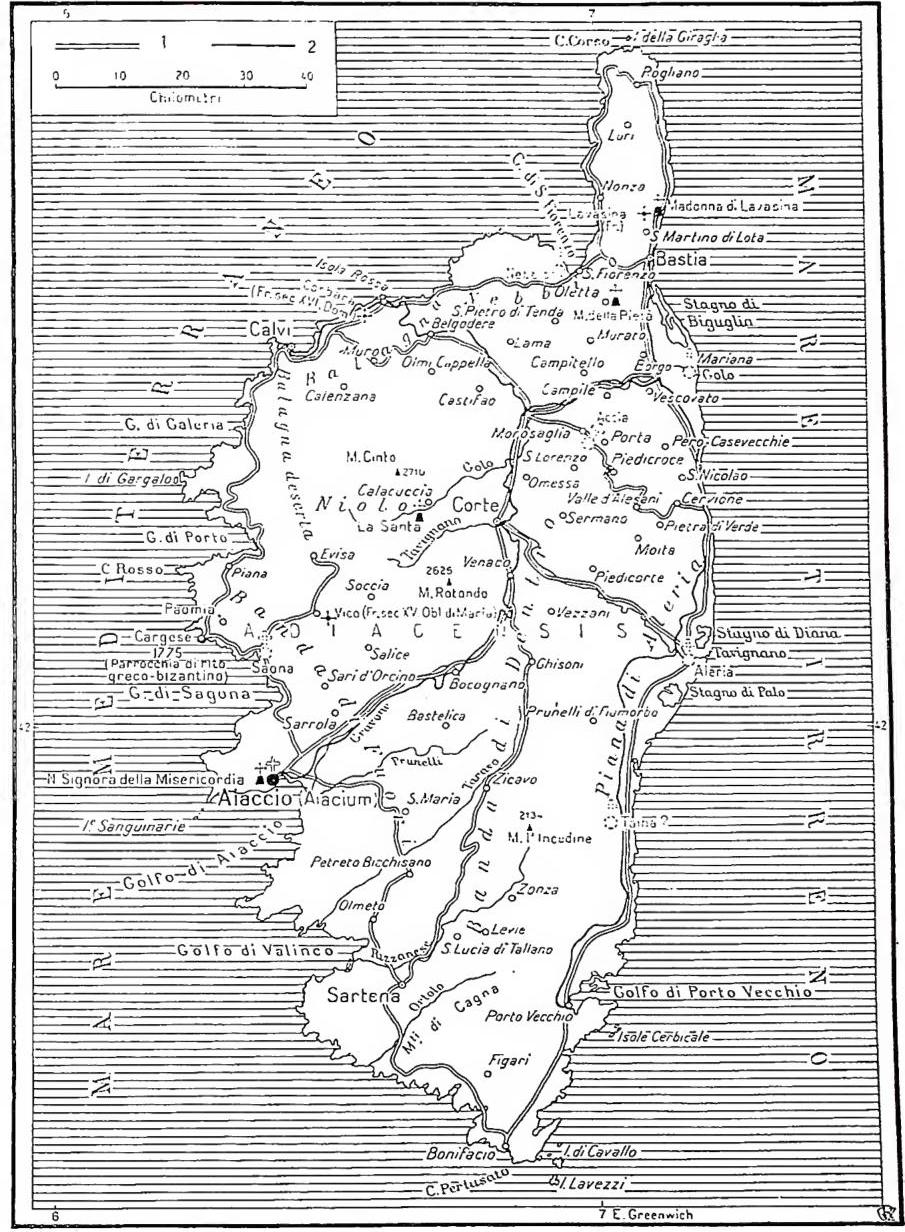
CORSICA. — By extent, it is the fourth largest island in the Mediterranean, though less than half the size of the two largest (8,722 sq. km.). Geographically, it forms a system with nearby Sardinia, from which it is separated by a narrow stretch of sea (the Strait of Bonifacio, 12 km wide). Almost entirely mountainous, it presents notable variations in aspect. The interior is traversed by rugged mountain ranges, culminating at 2,710 m in Monte Cinto. The climate, temperate maritime along the coastal regions, becomes less mild or even extreme as one moves inland; rainfall, sufficient everywhere for agricultural needs (800–900 mm annually), is greater on the side facing the Tyrrhenian Sea.
Natural vegetation, dominated by forests and maquis, has given way to cultivated areas of relatively limited and much reduced extent over the past twenty years. Both pastoralism and agriculture yield less than they might due to a shortage of labor, lack of capital, backward techniques, and a deficiency of government provisions (land reclamation). Chestnuts, olive oil, citrons, and fruit are the most notable products. Pastoralism is of minor importance, fishing is almost entirely neglected, and industry is virtually nonexistent.
The population, which has doubled in the last 150 years, amounted (1946) to 268,000 inhabitants (333,000 in 1936), corresponding to an average density of 30 inhabitants per sq. km. (31 in the province of Nuoro, but 43 across Sardinia as a whole). The only two notable urban centers are Bastia (32,000 inhabitants) and Ajaccio (31,000 inhabitants).
Corsica has been French since 1768. Italians, listed in censuses among foreigners (3.4% of the total population), probably number over 10,000.
II. DIOCESES AND ANCIENT HISTORY
There are no reliable accounts of the origins of Christianity in Corsica. Bishop Florenzio, cited by some as the evangelizer of Corsica and venerated on the island, may have been an African martyr whose relics were brought to the island by African refugees fleeing the Vandal persecution (Lanzoni, I, pp. 699 and 1097).Lanzoni believes that Christianity reached the island through sailors, soldiers, and freedmen. The fleet of Misenum had two stations in Corsica: Aleria and Mariana, both on the eastern coast. Inland, at the time of St. Gregory (597), the mountains of the diocese of Aleria were still inhabited by pagans; Pope Gregory the Great had a church and baptistery built on the Ninu (Jaffé-Wattenbach, 1488).
At the same time, there were five dioceses on the island, all on the coast. On the eastern coast were the dioceses of: Mariana, on the Golo River, whose first securely attested bishop dates to 649; Aleria, at the mouth of the Tavignano, was without a bishop in 591 (“iam diu pontificatu destituto,” Jaffé-Wattenbach, 1146); in that year, Martin, bishop of Taina, was transferred there; he was succeeded by Peter (ibid., 1402). Taina, near Aleria, was invaded and sacked in 591 while Bishop Martin was present. On the western coast were Ajaccio, which had long been without a bishop in 601 (Jaffé-Wattenbach, 1850), and Saona, which was also without a pastor in 591.
The patron saint of Corsica is St. Julia, recorded in the Martyrologium Hieronymianum under May 22: “in Corsica insula passio sanctae Iuliae.” Her *passio* is unreliable (BHL, 4516–17); she may have been an African martyr whose relics were perhaps translated to Corsica at the same time as those of St. Florenzio.
The other two martyrs venerated in Corsica, Annanza and Laurina, are not mentioned in hagiographical sources.
III. MEDIEVAL AND MODERN HISTORY
At the dawn of the Middle Ages, the authority of the papacy is seen taking an interest in public works even in Corsica, as on the Italian mainland. Gregory the Great built roads and transformed monasteries into fortresses to defend the people, neglected by the civil authorities. In 774, confirmed by Charlemagne’s donation of Pepin, Corsica became part of it in name, if not in fact. Under the Franks, frequent Saracen raids plagued the island for a long time, until the mid-11th century, when the combined forces of the maritime republics of Pisa and Genoa succeeded in driving off the grave threat.In 1078, Gregory VII, reaffirming papal sovereignty over Corsica, granted legatine powers to the bishop of Pisa, provoking the jealousy and discontent of the Republic of Genoa. Thus, in the following two centuries (12th and 13th), Corsica became one of the principal causes of discord between the two republics, which fought bitterly for control of the upper Tyrrhenian. This ended in 1284 with the Genoese victory at the Battle of Meloria, inflicting a crushing and irreparable defeat on the Pisans. However, angered by the anti-Guelph policies of the rival republics, Pope Boniface VIII granted the kingdoms of Corsica and Sardinia to James II of Aragon, who was, however, unable to immediately proceed with their conquest and occupation.
In the 14th and 15th centuries, factional struggles between nobles and commoners, with shifting fortunes, devastated Corsica, prompting the intervention of various states and princes, including Pope Eugenius IV, who in 1446 sent his own legate and a body of troops. To escape a difficult and precarious situation, in 1453 the Corsicans turned to the Bank of San Giorgio, to which Genoa ceded its sovereign rights. After fierce efforts, the Bank succeeded in striking a severe blow against local feudalism and maintaining its dominion over the island until the period of fierce conflict between France and Philip II of Spain. At that time, under the leadership of Sampiero Corso, a valiant and courageous captain, the Corsicans rebelled against Genoa, allied with the Spaniards, and took up arms in favor of the Franco-Turkish forces. However, the Peace of Cateau-Cambrésis forced the French to withdraw from occupied territory, and Corsica, after further attempts at rebellion and the assassination of Sampiero in an ambush (1567), returned to full Genoese control.
From then on, the Republic sought to reorganize the island administratively and restore order, tranquility, and ecclesiastical discipline, deeply disrupted by war, internal strife, and the prolonged absence of bishops. The Holy See naturally contributed to this effort: even before Julius III, in full agreement with St. Ignatius of Loyola, had sent to Corsica, with the title of apostolic visitor, Fr. Silvestro Landini, a Jesuit, who preached there with great success, sparking an extraordinary conversion of the people. Shortly afterward, in 1570, Pius V appointed St. Alexander Sauli bishop of Aleria, where he remained for twenty years, devoting himself to his pastoral duties and striving especially to quell hostilities and instill true Christian life in the people. Later, in 1595, Clement VIII, at the request of the Republic of Genoa, sent various missionaries, and six years afterward, two apostolic visitors from the same Society of Jesus. Following their advice, in 1602 the decision was made to open a first college in Bastia, and in 1617 a second in Ajaccio.
For over a century and a half, Corsica remained quiet or resigned under Genoese rule; but in 1729, due to the oppressive method of tax collection, the population’s revolts against the constituted authorities resumed. In the following years, a diet at Corte (1735) declared the island free from all political dependence on the Republic and proclaimed the Immaculate Conception of the Virgin Mary as its protector. There then followed various so-called national governments, the last of which was led by Pasquale Paoli, the hero of Corsican independence, from 1755 to 1769, until he was defeated by an army of the King of France, to whom Genoa had fully ceded all its rights over the island (v. PASQUA).
After the conquest, Corsica was subjected to a military regime and reduced to obedience. Only twenty years later, on 30 November 1789, the National Assembly in Paris subjected it to common law and declared it, without further ado, to be united with France, i.e., part of the national territory. Later, the Concordat of 1802 reduced the island’s five dioceses to a single one, with its see at Ajaccio. In more recent times, namely during the pontificate of Pope Pius X and Cardinal Merry del Val, negotiations took place between the Holy See and the French government to divide the island into at least two dioceses, a division demanded by its geographical conditions and already well advanced, when various reasons—among them, primarily, the diplomatic rupture between the two parties—brought everything to naught.
At Ajaccio there is a sanctuary of Our Lady of Mercy, who appeared at Savona in 1636, and is the patroness of the Corsican capital.
At Cargese there still exists a parish of the Byzantine rite, whose history has been quite turbulent. The Genoese, in fact, transported a colony of Greeks from the Peloponnese to Paomia in 1676; from this village, they were driven out to Ajaccio and in 1775 were moved to Cargese. Vedi tav. XXXIII.
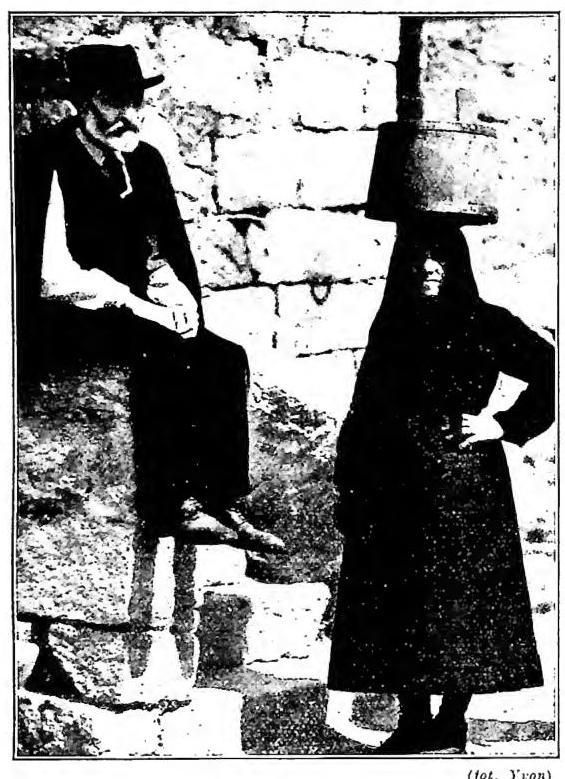
IV. FOLKLORE OF CORSICA – The singular aspects of Corsican folklore, which once made the island so picturesque in the 19th century, are now fading or disappearing. Among the elements of men’s dress, the “berretta misgia” still survives: now made of simple cloth, rounded at the top and folded to one side. On the other hand, the “pione,” which in Tommaseo’s day was a “goat-hair gabardine,” and the footwear of leather strips woven over the instep and under the sole are disappearing. Similarly, while women of the people now habitually wear black, in the last century they wore brightly coloured costumes that included the “bustu,” “a rota” (a wide skirt with tight pleats), and “u scurzale” (an often embroidered apron), as well as “u mandile” (a headscarf) or “a faldetta” (a petticoat tied at the waist and draped over the head). The betrothal ceremony, still called “l’abbraccio” or “l’amicizia,” was conducted according to graceful traditional practices; but the funeral customs, of very ancient stamp, are still more vividly alive. The manifestations of grief, often violent, form part of the rite, which varies from place to place. In it, the funeral lament (“vòcero”) is a source of poetry in which maternal and family sorrow finds expression in the most dramatic accents. In the “vòcero,” with expressive imagery and original metaphors, the virtues of the deceased are extolled, their untimely death or life spent in hard agricultural labour is mourned. Often the “vòceri” are also songs of vengeance, for through them women spur their closest male relatives to avenge the dead (if the death was violent). This custom, which gave rise to an endless chain of murders and fed banditry, has now disappeared: perhaps too much colourful literature has been written about Corsican vengeance. The same may be said of banditry, which found its justification in particular psychological, historical, and environmental conditions that are rapidly changing. Thus, the songs of the bandits, which constitute a distinctive sector of Corsican popular poetry, are also disappearing, while strambotti, lullabies, children’s songs, toasts, etc., find perfect counterparts in similar songs from Tuscany, perhaps introduced there by Lucchese woodcutters during their seasonal migrations into the Corsican mountains. Nevertheless, the oldest stratum of customs, taken as a whole, points to a close affinity with Sardinian folklore.
In churches, and especially in those of the island’s interior, certain prayers are habitually said in Italian (the Rosary, the Way of the Cross, religious songs); the same is true in many places for sermons. The dialect is still spoken by the majority of inhabitants, even by those who have been settled in France for many years. It should be noted that in the sanctuary of “La Santa” (Calacuccia), on 8 September, there takes place a characteristic procession of men only, which winds in a spiral and is called “la granitola.”