
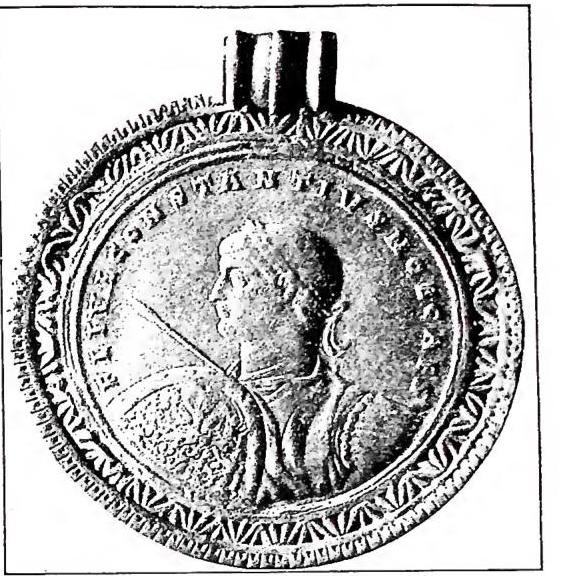
CONSTANTIUS II (Flavius Iulius Constantius), EMPEROR. – Son of Constantine the Great and Fausta, born on 7 Aug. 317, probably at Sirmium, appointed Caesar on 8 Nov. 324, he became Augustus before he was twenty at the death of his father on 22 May 337, together with his brothers Constantine II and Constans. His father had assigned to him, as his share of the Empire, Egypt, Syria and Asia Minor. Immediately after Constantine’s death, his half-brother Julius Constantius was killed by the soldiers, together with his sons Dalmatius Caesar, Hannibalianus king of Pontus and other relatives. It is not certain whether C. was the author of these crimes or merely aware of them, but all believed him guilty and he himself felt remorse for it all his life (Gregory Naz., Orat., 21, 26).
The three brothers met in Sept. 337 at Viminacium on the Danube and arranged the partition of the Empire. The share of the murdered Dalmatius, Thrace with Constantinople, was assigned to Constans, then (339) to C. In the early years C. mostly resided at Antioch, always occupied in the struggle against the Persians. At the death of Constantine II in 340, C. henceforth dominated all the East, at that time the most powerful part of the Empire. In 350 the usurper Magnentius, after killing Constans, seized Gaul, Italy and Africa. C. created Caesar his cousin Gallus, son of Julius Constantius, who had been killed in 337. C. defeated Magnentius in the bloody battle of Mursa (28 Sept. 351) and pursued him into Gaul, where Magnentius ended by suicide (Lyon, 10 Aug. 353). In 354 C. also had Gallus executed and appointed Caesar Julian, half-brother of the deceased (6 Nov. 354). From 350 onwards C. mostly resided at Sirmium. In 357 he made his only visit to Rome. When in 361 Julian’s troops at Paris proclaimed him Augustus, C. suspended his expedition against the Persians and marched to fight the rebel, but death overtook him at Mopsucrene in Cilicia on 3 Nov. 361, baptized by the Arian bishop Euzoius, at the age of only 45.
Although it is possible to follow C.’s steps almost year by year, less is known of his personality and character than of Constantine’s. C. appears rather mediocre, lacking drive or personal charm; under him the prestige of the Empire declined noticeably. He surpassed his father, however, in the obstinacy of his religious policy. Constantine wished to appear and be the benefactor of the Church; C. wished to be its master; and he was the first true representative of the so-called caesaropapism.
He was a convinced Arian, thanks to the religious formation he received in the last years of Constantine’s reign, when the influence of Eusebius of Nicomedia dominated the court. As long as his brother Constans lived, who adhered to the Council of Nicaea, he must have felt somewhat constrained, although even at that time he protected Macedonius of Constantinople and fought against Amasius. But after his brother’s death (350) and his victory over the usurper Magnentius (351), he assumed the titles *Aeternitas mea* (Ammianus, *Rer. gest.*, XV, 13) and *Episcopus episcoporum* (Lucifer, *Moriendum esse pro Dei filio*, 13), terrorized the Synods of Arles (353) and Milan (355) and attempted to intimidate Pope Liberius (v.).
After 358, under the influence of Basil of Ancyra, C. detached himself from the extreme Arians (Anomoeans), indeed he proceeded to persecute them, without relaxing the pressure on the orthodox at the Synods of Rimini and Seleucia. With C.’s death Arianism in the Empire quickly vanished, a sign that he had been its principal support.
As to the scope of C.’s laws against pagan sacrifices (Cod. Theod., XVI, 10, 2 of 341; 10, 4 of 356; 10, 5 of 353) and against diviners and astrologers (Cod. Theod., IX, 16, 4, 5, 6), modern authors are of divergent opinions (cf. Filche-Martin-Frutaz, III, nn. 172, 184-87). Their repetition seems to indicate their limited efficacy. Like his father Constantine, C. held the title of *Pontifex Maximus*.
(from J. Burckhardt, *Die Zeit Constantins des Grossen*, Vienna n.d., pl. III)
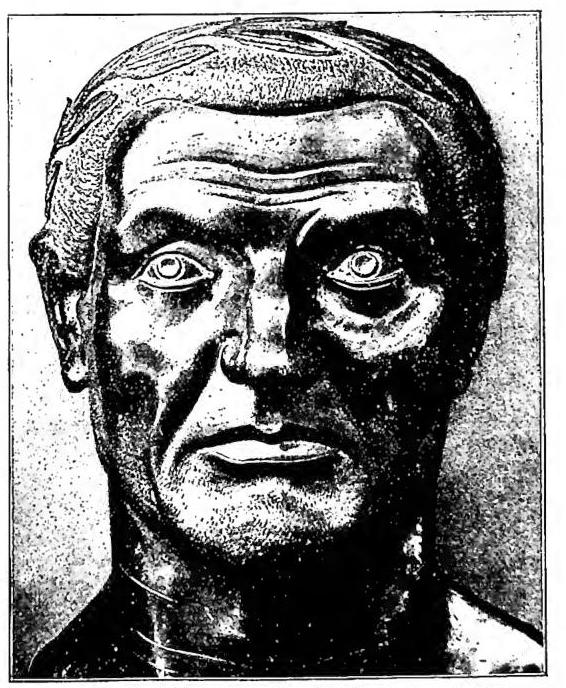
CONSTANTIUS I CHLORUS – Bronze head (3rd–4th cent.). Munich, Glyptothek.