
DÉBORA (Heb. Débhôrâh «bee»; Septuagint Δεβθώρα;
V. Debora)
Prophetess, heroine, and poetess, third among the «Judges» of Israel (Judg. 4:1–5:31), who delivered Israel from the oppression of Jabin, king of Hazor (Hador, near Lake Huleh, according to various biblical data and Flavius Josephus, *Antiquities of the Jews*, IX, 11, 1), by inspiring the enterprise of Barak and the northern tribes in the battle of Taanach (near Megiddo in the plain of Esdraelon), and then celebrating their deeds in her song (Judg. 5:1–31), one of the most precious biblical documents.D., wife of Lapidoth (not mentioned elsewhere), lived between Ramah and Bethel, north of Jerusalem, in the territory of the tribe of Ephraim. Owing to her prophetic authority, Israel came to her under «her palm tree» to seek her oracles. Witnessing the oppression weighing upon the northern tribes—Naphtali, Zebulun, Issachar, and the Cisjordanian half of Manasseh (Machir)—she stirred the revolt, ordering Barak of the tribe of Naphtali to gather 10,000 men, especially from Naphtali and Zebulun, on Mount Tabor; she herself went there. Volunteers from Machir, Issachar, Ephraim, and Benjamin joined them, while the remaining tribes were either absent or inactive. To counter the threat, Sisera, commander of Jabin’s southern forces, took up position by the Kishon River, which flows through the plain of Esdraelon, boasting of his 900 iron chariots. But the impetus of the Israelites, roused by Deborah and Barak, together with a providential storm that swelled the river, overwhelmed them in total rout. Sisera fled southward and, exhausted, sought refuge at the tent of Jael, wife of Heber the Kenite, in Kedesh (of Esdraelon, probably modern Tell Abû Qudeis). While he slept, Jael drove a tent peg through his temple into the ground.
At the victory celebration, Deborah joined Barak in witnessing the triumphal procession of the victors, and she intoned her famous song (Judg. 5:1–31), a solemn epinicion and religious hymn whose literary brilliance is universally acknowledged. Analysis of the text reveals a structure of seven sections, each consisting of two strophes except the central one, which has three; all are identical in form to the theophany (ibid., vv. 4–5).
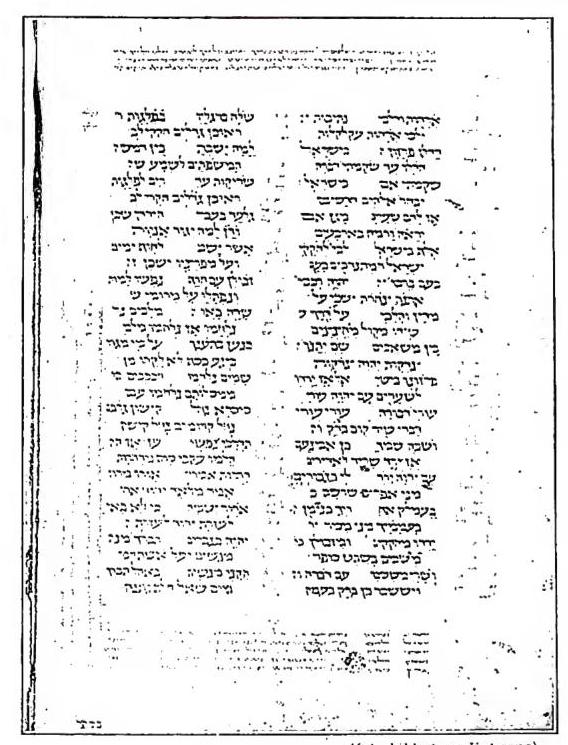
1. Prologue: a) lyrical proem, b) epic proem.
2. The misery of Israel: a) mournful recollection, b) prophetic explanation.
3. Description of the triumphal procession: a) invitation to the people, b) invitation to the leaders.
4. Praise and reproaches to the tribes: a) greeting to the first combatants, b) reproach to Reuben, c) reproaches and praise to the others.
5. Recounting of the battle: a) the enemy’s assault, b) their complete defeat.
6. The deed of Jael: a) the scene in the tent, b) the death of Sisera.
7. Enemy dismay and Yahweh’s triumph: a) the waiting of Sisera’s mother, b) her disappointment and the final hymn.
The Song of Deborah is recognized as an extremely ancient historical source, a point that bears on the documentary question when comparing it with the prose narrative in Judg. 4:1–24. The only discrepancy—naming Sisera in the song and Jabin, king of Hazor, in the prose—can be explained by the rebuilding of Hazor already hinted at in Joshua’s time (cf. Josh. 11:1–13 with 19:36), as is confirmed later in Solomon’s reign (1 Kgs. 9:15), by Tiglath-pileser (2 Kgs. 15:29), by Tobias (Tob. Gr. 1:2), and by the Maccabees (1 Macc. 11:67; there Nzsoq for haplography of the final v), as well as by the existence of homonymous cities in royal series and by Sisera’s strategic role. Another explanation lies in the contribution of independent traditions (cf. Ps. 83:10) extraneous to the lyrical scope of the poem.
Two other biblical women share the same name: D. (Septuagint: Δεβόπρα), Rebecca’s nurse, who accompanied Isaac’s bride to Canaan and shared her fate (Gen. 24:59; cf. 35:8); and D. (Septuagint: Δεβόπρα), Tobit’s paternal grandmother (Tob. Gr. 1:8).