
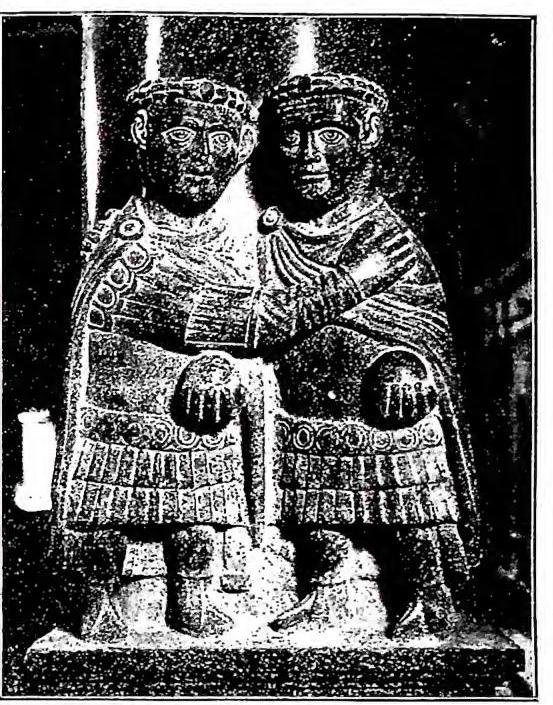
DIOCLETIAN, Roman Emperor — D. and Maximian (4th century). Vatican Library.
D. was a man of strong character, with a practical, though rustic, common sense, tenacity in his opinions, soldierly promptness in executing what he had decided, a high sense of duty, and complete dedication to II. The two gravest evils afflicting the Empire were the incessant barbarian incursions at the frontiers and the lack of a rule for imperial succession, which led to equally incessant usurpations of emperors, elected in the most anarchic ways, and which wore out the Empire’s insufficient forces in sterile and ruinous internal struggles. Diocletian set to work to remedy these two evils. The vastness of the frontiers made it difficult to guard them all effectively; moreover, in such troubled times even a victory could be dangerous, since it had often happened that victorious soldiers proclaimed their commander emperor, forcing him to assume the purple, and sometimes even killing him later. Diocletian began by appointing a colleague, choosing a man of his own stature, from a humble family, an Illyrian, a soldier, rougher than himself, endowed with personal courage and absolute loyalty: Maximian.
To him he entrusted the Western provinces, keeping the Eastern ones for himself; in this way, it was less difficult for the emperor to personally rush to a threatened frontier and not leave the glory of victory to others.
Having found this expedient good, a few years later (293) he proceeded to a more radical reform designed to eliminate the uncertainty of succession. He appointed two Caesars attached to the two Augusti, invested with authority superior to that of any other magistrate or general, and destined to become Augusti when the latter should die. Succession was thus made automatic, and the risks of usurpation were, in theory, to disappear. The choice was to be guided by a single criterion: the adoption of the best suited, without regard to kinship ties. Conversely, a kind of fictitious kinship was established among the four rulers, the two Augusti being called brothers and their two Caesars called their sons. The division was purely administrative and was not intended to undermine the unity of the Empire, for the authority of the senior Augustus was to prevail over all.
The Empire thus ceased to be a kind of extraordinary magistracy and became a sort of college to which access was by co-optation. The two great electors, the Senate and the army, were entirely eliminated, and since they had hitherto acted as representatives of the Roman people, the Roman people were no longer the masters of a state that continued to call itself the *res publica Romanorum*.
Thus the concept and function of imperial dignity were radically altered; there was no longer any reason not to assume fully the character and outward manifestations of an absolute sovereign, with ceremonial borrowed from the courts of the East.
A clever and sound construction, yet one of a certain naive schematism that did not withstand the complicated and selfish psychology of men. The results, however, were good at first: victories on all frontiers, internal security, about twenty years of tranquility. The loser was Rome, which ceased to be the seat of the Empire. All four rulers stationed themselves in cities closer to the borders: Diocletian at Nicomedia in Bithynia, Maximian at Milan, and even further forward the two Caesars: Galerius at Sirmium on the Danube, Constantius Chlorus at Trier on the Rhine. The four cities had to be equipped to serve as capitals, and the multiplication of courts and bureaucracy, as well as the increase in the army, came to weigh rather heavily on the state’s budget. Attempts were made to remedy this through radical reforms in the tax system. Wealth consisted of landed property and the productive capacity of human and animal labor; these two sources of wealth were obliged to yield part of their produce to the State through the two taxes of *inglata* (land tax) and *capitatio* (poll tax). Connected with the tax reorganization was Diocletian’s attempt to achieve stability and reasonableness in the prices of goods and labor, an attempt that was not new in the ancient world but had never before been so extensively and meticulously implemented. The relevant edict is preserved in many epigraphic copies found in several cities of the Eastern provinces (only one in Italy), none complete.
As regards religious policy, Diocletian, a sincerely religious man, sought to restore the ancient Roman faith and cult, upon which the loyal observance of the subjects toward the imperial dynasty was to be based: Diocletian’s line was called Jovian and Maximian’s Herculean, reproducing in a way on earth the supreme celestial hierarchy: Jupiter, divine intelligence and will, Hercules, executor of that will. Religions other than the official one were tolerated by ancient Roman practice, but kept under surveillance and even repressed if judged too divergent from the prescriptions of the state religion. In such a condition could be found Christianity, and though in the first years of Diocletian’s reign it was not molested, moments of persecution followed. According to Christian writers, the persistent and insistent enforcement of rigorous measures would have been the work of the Caesar Galerius, a rough soldier, superstitious, and son of a fanatical priestess of barbarian cults.
Persecution proper came gradually. At first, measures were taken against Christians serving in the army, probably provoked by the refusal of Christian soldiers to obey orders they deemed, rightly or wrongly, contrary to their conscience. Soldiers were ordered to pay homage to the national deities, under penalty of dishonorable discharge and expulsion from the army. Capital sentences appear to have been rare.
The same provisions were then extended to civil servants; yet a bloody persecution, which Diocletian, by temperament and from seeing its futility, did not wish to initiate, had not yet been reached. But at the insistence of Galerius and following an oracle from the Apollo of Didyma at Miletus, the prescriptions of Valerian were revived: destruction of sacred books and churches, confiscation of their goods, and arrest of the Christian hierarchy.
It happened that the burning of the church at Nicomedia was followed by a fire in the palace, and the fire was attributed to the Christians and deemed deliberate. Then came the order that all inhabitants of the Empire should perform a public act of worship to the official deities of the State, and that refusal to obey should be punished (303). The relevant edict, as always compulsory for all four rulers, was enforced with varying intensity in different regions: very mildly by Constantius Chlorus, most harshly by Galerius, and also by Diocletian, who always took seriously whatever he decided to do. The failures of previous persecutions now necessitated more radical and merciless measures. Many of the most illustrious martyrs we know were victims of this final persecution.
But Diocletian was not for long a persecutor. Eager to see in his lifetime the orderly working of the system of succession he had devised, he at a certain point wished to resign the Empire and impose the same renunciation upon his colleague Maximian. On 1 May 305 the two Augusti abdicated, and their place was taken by the two Caesars. Two new Caesars were appointed, chosen outside the families of the dynasties. Diocletian retired into private life in the great palace he had built near Salona, within which is nestled the oldest part of the city of Spalato, from which he once emerged to attempt to restore order among his successors and usurpers (the Carnuntum conference). Maximian’s end is not precisely known, either in year or in manner.
Roberto Paribeni
Iconography. — G. Malalas (12, p. 306) describes Diocletian as tall in stature, with grey hair and beard, fair skin, blue eyes, and a strong nose. The various types of coinage agree in their fundamental physiognomic traits: square head, short nose set at an angle to the forehead, prominent chin, full neck, and sturdy nape (J. J. Bernoulli, Römische Ikonographie, II, III, Stuttgart 1894, p. 193 ff.). Of sculpted portraits, the following may be considered secure: a togatus statue (Rome, Villa Doria Pamphili) with a head belonging to it (later detached, reworked, and passed into the antiquities trade); a double herm with Saturn, formerly in the Jerichau collection, Rome; a colossal head with a civic crown, from Nicomedia (K. Dörner, Ein neuer Porträtkopf des Kaisers Diokletian, in Die Antike, 17 (1941), p. 142); two porphyry reliefs, one in the Vatican Library (R. Delbrück, Antike Porphyrowerke, Berlin-Leipzig 1932, p. 35) and one in St Mark’s, Venice (ibid., p. 36); and the clipeate image on the frieze inside Diocletian’s Mausoleum at Spalato (ibid., p. 61). — See pl. XCVIII.