
ITALIAN HOSPITALS. — According to Italian law, a hospital is a public institution intended for the free medical care of the sick and injured through admission, maintenance, and medical-surgical treatment. The element of gratuity must never be lacking, even if limited to a certain number of beds; otherwise, it would become a private nursing home operating for speculative purposes. The free service, which may be restricted to certain categories of patients, may be provided either as an act of public charity or under a social insurance scheme.
Hospitals are classified according to their governing body as public or private. Public hospitals are those administered by public entities, while private hospitals are maintained by private individuals or legal entities; this second category includes hospitals run by religious orders or congregations. Most existing public hospitals belong to charitable institutions; there are also hospitals owned by many municipalities, civil and military hospitals of the State, those of the Sovereign Military Order of Malta, the Maurizian Order, and many welfare and social security bodies.
Consequently, this distinction entails, first, that the relationship between the governing body and its staff falls under public employment law in the first case and under private employment law in the second, with all substantive, formal, and procedural legal effects. Second, the relationship between the governing body and the patient must also be distinguished: it is a public law relationship governed by the principles of public contracts in the first case, and a private law relationship governed by the principles of private contracts in the second. Finally, public hospitals are subject, in addition to ordinary administrative controls, to those exercised by central and provincial health authorities. Private hospitals are subject only to external police oversight to ensure compliance with public health safety regulations (Art. 193 of the Consolidated Law T.U. 27 July 1934, No. 1265).
All hospitals operated by public bodies must comply with a set of common regulations concerning building techniques, related facilities, internal service organization, and the legal status of staff. Regulations on hospital construction are contained in a decree issued by the Head of Government on 20 July 1936. The organization of services is governed by a specific regulation issued by Royal Decree No. 1631 of 30 September 1938, to which Article 192 of the Consolidated Health Law refers. The same regulation also governs the legal status of staff employed in hospitals, which previously varied according to the different administrations.
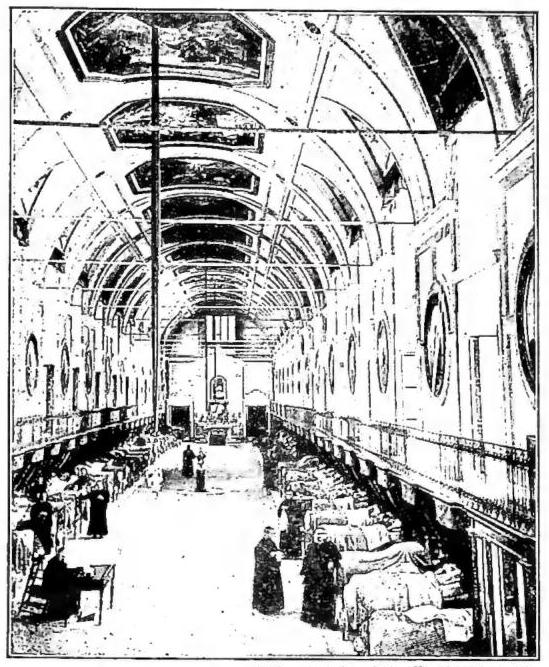
Hospitals — Ward of the Fatebenefratelli Hospital photographed in 1883. Frescoes by Viola and Diano (1764–78) depicting the life of St. John of God and medallions of the most illustrious Fatebenefratelli — Naples, S. Maria della Pace.