
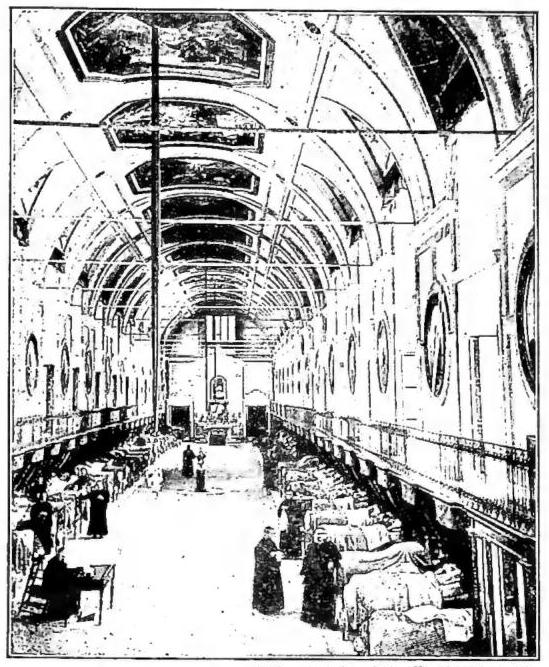
HOSPITALS — Ward of the Fatebenefratelli Hospital photographed in 1864. Frescoes by Viola and Diano (1764–76) depicting the life of St John of God and medallions of the most illustrious Fatebenefratelli — Naples, S. Maria della Pace.
When special epidemics spread in the West, especially from the 11th century onward, special hospitals were also established, run by nurses living in community, such as the Antonines in Vienne (Provence), or, to stem the advance of leprosy, special leper-houses (v.) or lazzaretti (v.). As the communal regime progressed and industries organized themselves, it was the individual guilds that provided for the hospitalization of their sick members or the shelter of those unable to work; it was the confraternities that similarly cared for their own members; and in particular it was the societies of the Flagellants that promoted the building of new major hospitals. One must not imagine that, in those times (13th century and following), the institutions were as organized and complex as those of the modern age: medical care and treatment were not lacking, however, entrusted either to special nursing staff or to compassionate people, especially women. In the cities most frequented for commerce or transit, hospitals were founded for the needy or for pilgrims of particular nations, as happened in Rome in imitation of what had already been done in the early Middle Ages; likewise, at obligatory crossing points, on rivers or mountains, it was special hospitaller orders that governed the hospitals. With the Renaissance, especially in Italy, a further advance is noted: in the larger cities, above all, many small hospitals were consolidated into one, giving rise to more hygienic and grand buildings (up to monumental scale), with more adequate regulations or richer endowments; suffice it to recall, besides those in Rome, those in Genoa, Milan, Venice, Florence, and Siena. Leper-houses, which had become almost useless in many places, were replaced by hospitals for the incurable and by lazzaretti during epidemics. The hospital system then improved further in the following age; to the ancient hospitaller orders, which had declined and transformed their institutions into commendams more to the advantage of the individual commendators than of the poor, there succeeded, at least in many places, special religious congregations (Fatebenefratelli, Camillians); from the 17th century onward, women also began to dedicate themselves to the care of the hospitalized, organized in ways suited to the needs, until they too formed special congregations whose sole purpose was nursing assistance or combined it with other religious activities.
In modern times, hospitals are more properly nosocomiums, sometimes limited to the care of specific diseases or classes of patients (children’s hospitals). Assistance to other classes of the needy, which during the Middle Ages had been entrusted to hospitals, is today devolved to special institutions for infants, the elderly, orphans, and the chronically ill. On the other hand, nursing homes and clinics that no longer assume a charitable character cannot be counted among proper hospitals.