
ECBATANE – Hamadán, Musallah hill, on the site of ancient E.
ad Articulos sibi impositos (1326). The Opus tripartitum was to encompass the opus propositionum, whose complete exposition is known from the Prologi and from one developed thesis (Esse est Deus); the opus quaestionum, consisting of lessons and disputations; and the opus expositionum, consisting of passages from the biblical text and materials for sermons (opus sermonum, ed. Benz, 1937). The opus expositionum consists of prologues and explanations In Gen. 1 (I form), In Eccli. XXIV, In Sap. (ed. G. Théry, 1928–29), In Gen. 1 (II form), In Ex. (II form), In Gen. 2 (Liber parabolarum Genesis), In Io. (edd. K. Christ and J. Koch, 1936 ff.). Of the Latin writings (cf. Faggin, M. E., pp. 68–75, 377–79) studied since Denise, two recent editions are concerned: one headed by G. Théry (Leipzig, 1933, thus far 3 fascicles), the other promoted by the Deutsche Forschungsgemeinschaft and edited by J. Koch, B. Geyer, K. Weiss, K. Christ, R. Benz, and R. Seeberg (Stuttgart–Berlin, 1936 ff., thus far 10 fascicles).
E.’s thought unfolds around 3 preferred problems: God, the origin of things from God, and the return of spiritual creatures to God; in solving them, in addition to Neoplatonic, pseudo-Dionysian, and other elements, it brings the riches of the classical school of St. Thomas, together with the contribution of an original and daring mind.
“Esse est Deus,” in the sense of absolute being, not in the sense of inherent, created being. The creature is non-being, relative, shadowy being; created being is nothing without the being of God. “Deus non habet esse” means that in God there is the fullness, perfection, and purity of being. Being and essence are really distinct. Employing the methods and formulas of negative theology, E. teaches that God is without a name, that God is not good, that is, not good according to created goodness. Being thus defined is for E. the deity, distinguished from the triune God of Revelation. The Trinity is explained through a process of self-knowledge of the divine essence, while avoiding the meaning falsely attributed to it by J. W. Preger, namely, a temporal succession from potency to act. E. teaches God’s eminent being as metaphysical and as mystical. The same applies to his thinking and speaking of the divine attributes: unity, simplicity, spirituality, etc. God’s creative act is eternal, but the creature is not. Through his clear concept of creation E. is many miles removed from pantheism (F. Pelster).
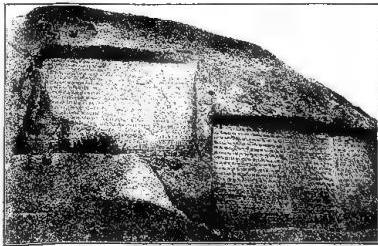
(from A.F.W. Jackson, Persia Past and Present, Nueva York 1995)
ECBATANE - Cuneiform inscriptions of Darius and Xerxes near Hamadán (5th century B.C.).
corporeal according to essence and the lower faculties, the soul, according to its higher faculties (intellect, will), lives in the world of the spirit. The ratio superior of the one and spiritual soul gives its orientation toward God. E. sometimes speaks of the castle, spark, or summit of the soul, the « seat » where the union of God and the soul takes place according to the three layers of natural spirituality, elevation to the supernatural order, and mystical experience. While Neoplatonists and Beghards consider a natural aptitude sufficient for mystical union with God, E. admits the soul to be « divinized » only through the infusion of Grace and the gift of God.
Asking why there are good works, worship, the world, and the Incarnation, E. replies: so that God may be born in the soul and the soul in God. This « Gottesgeburt » is a central idea and fact of the world, connected with the birth of the Son from the Father in the bosom of the Most Holy Trinity. Transformation into the Son does not cause man to lose his existence, but his egoism; it does not lead to quietism, but to the interior fullness of works of charity and social assistance. The negative aspect of the birth of God in the soul is withdrawal, which nevertheless rises to a positive function: « nihil apponendo, sed subtrahendo, in anima invenitur Deus ». The informing of us by God, the loss of the « form » of everything in us that opposes the divine form, abandonment to God, and « passive » union with God make the soul docile and pliable under the light and action of God; it listens and sees without images and acts without effort. In abandoning himself, man abandons all things and establishes in himself true freedom for God.
The most accurate transcription of E.’s Latin works is due to Cardinal Cusano; German sermons were printed in the 15th century. Romantics, philosophers, theologians, and Germanists of the 19th century brought him out of obscurity. C. Schmidt of Strasbourg made him a pantheist, Martensen believed him to be an atheist, and Lasson placed him in opposition to the Church. While F. Pfeiffer (1857) edited the German E., J. W. Preger (1874) sought the historical person, and H. Denifle (1886–89) shed considerable light on E.’s figure and Latin writings. For Deacroix (1907), H. Büttner (1917), and Ott (1937), E. is a precursor of Luther; for A. Rosenberg, he is the great apostle of the Nordic West. While H. Denifle, H. V. Hornstein, G. Théry, and J. Koch insist on E.’s Latin writings, O. Karrer and H. Piesch affirm his orthodoxy, and A. Dempf, while nevertheless giving priority to mystical inspiration and originality of thought, reaffirms his integral Catholicism. A critical edition of the works will facilitate the exegesis of E.’s authentic thought and endeavor.