
Edessa (Edesse)
In origin Orhai, from which the name Osroene derives for the region of which it was the capital, Edessa was situated to the northwest of Mesopotamia on the river Scirtus; by the Arabs it was called ar-Ruhā, today Urfa. It was founded by King Seleucus I, who gave it the name of the like-named Macedonian city; Antiochus IV called it Antiochia "near Callirhoe." It was the capital of Osroene from 137 B.C. to A.D. 216. Having become Roman under Pompey, it was then contested in the Roman-Parthian wars until in 217 it became a Roman colony. Caracalla was killed there in 217. After being destroyed by an earthquake, it was rebuilt by the Emperor Justin I, who called it Justinopolis. In 609 it was captured by the Persians. In 709 Godfrey of Bouillon raised it to a county, and the counts succeeded one another until 1144. After passing from the Mongols of Hūlāgū to the Muslim Egyptians, it was conquered by the Ottoman Turks in 1637. Among its fifteen rulers, who bore the title of Abgar, that of Abgar Ukkāmā is notable for the Christian legend concerning him (v. Turchi).
### I. Christianity in Edessa
Abgar (v.) and Addai, it must be held that Christianity, probably introduced in apostolic times, was already organized in Edessa by the middle of the second century. Apart from the testimony of the epitaph of Abercius, Eusebius (Hist. eccl., V, 23) informs us of a synod of Osroene around 197, which sent a letter on the controversy over Easter. The opinion that King Abgar IX (179-216) and his court became Christian is unfounded. It is certain, however, that about that time Edessa received from Serapion of Antioch its first Catholic bishop, Palūt. With this consecration the Church of Edessa entered the orbit of the Greek Churches, which until then it had probably belonged to the Judeo-Christian current.
Edessa became the center of the spread of Christianity in eastern Syria and thus also in Persia during the third century. Its Aramaic dialect, namely literary Syriac, served for the direct Syriac version of the Old Testament called the *pēšīṭtā*, which probably saw the light there toward the beginning of the Christian era. Later, Tatian composed in Syriac, perhaps there itself, his *Diatessaron*. The persecutions of Decius and Diocletian produced martyrs in Edessa, among whom are to be remembered: Šarbil, Gūrā, Šērōnā, and Ḥabbīb. The Council of Nicaea was attended by Ajallāhā (Ethlans), bishop of Edessa. During the fourth century the Edessene Church was distinguished by the work of St. EPHRAIM (v.). The Christological controversies brought grave disturbances to the Church of Edessa: after Rabbūlā (432-435), a staunch defender of orthodoxy, came Hībū (435-457), absolved by the Council of Chalcedon but author of the letter to Mārī condemned by the Fifth Ecumenical Council. With Jacob Baradaeus, however (543-578), Monophysitism became established there, and from then on Edessa almost always had a double hierarchy (Monophysite and Orthodox). Of the Latin hierarchy established there at the time of the Crusades, the present titular metropolitan see of Edessa in Osroene remains as a reminder. A similar titular see exists for the Catholic Syrians. There are few Latins (cared for by the Capuchins) and also few Maronite, Chaldean, and Armenian Catholics.
For the Christian monuments of Edessa, V. OSROENE.
**
### II. School of Edessa
It is the direct descendant of the ancient School of Nisibis (v.) and the mother of the new Nisibene School. When in 363 Jovian ceded Nisibis to the Persians, a part of the Christian population went eastward; thus the school founded by
---
Eden
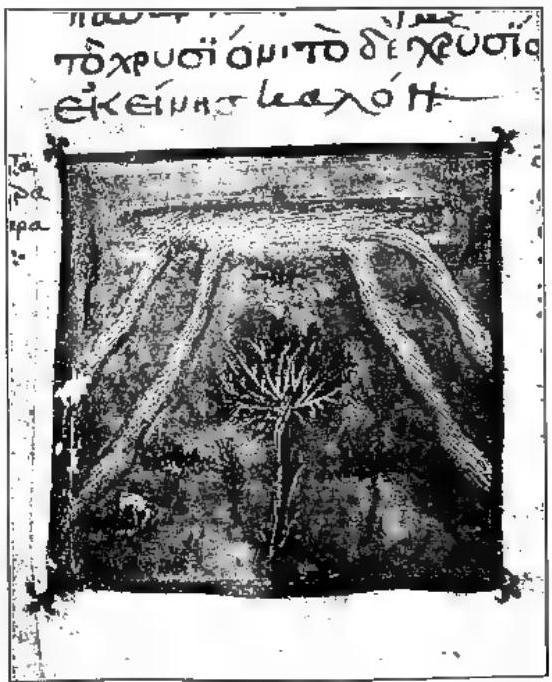
The Eden with the four rivers. Miniature from the Octateuch, contained in cod. Vat. gr. 746, f. 35r (12th century) — Vatican Library.
---