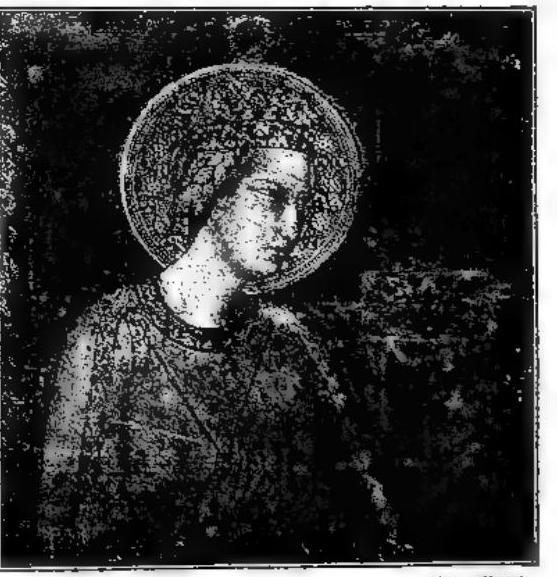
ELISABETH OF THE HOLY TRINITY, Venerable. – Discalced Carmelite mystic, born Marie Joséphine Élisabeth Catez on 18 July 1880 in Avord (Cher). From 1901 she was a Carmelite in Dijon, where she died in a reputation for holiness on 9 November 1906. She succeeded in wonderfully realizing a life of intimate and continual communion with the one and triune God, attaining the heights of contemplation. The cause for her beatification has been introduced.
The accounts of her life and interior life, drawn from her writings, were published by her fellow sisters in Dijon under the title: Soeur Élisabeth de la Trinité, religieuse carmélite, Souvenirs (Dijon 1915, 1918, 1930, 1935; Paris 1927), in Italian translation (Florence 1926) and in English translation (London 1912).
Bibl.: M. V. Greifensein, Schwestern Elisabeth von der Hl. Dreifaltigkeit, Sarajevo 1914; A. Beschin, Lettres de direction du breton (Castro de Reto) à la mère Élisabeth, 1914
ELISABETH OF THURINGIA – ELISABETH OF HUNGARY
Born in 1207, daughter of Andrew II, King of Hungary, and Gertrude of Merania, she was betrothed at the age of four to Louis, son of Hermann, Landgrave of Thuringia, and was sent to the Wartburg to be educated. In 1221 she married Louis, who succeeded his father in 1227. She bore three children: Hermann (d. 1241), Sophie (d. 1275), and Gertrude (d. 1297). Her spiritual director was the learned Conrad of Marburg, who later became a Franciscan tertiary. At a very young age she was widowed by the death of Louis (12 September 1227), which occurred in southern Italy while he was accompanying Emperor Frederick II on crusade in the Holy Land. During her husband’s absence, a great famine struck the land; she supported many hundreds of the poor with public funds, even against the wishes of the nobles, and personally attended the sick in Eisenach. It is now certain, contrary to the hypotheses of Wenck and Michael, that after becoming a widow, she was violently driven from the Wartburg castle in the winter of 1227. On that night she went to the Franciscan convent in Eisenach and begged the friars to sing the Te Deum in thanksgiving for her tribulation. For some time she lived in great want and begged for alms; she was aided by her kinswoman, the Abbess of Kitzingen, and by her uncle Egbert, Bishop of Bamberg, who wished to arrange a remarriage for her. When the knights returned with the bones of Louis from the crusade, her circumstances changed somewhat, especially when Gregory IX appointed Conrad as her “defender.” But already, devoting herself to an ascetic life, in 1228 she solemnly renounced the world in the church of the Friars Minor in Eisenach. She received the grey habit of a tertiary from Conrad’s hands, and with the property assigned to her for her widowhood, she built the hospital at Marburg, whose chapel she dedicated to St Francis, recently canonized. She died at the age of twenty-four, exhausted by constant service to the poor, the sick, and lepers, on 16 November 1231. It is said that St Francis himself sent her his mantle, which is said to be preserved in the parish church of Oberwalluf near Mainz. She was buried in the cathedral of Marburg.
Miracles that occurred immediately after her death led to the initiation of the canonization process, which concluded on 27 May 1235 with her proclamation as a saint by Gregory IX in Perugia. The translation of her relics was attended by a great following of princes, including Frederick II, who later wrote a letter on the event to the Minister General of the Franciscan Order, Brother Elias (Acta Imperii Medicea, ed. E. Winckelmann, I, Innsbruck 1880, pp. 299–300). The cathedral of Marburg was a site of pilgrimage until the time of the Protestant Reformation, when Philip of Hesse dispersed her relics; some are now preserved in Vienna. The head preserved in Besançon is of doubtful authenticity (cf. Rev. d'hist. franciscaine, 2 [1923], p. 275). Numerous religious congregations, especially Franciscan tertiaries, are named after her. The Elisabeth Conferences were first founded in Trier in 1840 (W. Liese, Gesch. d. Caritas, Freiburg 1922; the letter of Pius XI for the centenary of her death in AAS, 23 [1931], pp. 525–27). Her feast is celebrated on 19 November.
Representations of St Elisabeth are extremely numerous throughout Europe (cf. S. Elsner, in Franziskanische Studien, 18 [1931], pp. 205–237). The saint is depicted distributing bread to a poor person at her side, or, after the fifteenth century, hiding a bundle of roses in her lap, in reference to the miracle of having turned the bread she was carrying to the poor into roses so that it would not be known (cf. L. Lemmens, Zum Rosenwunder, in Katholik, 24 [1922], pp. 381–84). The rapid spread of the cult of St Elisabeth in Italy is evidenced by the fourteenth-century pictorial cycle in the church of Santa Maria Donna Regina in Naples. – See plate XL.
BIBL.: Sources: The sources for the life of St Elisabeth are listed with their editions in Arch. Franc. hist., 2 (1909), pp. 243–49. Among them is a letter of Gregory IX written while Elisabeth was still alive. Conrad of Marburg, who worked for the process of her beatification, wrote an Epistola de vita ad papam in 1232; the Ditta IV Ancilia, before 1244, expanded in the Libellus edited by A. Huyskens, Der sog. Libellus de dictis IV Ancilia, Munich 1911; the Life written by Caesarius of Heisterbach before 1237, ed. by Huyskens, Cologne 1908; BHL, nos. 2488–2514; U. Chevalier, Bibliothèque hagiographique latine, I, 2nd ed., Paris 1913, cols. 1304–1307. Modern biographies: E. Horn, Sainte Élisabeth de Hongrie, Paris 1902, Italian trans. Milan 1924; M. Maresch, Elisabeth Landgräfin von Thüringen, Munich-Gladbach 1921; K. Adam-Kappert, Elisabeth von Thüringen, Vienna 1929; P. Dörfler, Die heilige Elisabeth, Munich 1930; J. Ancellet-Hustache, Sainte Élisabeth de Hongrie, Paris 1947. Studies: L. Crick, Culte de Sainte Élisabeth de Hongrie en Belgique, Sainte Élisabeth de Hongrie, Paris 1902, Italian trans., Milan 1924; St. V. Durnin-Borkowski, Die hl. Elisabeth in der Kirche zu Bonn, in Katholik, 49 (1917), pp. 218–23; G. Haselbeck, Die hl. Elisabeth und ihre Beichtväter Bruder Rodeger und Konrad von Marburg, in Franziskanische Studien, 18 (1931), pp. 294–308; id., Die hl. Elisabeth in ihrem seelischen Wachsen und Werden, in Thüringen-Franciscana, 15 (1931), pp. 108–57; id., Das religiöse Wollen der hl. Elisabeth, ibid., 15 (1931), pp. 247–77; E. Hernelink, Ein Fahrtenbund Elisabethforschung, in Theol. Rundschau, 4 (1932), pp. 121–38. Ottocaro Banzmann.