
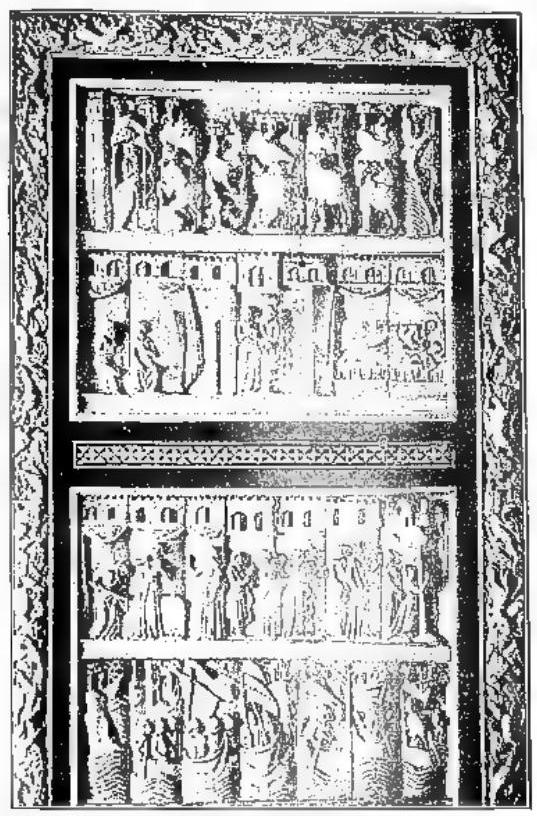
EMBRIARCHI (EABRIACH). — A family of bone-ivory carvers active in Venice between the 14th and 15th centuries. BALDASSARRE is the most famous; to him is attributed the magnificent altarpiece in the sacristy of the Certosa of Pavia (1400-1401). The carved bone panels are set close together and enclosed in wooden frames of different colours, inlaid in the manner known as “alla certosina.” In the style of these ivories, carved with subjects either sacred or profane according to use, the derivation from French Gothic ivories is evident, with reflections of Tuscan art; indeed, documents attest Baldassarre’s sojourn in Florence before his family moved to Venice.
Members of the same family include ANDREA, ANTONIO, and GIOVANNI degli E., along with their sons GERONIMO and Lorenzo. The vast artistic output of these carvers (caskets, coffers, wall mirrors, etc.), scattered across nearly every collection and museum in the world, suggests not merely different personalities working in the same workshop but rather various production centres spread across northern Italy.
Important collections of these ivories are preserved in the Museo Civico of Bologna, the National Museums of Florence and Ravenna, the Museo Correr of Venice, etc. — V. XXII.