
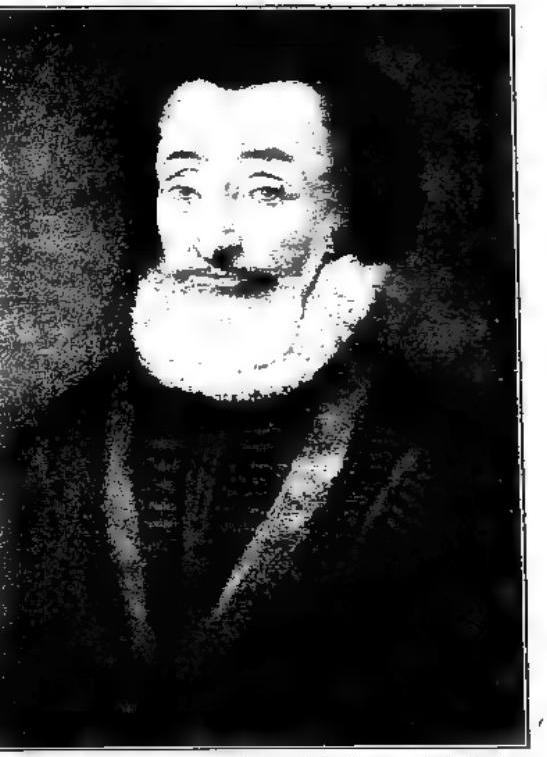
of the Calvinists. With the support of the dowager queen, Catherine de’ Medici, he married her daughter, Margaret (17 Aug. 1572), a pledge of peace between Catholics and Calvinists; but a week later, on the night of St Bartholomew, that plan was brought to an end and Henry was saved, it seems, only by the intervention of Charles IX. Even after the marriage (Sept. 1572), he was kept at court under a form of house arrest. He escaped in Feb. 1576, returned to Calvinism, and became its military and political leader, even in rivalry with Henry I, Duke of Condé, and was recognized as such by the Protestant powers. He nevertheless presented himself as tolerant, so as not to burn all bridges with the other side, in case he should, however improbable it seemed, become heir to the French crown. The case arose in 1584, upon the death of Francis, Duke of Alençon, the last brother of Henry III, who left no issue. But a bull of Sixtus V (9 Sept. 1585), prompted by the Catholic League, deprived Henry and Condé of their rights of succession. As long as Henry III lived, Henry IV professed loyalty to the king, supported him in his struggle against the Guises, and drew financial support from the Protestant powers, while the Catholic powers, especially Philip II of Spain, backed the Guises. With the Guises and Henry III gone (1 Aug. 1589), Henry IV found himself king of France only in the eyes of part of his subjects: the Calvinists, the legitimist Catholics, and the politiques, who held that the king might be of a different faith from the majority of his subjects, but not in the eyes of the majority of the French, especially in the northern and eastern provinces (notably the capital), which opposed him as an antichrist and chose as their leader his uncle Charles, Cardinal of Bourbon. He was forced to abandon his tolerant stance, to fight these rebellious subjects, and above all Philip II, who supported them with the arms of the highly able Alexander Farnese. Yet neither Ivry, a victory for Henry, nor Lagny, a success for Farnese, was decisive. What proved decisive was Henry’s realization that only a Catholic king could give France peace; and decisive too was the Catholic League’s realization that the continuation of civil war would mean the dismemberment of France at the hands of Philip II. As the two opposing parties drew closer together on the idea of the unity of France, it became possible for Henry to effect, without too much scandal, his second abjuration (25 July 1593), to be crowned at Chartres (27 Feb. 1594) and to enter Paris on 22 March following. On 17 Sept. 1595 Pope Clement VIII absolved the relapsed king, thereby removing every religious justification for Philip II’s war and for the stubborn resistance of certain League cities. Finally the war ended through the financial exhaustion of the belligerents in the Peace of Vervins (2 May 1598). Almost at the same time the Edict of Nantes guaranteed to Protestant subjects the exercise of their religion, despite the reluctance of the provincial parliaments to register so unprecedented a novelty; of these parliaments, moreover, Henry IV did not hesitate to take little account, as in the case of the recall of the Society of Jesus (1603), imposed by the king against the Parliament of Paris.
But after Vervins, after inducing the restless Duke of Savoy, Charles Emmanuel I, to make peace (Treaty of Lyons, 1601), and after subduing the last rebels, such as the Duke of Biron (1602) and the Duke of Bouillon (1606), all Henry IV’s energies were directed to healing the terrible wounds of war and the poverty of the state treasury. Guided by a kind of early physiocratism, inspired by his excellent minister the Duke of Sully, and only in part by the mercantilist ideas of de Laffemas, the king, within a few years, restored France to a relative prosperity and to a leading role in European high politics: thus in 1607 he intervened in the bitter controversy between Venice and the Holy See, and two years later induced Spain to agree to a twelve-year truce with the United Provinces of the Netherlands. But all this was a prelude to a projected armed intervention against the Habsburgs in Germany and Italy, in alliance with the German Protestant princes and with Charles Emmanuel I of Savoy, when the dagger of the fanatic François Ravaillac put an end to the grand dessein.