**Epigraphic Christianity**
Archaeology. How difficult it is to make a monument speak when it bears no trace of writing! And even then, the voices that can be drawn from it will always be faint and uncertain. It is a privilege of Christian antiquity to be illustrated by a vast number of inscriptions. Various more or less approximate figures have often been proposed, and new discoveries continually render them less exact year by year. More than twenty thousand texts have so far been recovered from the Roman catacombs; about a thousand from Syracuse; and an almost countless dust of the most varied fragments has been gathered from the cemeteries of ancient Christian Carthage.
Yet it is not always easy to judge whether an inscription is Christian or pagan—that is, whether it was produced by Christians or not. In practice, Christian epigraphy properly so called takes into consideration only those inscriptions that bear a mark of Christianity, since its principal task is to collect from tombstones the testimonies of ancient Christian life as such. Nor need one fear that this method, applied to the period when Christianity was the religion of the great majority (such as the fifth and sixth centuries), would logically lead to the classification as pagan of a great number of inscriptions that are in fact the work of Christians. For in antiquity, and especially in those centuries, there scarcely existed a class of purely civil and secular inscriptions; their profound religious sentiment found expression even in the most ordinary circumstances.
The study of Christian epigraphy thus makes it possible to form a more precise idea of the general life of ancient Christians; of their religious and civil customs and institutions. The exploration of ancient cemeteries reveals their funeral rites and many curious details of daily life—for example, the secrets of personal onomastics and its transformations. From ancient churches one learns more concretely how official worship was conducted, under what material conditions, and with what instruments. Civil and private epigraphy, and in particular the multifarious instrumentum domesticum, show to what extent the Christian religious spirit had penetrated souls and manifested itself even in the most unguarded expressions, sometimes in true deviations of superstition. The rich iconographic heritage of figured monuments, which has revealed an often curious and unexpected world of artistic ideas and symbolic elaborations, receives from the inscriptions that sometimes accompany them fixed points for a positive interpretation of otherwise insoluble problems and for a certain chronological arrangement and historical overview of the whole body of evidence.
Philology, which once believed worthy of study only the pages of great authors written in the official language and disdained the humble testimonies of unpretentious texts—often incorrect, barbarized, and full of vulgarisms—has now learned the value of attending to rough but spontaneous and genuine documents of the living language. It now successfully studies the evolution of Latin and Greek, which in pronunciation, forms, and vocabulary are increasingly giving rise to the modern languages.
Yet even history, properly so called—that is, the grand history of events deemed important by men—often finds in the age of epigraphy, above all regarding individual facts known only from inscriptions or receiving unexpected and decisive illustration from them, and sometimes even in matters of a more general nature. It is now admitted, to give a few examples, that a history of the early spread of Christianity (and thus the geography of the orbis christianus antiquus) cannot be written without the valuable contribution of epigraphy, as Adolf von Harnack has shown; how much light the African and especially Roman epigraphy can shed has been demonstrated repeatedly by Hippolyte Delehaye and René Mouterde; the inscription of Aezani (v. 1) sheds instructive light on the persecution under Maximinus and the famous question of the census of Quirinius, while the mutilated inscription from Tivoli is deeply concerned with the census of Quirinius, and another recently discovered at Nazareth may preserve the echo of the rumors deliberately spread by the Jews about the disappearance of Jesus’ body (Mt 28:13). What would we know of popes such as Eusebius and Marcellus without the inscriptions dedicated by Pope Damasus? What of St Abercius and St Eutychius without their funeral elogia? Even literary history now finds in epigraphy texts worthy of its consideration, such as not a few metrical compositions, and now precious sources of documentation, like the catalogue of the books of St Hippolytus inscribed on the back of his chair, or the letter of St Athanasius to monks, whose original text was found written on the door of a monastic cell near the Egyptian Thebaid.
Semitic and ancient Egyptian epigraphy have contributed innumerable insights to a better understanding of the historical setting and certain facts and figures of the Old Testament, as François Vigouroux has shown at length. But the New Testament, and especially the Acts of the Apostles, have also received new light on many points from epigraphic discoveries. Yet the benefit that the student of the Bible may derive from ancient inscriptions relates more generally to the text and language. An innumerable series of biblical quotations in Greek and Latin scattered across inscriptions, if systematically collected and studied as a whole, could teach us much about local textual variants, the spread of particular recensions, the use of different translations, and the familiarity with and transmission of the text and its meaning.
The pronunciation of Latin and Greek in the fourth and fifth centuries was already profoundly altered, and if a man of the age of Pericles or Caesar were to walk the streets of his city again, he would struggle to recognize it as his own and to make himself understood. The poor authors of Christian inscriptions, who write as they speak, constantly confuse B with V (Vitalis and Bitalis), DI + vowel with Z (diaconus and zanonus, baptizatus and baptidiatis), C, K, and Q (quies and censes, Quirinus and Cyrius), X with C, S, and S (vita, vicesi, visti, Xystus and Sistus), IE with GE and ZE (Iesumus and Genorus and Zenaria, Aloisius and Alogiosus, Genesis et Jenesia, Manus and Magius), TJ with Z and S (Gentiane and Genese), Y with E (Hypatus and Epatus), and V with O, and E with I, especially in Gaul (christiani and crestiani, luthum and tetolum), not to mention diphthongs, double consonants, and aspirates, where they often fail to make sense, and final consonants are frequently omitted in writing as in speech (bocata so = vocata sum). It is even worse when, through misguided etymologizing, they reverse the derivation (Aeliorius for Heliodorus, thinking it derived from Aelius).
**CHRISTIAN EPIGRAPHY**
(from E. White, *The Monastery of Epiphany at Tientsin*, 1913)
Christian Epigraphy – Fragments of a Letter by St Athanasius, Thebes, Monastery of Epiphanius.
The charm of poetic composition itself was such that it easily overlooked all defects of style, memory, language, and even inspiration.
The phonetic and morphological defects are much more serious and frequent in proper names, where they then create far greater difficulties for correct reading and understanding. Since even the onomastics of Paleo-Christian inscriptions is now very different from that known from classical sources. The use of the *tria nomina* still common in the 3rd century becomes then very rare, and even the presence of *gentilicia* becomes increasingly sparse over the course of the 5th century. Great disorder also arises in the titulature of important figures, for whom *gentilicia* often become surnames (and even serve as given names), while true surnames take on the endings and forms of *gentilicia*. The only constant element, even for people of good standing, is the presence of a surname, and those who wish to appear distinguished adopt more than one. Modern personal names descend in a direct line from the surnames in use as early as the 4th and 5th centuries.
Many have raised the question of names that are typically Christian, i.e., coined by Christians, and have gone far down this path. It is a difficult and thorny road to travel, full of pitfalls. All things considered, it does not seem that, at least for the 4th and 5th centuries, there were many names introduced by Christians. These include certain biblical names such as PETRUS, IOANNES, SUSANNA; those derived from Christian concepts such as ANASTASIUS, PASCHASIUS, AGAPÈ, ATHANASIUS, ADEODATUS; or certain compounds especially favored by Africans (DEOGRATIAS, QUODVULTDEUS, HABEDÆUS, DEUSDEDIT, etc.); sometimes names already used by pagans became very common and almost exclusively Christian due to their fame or meaning, such as PAULUS, MARIA, STEPHANUS, REDEMPTUS, CYRIACUS, BONIFATIUS, DOMINICUS, ELPIS. Among these are often counted the so-called "names of humiliation," such as PROIECTUS, STERCORIUS, KONTRAVOÇ, CALUMNIOSUS, CONTUMELIOSUS, IMPORTUNUS, ALOGIUS; but these are rather to be attributed to a fashion of the time than to a sentiment of Christian virtue. Moreover, the same names are found in pagan inscriptions of the same period, including those of pre-Christian idolatrous mariners, such as MERCURIUS, VENERUS, ISIDORUS, DIODORUS, APOLLODORUS, DIOGENES, SATURNINUS, PALLADIUS, APHRODISIUS, etc. No one paid any attention to this.
However, these names are very often no longer used in the proper forms of classical antiquity but adapted to current taste with new suffixes such as -ins, -ontius, -ontius, -ontius, -ontius, -ontius, -ontius, -ontius (etc.). Thus, instead of EUTYCHES and EUCÈFÈRÈS, one finds EUTYCHIUS and EUCÈFÈRIUS; TYRANNIO and DOMINO instead of TYRANNUS and DOMINUS; BONOSUS and LEONIUS instead of BONUS and LEO; and similarly ASTERIUS, ADELPHIUS, AGAPIUS, VENANTIUS, VINCENTIUS, MARTE(n)sis, CALENDIO, TROPHIMIUS, EUCÈFÈRIUS, etc. Their declension is also profoundly altered by a series of phenomena that can be traced to two main causes: the invasion of Greek cases over Latin ones and the prevalence of weak forms over strong ones. IULIANE-ES, like AGAPÈ-ES, MENAS-A become normal forms, and alongside HAGANA-NE one finds HAGANE-ES or HAGANE-ES, and similarly SEMNE-ES or OUI, SPES-ENIS, EUTYCHES-ES, HEDYS-NIUS, and similar forms, up to VITATHIS-NIUS, MENAS-ATIS, EPICTESIS-IDIS, ATTILUS-ANIS.
There is no need to be concerned if this entire onomastics is etymologically more Greek than Latin. Many believe they can deduce a person’s nationality from the quality of their names, but a study of inscriptions shows that, at least for the 3rd–5th centuries, this is an illusion. Latin names were at that time very common among Orientals, just as Greek names were among Westerners. No one paid any attention to this, or if any factor influenced it, it was merely a certain fashion for exoticism.
It is more instructive to examine in inscriptions the decline of the use of Greek in the West. Up to the time of Constantine, from a third to a quarter of inscriptions are in Greek. Thereafter they rapidly decrease, so that from the mid-4th century onward, except for some artificial poetic compositions, only inscriptions by Orientals—who almost always declare themselves as such—are in Greek.
The dating of these inscriptions is determined by various clues, but above all by paleography, the formulary, and the date that is sometimes inscribed, more rarely by allusions to known persons or events. The paleographic argument, and to some extent that drawn from the formulary, is easy to handle in a sufficiently large and homogeneous body of inscriptions, but very difficult and delicate when dealing with individual inscriptions. In such cases, caution can never be excessive.
The date on inscriptions (i.e., the year in which they were written) is usually given according to the consular era, which was the official era of the Roman state, or according to other local or regional eras. Up to Constantine, this was done very rarely; from the mid-4th to the mid-5th century, dated inscriptions become numerous. Their utility is evident, and for this reason, even if special collections have not been made, they serve as milestones marking the path of epigraphic development and help to establish chronological canons even for the mass of undated inscriptions. Throughout the West, the consular date is normally used, indicated by the consuls in office that year; only in western Spain and Mauretania are regional eras used. This practice, however, becomes universal in the East, where the multitude of local eras—often little known, especially in Asia Minor, Syria, and Palestine—often creates considerable difficulties. Nor should mention be made of the indiction (v.), which is often indicated in later inscriptions but is of almost negligible practical chronological value.
A problem no less difficult than the chronological one is often, at least for the earliest inscriptions, whether the texts are pagan or Christian. Even accepting the principle that an inscription should be considered pagan until its Christian character is proven—
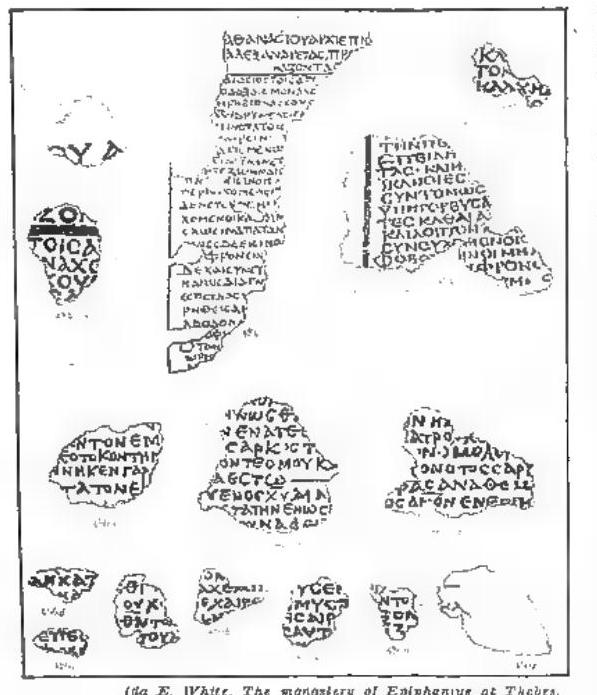
Christian Epigraphy — Fragments of letters of St. Athanasius, Thebes, Monastery of Epiphanius.
the poetic composition itself was so captivating that it easily overlooked all stylistic and metrical defects. Nevertheless, a wide field still remains for hypotheses and conjectures of various kinds. This is all the more true because inscriptions that are clearly Christian in context, such as those in catacombs, often contain elements that suggest paganism rather than Christianity, for example, invocations of dire vengeance against tomb violators, dedications to the Manes gods, mentions of ADE, Tartarus, and other pagan deities, or expressions of despondent pessimism. Conversely, manifestations of noble religious, monotheistic, or eschatological thought should not always mislead, for they can also be found on the lips of adherents to special philosophical currents or mystery cults, as in the case of the stele of C. Clodius Fabatus of Rignano Flaminio (Diehl, loc. cit., p. 3443). Today, the question is sometimes further complicated by hypotheses regarding membership in heretical sects or Jewish communities. Thus, an important inscription such as that of Regina (Diehl, loc. cit., no. 4933) is disputed between Christians and Jews, and another no less notable one of Probia (Diehl, loc. cit., no. 3320) between Jews, pagans, and Christians.
For the earliest periods, scholars have sought cryptic Christian formulae, but this path is exceedingly difficult and dangerous and has yielded no appreciable results. Thus, while Wilhelm succeeded in demonstrating the Christian character of a formula that in itself is neutral, such as ἔστρα στήλη τόσον δέν (a threat against tomb violators), disputes over the "rings" of the Theran stelae have not ceased, nor can anything certain be said about a group of inscriptions from Arles with the phrase *pax tecum* (CIL, XII, 84).
Often the Christian character of an inscription is also evident from the accompanying figures, which are almost always of a symbolic nature. Since such figures are very rare on pagan tombstones and, according to the various regions, are of a very specific character—generally much more secular than religious—some caution is necessary. Palms and crowns, for instance, are not infrequently used to adorn pagan epitaphs, and sometimes even fish, usually dolphins. In Phrygia, moreover, there appears a rich series of representations of a particular kind.