
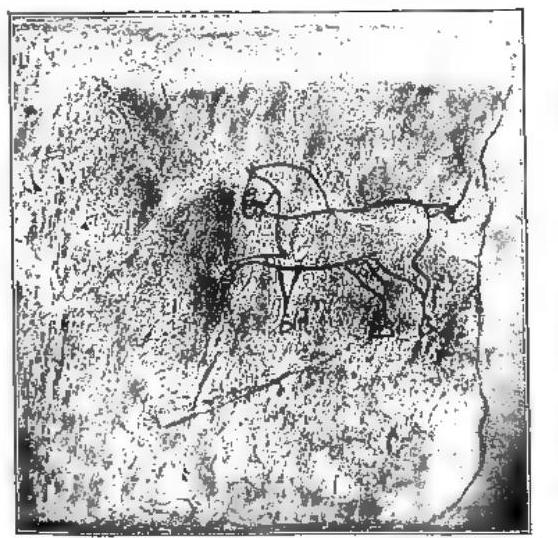
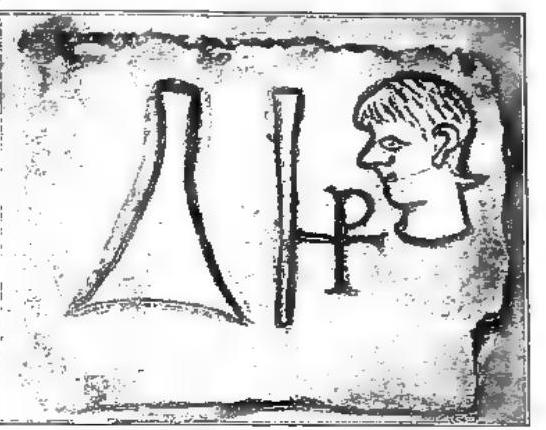
The most common Christian symbols include the Good Shepherd and the sheep, the orant figure, the dove of Noah, birds of various kinds (especially doves and peacocks), or alone and facing a vase, the phoenix, the dolphin or other fish. The anchor, crowns and palm branches, decussate monograms or monogrammatic crosses, alone or accompanied by the apocalyptic letters A and Ω, and also by doves, vine branches, sheaves of wheat, tools of trades (especially those of the stonecutter), scenes from private civil life and sometimes from religious initiation, even some biblical scenes, horses in motion, a ship reaching port, and often representations figured from the name of the deceased as if they were coats of arms (the figure of a sheep on the tombstone of a Probaust, because the sheep in Greek is πράξατο); the peacock, a bird of the sun called in Greek ἅλως, on the tombstone of a certain Aelia, and so on).
The vast majority of early Christian inscriptions are funerary, whether in prose or in verse. They share a general concern to mark the date of the death and burial of the deceased, something which, as a rule, pagans studiously avoided. Moreover, titles indicating civil status are usually replaced by those signifying the deceased’s position within the Christian community. The frequency with which Christians express their religious sentiments finds little counterpart in pagan epitaphs of the same period. More or less the same applies to the care taken in marking tombs. All this stems from that faith which, as it gave new form to life, so also confers a new aspect upon death, radically transforming the perception of their respective values.
Among other classes of inscriptions, those of a monumental nature—affixed to buildings—are noteworthy not only for their number and historical importance but above all for their distinctive character. Pagan inscriptions tend to highlight the author of the building and his work; Christian inscriptions, by contrast, focus on the purpose of the work, namely the interests of the community and divine worship. In the former, the person to whom a temple is dedicated remains in the background, almost in the shadows; in the latter, this person moves to the forefront, at the center of the subject. In general, it must be observed that all early Christian epigraphy, when compared with pagan epigraphy, presents a more spiritual, that is, a more deeply religious, character. In pagan inscriptions, faith and religious sentiment are usually replaced by a stereotyped formalism; in Christian inscriptions, by contrast, they are fully affirmed outside of any ritualism. This is perhaps the deepest and most universal value of early Christian epigraphy, one that surpasses even its historical and documentary significance. – See plates XXXIII–XXXIV.
The inscriptions of Rome were not included in vol. VI of the CIL, as they were to be published separately. De Rossi issued 2 vols.: I. Epitaphia certam temporis notam exhibentia. Rome 1857–61; II, part 1, Series codicum in quibus veteres inscriptiones Christianae descriptae sunt ante sac. XIV, ibid. 1888; III. Epitaphia certam temporis notam exhibentia. Rome 1857–61; IV. Inscriptiones incertae originis, ibid. 1923; V. Decemeteria in civis Cornelii, Aurelia, Portuensi et Ossis, ibid. 1933. Useful collections of a particular nature have been provided by F. Bussoni, Corpus epigraphicum, 2 vols., Leipzig 1892–94; E. Egli, Die christlichen Inschriften der Schweiz vom IV–XV Jahrhundert, Zurich 1895; S. Aurigemma, L’area cimiteriale cristiana di Ain Zara presso Tripoli di Barberia, Rome 1932; G. Vives, Inscriptiones christianae de la Epifanía romana y visigoda, Barcelona 1942.
They are more commonly regarded as excuses for not observing the law (v. INCOMODO).
Moreover, under the influence of the probabilistic moral system, commentators on St. Thomas have increasingly restricted the obligation to have recourse to a superior, which the Angelic Doctor required before the use of e., at least when the harmfulness of observing the law was doubtful.
The indeterminacy of concepts has led to considerable debate over the nature of e., which some regard as a kind of dispensation (Suárez), others as a license (Benedict XIV), and still others, more numerous, as an interpretation not of the words of the law but of the mind of the legislator.
Even today, authors do not share a single concept of e. It is commonly defined as: the interpretation of the law in a particular case contrary to the clear words of the law but in accordance with the mind of the legislator. Here, as in equity, we are faced with a presumption motivated by a higher sense of justice. But whereas in equity recourse to this higher justice is made by public authority, in e. it is made by the individual.
The entire value of e. reduces to a subjective prudential judgment, by which it is concluded that the law need not be observed in foro interno in a particular case due to special circumstances. This subjective judgment, however, does not alter the objective obligation of the law but merely renders the violation of it not imputable in foro interno.
When it comes to determining the scope or extent of e., much disagreement persists even today among authors. Some repeat Suárez’s doctrine, according to which e. should be applied whenever the universality of the law is lacking, either because of a defect of power in the legislator or a lack of will on his part, in the sense that for any reason it is presumed that he did not intend to bind in those particular cases (F. Maroto, A. Vermeersch, D. Prümmer, G. Michiels, etc.).
Many restrict the use of e. solely to cases in which, due to entirely extraordinary circumstances, it is presumed that the legislator did not intend to include the case within the scope of his law (D’Annibale, Chelodi, Coronata, etc.). All other cases are regarded by them as excuses for not observing the law. Finally, some authors apply the term e. to these latter cases as well, but in a broader sense (H. Noldin, Claeys-Bouüaert, A. Van Hove, etc.), reserving the term e. in the strict sense for the former case.
Amid such a diversity of opinions, one may, to orient oneself, distinguish between *epikeia* in the strict sense and *epikeia* in a broader sense. Those who speak strictly understand by *epikeia*, according to the conception of St. Thomas Aquinas, the extraordinary case or cases which, had the legislator been able to foresee them, he would have had to accept. In practice, it is nothing other than a presumed dispensation from the law. Hence, before availing oneself of it—if circumstances permit—it is incumbent to have recourse to the legislator, even to avoid dangerous illusions, in order to obtain at least an authentic declaration of non-obligation or a dispensation.
Those who speak in a broader sense include under the name of *epikeia* many other cases, which concern not only exceptional and unforeseen circumstances, but also cases of difficult execution of the law, of doubtful power of the legislator, of the cessation of the end of the law (in a negative sense, but not contrary), combined with grave inconvenience or moral impossibility. In all these cases, one speaks of using *epikeia* in the broader sense: the subject, basing himself on the presumed will of the legislator, concludes that the legislator in that particular case either could not have intended to oblige the observance of the law, or, even if he could have, would not have wished to do so—at least if he were humane, understanding, and equitable, as a legislator ought to be. In all these cases, which often reduce to grave inconvenience or moral impossibility, the use of a probable opinion—even regarding recourse to a superior—is readily admitted.
Beyond the concept and the modalities of *epikeia*, there is also disagreement among authors when it comes to delimiting the forum of its application.
For some, the application of *epikeia* is restricted to the internal forum, while in the external forum it is legal equity that corrects the inequities of the law (Koeniger, Hilling, Sägmüller, S. D'Angelo). For others, however rarely, *epikeia* may also find application in the external forum (D'Annibale, Maroto, Chelodi).
Nevertheless, it cannot be denied that *epikeia* has some reflection in the external forum. At the very least, *epikeia* may be invoked as proof of good faith and to request the non-application of ecclesiastical penalties. It will then be the duty of the judge, based on equity, to pronounce in the external forum on the rest of the *epikeia* and its consequences.
Moreover, the use of *epikeia* is not applicable to all laws. In divine laws, whether natural or positive, recourse to it is not permitted, since it cannot be conceived that to God, infinite wisdom, any case of impossible or harmful observance of the law could have escaped notice. Nevertheless, even here, when legal formulas are incomplete or imperfect, it is not impossible to construct an argument that leads to a kind of *epikeia*. In this sense, St. Thomas Aquinas speaks of *epikeia* even with regard to divine law (*Summa Theologiae*, II-II, q. 3, a. 4).
Suárez argued that even in the case of irritating and incapacitating laws, the use of *epikeia* is not permitted; but the reasons adduced do not seem convincing. Hence, it is commonly admitted that the irritating and incapacitating effect of the law may cease when insistence on the application of the law would exceed the powers of the legislator. In such a case, the act would become valid and the person capable.
In practice, even in the case of irritating and incapacitating laws, the use of *epikeia* is admitted in the case of impediments arising from disparity of cult (can. 1070), when a baptism is to take place between unbaptized parties and cannot be postponed until a baptized party is available or a dispensation obtained.
Some authors also permit the use of *epikeia* in the case of the withdrawal of jurisdiction for the absolution of an accomplice (can. 884). It is disputed whether the canonical law on reserved faculties of dispensation regarding certain matrimonial impediments ceases in an urgent case outside that envisaged by can. 1043, when the impediment is one for which the Church usually grants a dispensation. Nevertheless, in such cases, even after the use of *epikeia*, recourse should, if possible, be made to dispensation or sanction in the ordinary form.