
ASCLEPIUS ("Ασκληπτικός"). — The Greek god of medicine. Numerous etymologies have been proposed to explain his name, both from Greek and from Semitic languages; some have even supposed a pre-Hellenic origin.
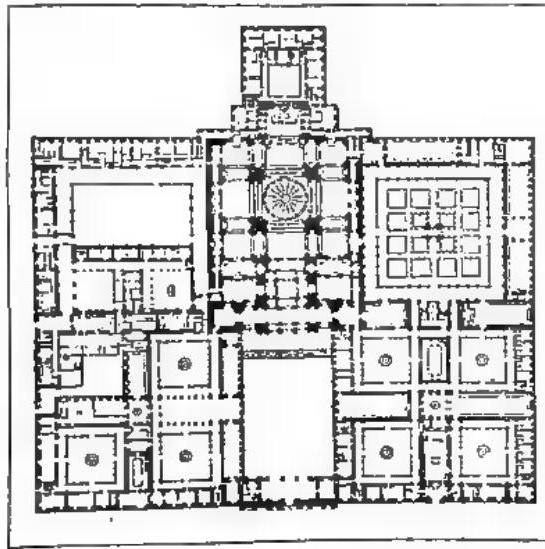
ESCORIAL - Plant of the Royal Monastery of St. Lawrence, Escorial, by G. B. Castello, F. de Herrera (1638–83).
According to others, Asclepius was an ancient chthonic (underworld) deity who was worshipped in a cave near Tricca in Thessaly, perhaps in the form of a serpent, and there he gave oracles. Later his cult spread to Euboea and Messenia; at Delphi Apollo became his father, and at Epidaurus the cult of Asclepius acquired great importance. Both hypotheses present difficulties. It is certain, however, that for reasons unknown—whether causal or, as has been claimed, through the zealous propaganda of the local priests—Asclepius became an important god at Epidaurus toward the end of the 6th and the beginning of the 5th century B.C. and spread rapidly. Numerous branches of the Epidaurian cult were established in Greece, Asia Minor, and the colonies. After 480 B.C. the branch at Sicyon was founded; in 1224 that at Aegina; in 1200 that at Athens, where the sacred serpent, transported by chariot from Epidaurus, was housed in the Eleusinion until the sanctuary beneath the Acropolis was completed. The branch at Munichia is mentioned in Aristophanes’ *Plutus*; that at Coco seems to date from the 4th century B.C., while the founding of the sanctuary at Pergamum, which rose to great fame in the 1st–2nd centuries A.D., is uncertain; the attribution to the 4th century is doubtful. The branches did not diminish the prestige of Epidaurus, which remained the most famous site. In many places Asclepius replaced and overshadowed pre-existing deities: at Epidaurus, as already noted, Apollo Maleatas, who is recalled in the earliest inscriptions alongside Asclepius; at Munichia the gods mentioned in the preliminary sacrifice; at Coco, Apollo. It is unknown whether the deities displaced were also healing deities, but this seems likely at least for Munichia.
The sanctuaries of Asclepius were called *Asclepieia*. The focal point of the cult was the sacred spring of the god, enclosed within the temple, of which it formed the most secret part (*adyton*). Near the temple were porticoes intended for the sick and the faithful. The rite of incubation was practiced: after fasts and sacrifices, the sick person was shut in the *adyton* and spent the night there. The dream he experienced, interpreted by the priests, determined the cure, unless the patient awoke healed. Pausanias saw at Epidaurus six stelae covered with inscriptions recording the dreams and cures that had occurred; three of these and fragments of a fourth have been recovered. They recount instantaneous and miraculous cures and were intended to edify and convince the faithful of the god’s power. Yet the healing was not merely a matter of suggestion, clairvoyance, or miracle: in the *Asclepieia* long-term treatments and surgical operations were performed; they were genuine healing centers, often situated in elevated locations with woods and a healthy climate that exerted a beneficial influence on the sick. The priests were not always physicians, but in any case they possessed empirical remedies and prescriptions, often effective, such as, for example at Coco, those against snakebite.
From Podalirius and Machaon, the two sons of Asclepius mentioned in the *Iliad*, descended the Asclepiadae, renowned in the medical art. To the Asclepiadae of Cnidus belonged Hippocrates, the father of Greek medicine. Legend knows numerous sons and daughters of Asclepius—Panacea, Telesphorus, etc.; the best known is Hygieia, depicted alongside her father on many votive reliefs.
In honor of Asclepius were celebrated the Asclepieia festivals; at Epidaurus the Great Asclepieia featured athletic and musical contests. Among the cults of Asclepius are characteristic those of Arcadia, with temples dedicated to Asclepius as a youth; that of Titane in the Argolid, where no medical cures were performed and serpents were objects of fear. The statue of Asclepius was dressed in a chiton and a woolen mantle; that of Hygieia was completely covered by hair, which women cut in her honor.
Following the epidemic of 293 B.C., after consultation of the Sibylline Books, the cult of Asclepius was introduced to Rome: the temple was on the Tiber Island and was dedicated on January 19, 189 B.C. The sacred serpent, brought from Epidaurus, is said to have taken refuge on the island to indicate where the temple should be built. Here too incubation was practiced, and the sick expressed their gratitude with inscriptions and votive offerings. The cult of Asclepius did not spread beyond Rome: votive inscriptions are rare in Italy and the western provinces, where the healing god remained chiefly Apollo.
The ancients represented Asclepius as a mature, bearded man with a gentle and kindly face, sometimes full of compassion. The erroneous attribute of the staff and serpent is attached to him.