
EYCK, HUBERT JAN van. — H. died in 1436, still mentioned in 1425; J., the younger brother, died in 1441. A late (?) inscription on the frame of the Ghent altarpiece is the main document attesting H.’s existence as a painter, who is said to have begun the altarpiece, completed after his death by J. J.’s life is much better documented: in 1422–24 he was a painter in the service of Count John of Bavaria at The Hague; in 1425, after the count’s death, he became “varlet de chambre” and court painter to Duke Philip the Good of Burgundy, a position he retained even when he moved from 1425–28 to Lille, and from 1430 to Bruges, where he remained until his death, and where he completed the Ghent altarpiece in 1432. For the duke he made trips to Tournai, Portugal, etc.
There are still conflicting theories regarding the Ghent altarpiece: according to some scholars it is entirely by Jan; the stylistic differences among the twelve panels are explained as deriving from the artist’s evolution during the work. According to others, who adhere to the inscription, the altarpiece was begun by Hubert and finished by the younger Jan. In this case, the division between the two brothers remains extremely difficult and uncertain. Perhaps the lower sections, with the Adoration of the Lamb, the Procession of the Knights, the Hermits, etc., are by Hubert (or partly by him). The upper and outer shutters and some repainted sections completing the lower parts would be by Jan.
In any case, with the Ghent altarpiece a new era in Northern painting begins: it is dominated—whether by one or two artists—by a plastic sense, a broad and powerful naturalism, and an individualistic expression that contrasts with the previous Gothic style and the tenderness of the so-called International Style of the early century; this should also be understood as an affirmation of the wealthy bourgeoisie of the Flemish cities, in contrast to the courtly taste of previous generations.
Depending on whether the individual parts of the Ghent altarpiece are attributed to one or the other of the brothers, it will be necessary to reconsider the attributions of earlier works. These include the Crucifixion and the Last Judgment in the Washington Gallery (formerly in Leningrad), the Three Marys at Christ’s Tomb in the Beuningen Collection, Vierhouten (formerly Cook, Richmond), the Madonna in the church and the Crucifix between St. John and the Madonna in the Berlin Gallery, all
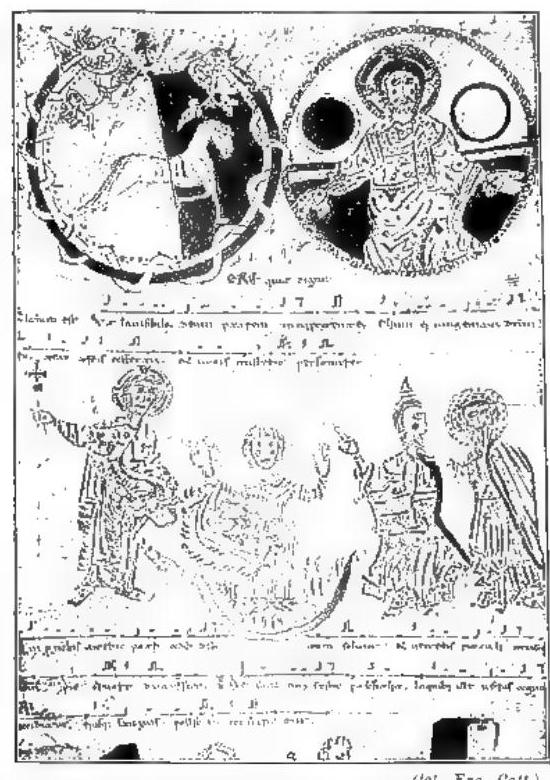
“Exultet” — Above: inside V with Alma Dei and Christ enthroned; below: Dies irae. Missal of the 12th century — Mirabella Eclano. Archivio chiesa collegiata.
BIBL.:
Nysticke, Anversa 1945; P. Jewett Mather, The problem of the Adoration of the Lamb, in Gazette des beaux-arts, 19 (1946), pp. 269–84 and 30 (1946), pp. 73–92; A. Zilber, La divorce de J. V. E., Paris 1947; A. H. Cornette, De portretten van J. V. E., Anversa 1947; L. V. Puyvelde, The Holy Lamb, Paris-Bruxelles 1947; id., The Flemish Primitives, London 1948; Th. Musper, Überstehungen zu Rogier V. d. Weyden e J. V. E., Stuttgart 1948; cf. also Flemish art: bibliography Bernardo Deghenart.