
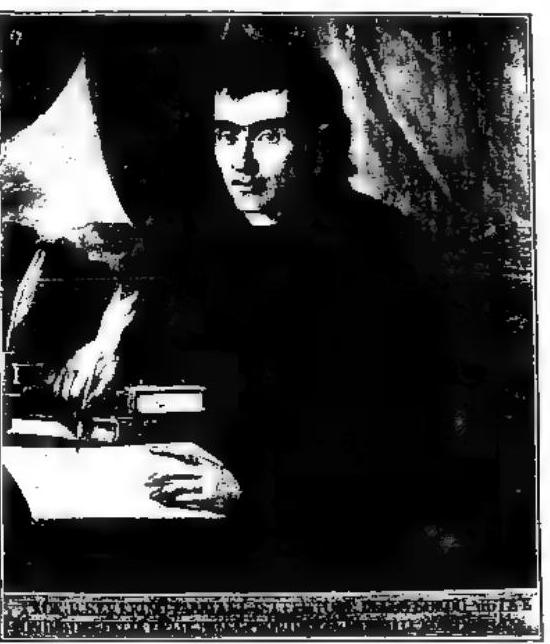
FABRI, HONORI. - Jesuit, polygraph, born at Viven-le-Grand (Ain) on 5 April 1607, died at Rome on 15 March 1688. Initially esteemed as a professor of philosophy, physics, and mathematics at Lyons (1646–60), he later became penitentiary of St Peter’s in Rome (1660–80), where, in addition to the duties of his new office, he continued to pursue his favourite natural sciences.
Quick and lively in intellect, he wrote extensively on the most varied subjects; but above all he indulged, with excessive vivacity, his marked inclination for controversy, taking an active part in the most hotly disputed questions of his time while still very young and highly probable. Mention may be made only of the *Tractatus physicus de motu locali* (Lyons 1646), the *Tractatus duo, quorum prior de plantis et de generatione animalium, posterior de homine* (2 vols., Paris 1666)—in the latter of which he records his observation of the circulation of the blood independently, albeit subsequently, of Harvey—the *Physica, id est scientia rerum corporarum* (I, Lyons 1666; II–III, 1617; IV–V, 1617).
Noteworthy among his controversial theological works, which caused a great stir, are: *Philosophus aut Dialogus de opinione probabili* (Rome 1659) in defence of probabilism; *Dialogus doctrinae moralis Societatis Iesu* (Lyons 1670), in which, following the earlier dialogue, he added others against the rigorists, such as the Dominican V. Baron and the canonist P. Fagnani, together with other pamphlets by various authors on the same subject. The work was placed on the Index in 1673 because it had been published without prior Roman censorship, and the author was sentenced to “45 days of more lenient imprisonment and 5 of slightly stricter and dishonourable confinement” (Reusch [V. BIBLICA.], p. 502). Meanwhile the *Apologeticus* went through 24 editions, expanded to twice its original size (2 vols., Cologne 1672), and included a refutation of Pascal’s *Provinciales*, as well as, under the two pseudonyms of B. Stubrock and L. Carter, some notes against G. Wendrock and L. Montalto. The work was again prohibited in 1672 and 1673, and the two series of notes likewise incurred particular condemnation (1673, 1678). Although they were attributed to him, F. always denied authorship.
Also worthy of remembrance are: *Corolla Virginea* (Palermo 1655) in defence of the Immaculate Conception; *Euphimeder, seu vir ingeniosus* (Lyons 1660) on studies in humanities and rhetoric; and, in defence of the virtues of Peruvian bark, a question then hotly debated, the *Pulvis Peruvianus vindicatus* (1655).
In the dispute over regal rights that arose between Louis XIV and Innocent XI, F. expressed the view that these were purely temporal matters; but since he had sided with the king, even though he did not admit any Gallican errors, he was obliged to resign his office as penitentiary.