
FINLAND
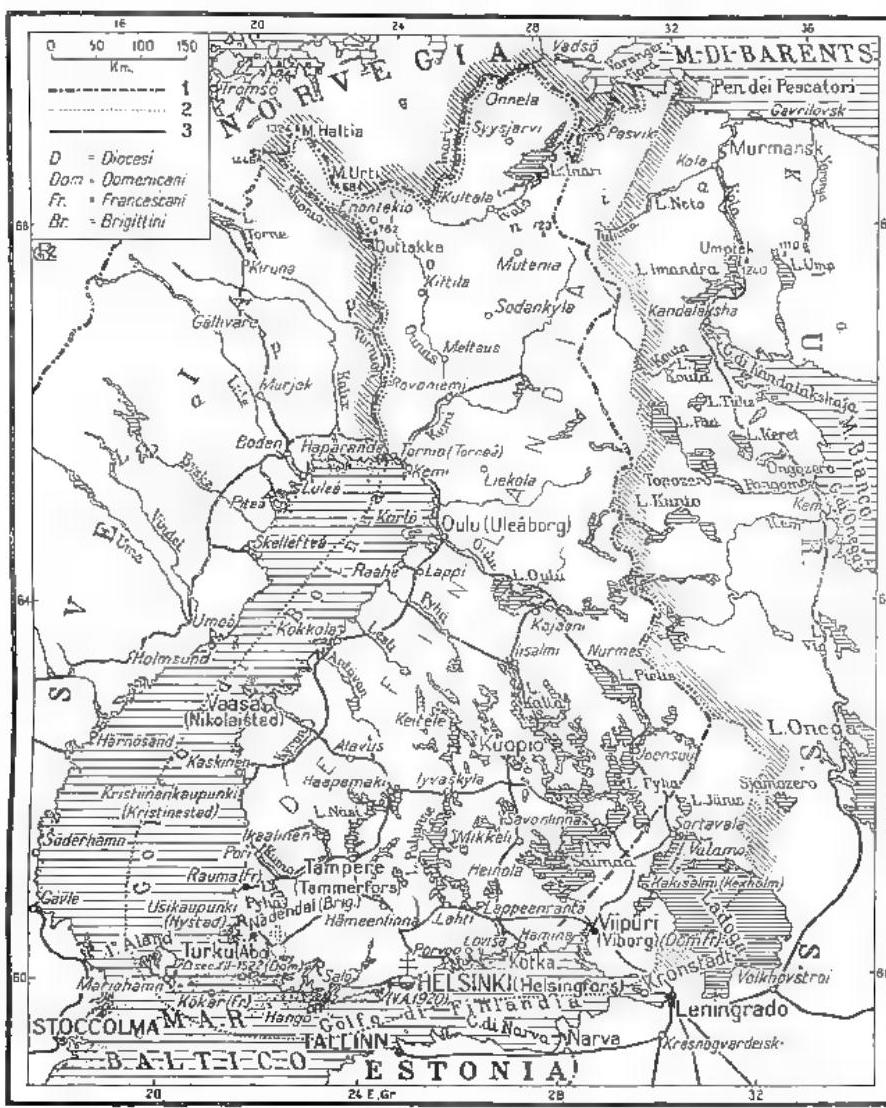
FINLAND — 1) State boundaries; 2) Ecclesiastical jurisdiction boundaries; 3) Railways.
FINKE, HEINRICH. [« Eminentemente medievale, 1853, b. at Krechting in Westphalia on 13 June 1855, d. at Freiburg in Breisgau on 14 Dec. 1938. Having studied at the University of Tübingen, he devoted himself to historical studies, especially of the late Middle Ages, in which he became a master of international renown. His studies on the Council of Constance led him to the Crown Archive of Aragon in Barcelona, where he discovered an inexhaustible mine of documents for the political, religious, ecclesiastical and cultural history of Europe in the 13th–15th centuries, much of which he made accessible through his monumental publications. Professor at the University of Freiburg (1899–1928), he trained a school of students who continued their master’s work. A lay Catholic of unblemished integrity, he took part in all manifestations of the cultural world; he was...]
a broad plain resulting from the leveling of an ancient granite upland, on which the Quaternary glaciations left a thick mantle of sediments and created a labyrinth of lake basins (over 35,000). The surface of these basins occupies one-eighth of the country, which is still covered by forest over more than two-thirds of its area.
The climate has a continental character, tempered in comparison with the neighboring Russian plain, but it becomes harsher in the northern regions where the tundra prevails (Lapland). Only 7.4% of the territory is arable land and 1.3% pasture; yet agriculture and livestock raising remain the principal occupations (60%) of the inhabitants, both pursued with modern intensive methods. The chief crops are cereals (oats, rye, barley); the cattle population allows for a large export of butter. Yet the richest resource of the country is forestry, which sustains a vigorous and flourishing industrial activity (sawmills, carpentry, furniture-making, wood pulp, cellulose), widespread especially in the southern regions. Favored by the abundance of water power but hindered by the lack of coal and iron, other industries are nonetheless important (metallurgical, mechanical, textile, chemical, etc.) and also export-oriented.
The population (4 million inhabitants; 11 per sq. km., much denser in southern Finland) is nine-tenths Finnish in origin, differentiated from the Swedes who live mainly in the southwest (fewer than 400,000 in all), to whom the use of their own language is permitted. As for religious affiliation, Lutherans make up 96.2% of the total, while Catholics number about two thousand. Only the capital, Helsinki (Helsingfors), is a large urban center (over 300,000 inhabitants); none of the other cities (Turku, Tampere,