
FIUME, Diocese of. - A city in Venezia Giulia immediately subject [to the Holy See]. It has united to it the abbatial title of S. Giacomo de Abbatia.
It has an area of 1,014.87 km², with a population of 110,000 inhabitants, of whom 108,000 are Catholics, distributed among 32 parishes served by 57 diocesan priests and 13 regulars; one seminary, 3 male religious communities, and 10 female ones (1950).
F., which arose in the Middle Ages on the ruins of ancient Tarastica and developed in the thirteenth century into a free, almost independent commune, was first under the authority of the bishop of Nola, who granted it as a fief to the lords of Duino, succeeded by the Walssee. Upon the extinction of the latter, F. passed under the rule of the House of Austria. Throughout this period, however, extending almost to the end of the eighteenth century, F. always remained under the ecclesiastical jurisdiction of the bishop of Pola.
Thus, several attempts were made to remove F. from dependence upon the bishop of Pola; one of the most serious occurred in the time of Bishop Sozomeno, who, through his intervention with the S. Sede, was then able to prevent the separation of F. from Pola.
In 1776 the city changed its political allegiance, since Maria Teresa separated it from Austria in order to attach it to Hungary, though through Croatia. But the imperial diploma did not meet with the favor of the people of Fiume, partly because they resented Croatian interference; they pressed the matter so vigorously that Empress Maria Teresa, by a new provision, in 1779 attached F. directly to the Crown of S. Stefano as a «separatum Sacrae Regni Coronae adnexum corpus». In 1787 F. was detached from Pola and united to the diocese of Segna. This political status, although it underwent various changes in the nineteenth century, was in its broad outlines that which prevailed at the time of the First World War of 1914–18.
From the standpoint of spiritual care, the ecclesiastical dependence of F. upon the diocese of Segna was not among the most fortunate, because the clergy, overwhelmingly Croatian—there were very few vocations from Fiume—although good
and conscious of its duties, had no influence whatsoever over a population of another language and another outlook.
The collapse of the Austro-Hungarian monarchy put an end to the city’s painful ecclesiastical situation. After repeated petitions from the National Council, which had been formed as the government of the city following the departure of the Hungarian authorities, the S. Sede first sent an apostolic visitor in the person of Mons. Valentino Liva to examine the entire situation. Then, when the National Council renewed its petitions, having removed F. from the diocesan jurisdiction of Segna, the S. Sede appointed Mons. Celso Costantini apostolic administrator (23 Apr. 1920), then director of the Archaeological Museum of Aquileia.
In 1920 the city was occupied by D’Annunzio, who established there the Italian Regency of Carnaro (Aug. 1920), but had to withdraw by virtue of the Treaty of Rapallo (Nov. 1920), which created the independent State of F. In 1924 this was definitively annexed to Italy, and on 25 Apr. 1925, by papal bull, the diocese
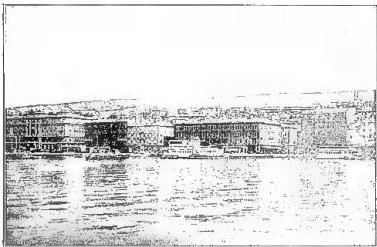
(Int. Enat)
The new diocese had the same boundaries as the province of Carnaro and was initially divided into four deaneries and rural vicariates: those of the city, Villa del Nevoso, detached from the diocese of Lubiana, and Volesca and Elsane, removed from the diocese of Trieste; later, when the territory of the province was enlarged, the deanery of Crusizza (Castelnuovo d'Istria), likewise removed from the diocese of Trieste, was added to II.