
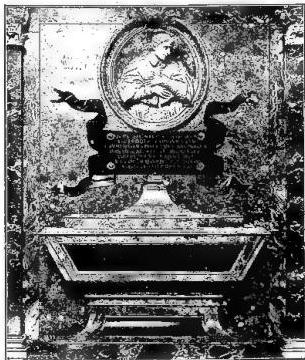
FONTANA, DOMENICO — The architect F. presented the plan of the Vatican Library to Sixtus V — Vatican Library.
including the Bigazzini (later Torlonia) palace in Piazza Venezia (1676), demolished in 1900, and the Grimani palace, now Tittoni, in Via Rasella.
His most notable activity was devoted to the construction of public buildings, under the pontificates of Innocent XII (the Customs House of the Land and Piazza di Pietra; the Customs House of the Sea and Ripa Grande; and the conversion into a seat of tribunals of the palace left unfinished by Cardinal Ludovisi at Montecitorio, which took the name of the Curia Innocenziana), and of Clement XI (the Hospice of S. Michele and the Casanatense Library). Of his activity outside Rome, we may mention the dome of the cathedral of Montefiascone, the Durazzo (later Royal) Palace of Genoa (1705), and several villas in the Sienese region; he also sent abroad designs for buildings, including one for the cathedral of Fulda.
His ingenious projects for the urban layout of the Borghi and the area around Montecitorio remained unrealized, but descriptions of them survive in his fundamental work on The Vatican Temple and in the Discourse on the ancient Monte Cittorio.
FRANCESCO, son of the preceding, b. in Rome in 1668, collaborated with his father on the Customs House of the Land and on other minor works. His is the rebuilding of the church of the SS. Apostoli, left unfinished because of his death in 1708.
GIROLAMO, son of a brother of Carlo, worked from 1690 to 1714. His principal work is the façade of the cathedral of Frascati, where he also executed the great fountain in the piazza; he was an expert in hydraulics, as attested by the construction of the aqueduct of Anzio.
CARLO STEFANO, brother of the preceding, active in Rome between 1711 and 1728. He was a beneficed abbot of S. Giovanni in Laterano, where he executed the decoration of the transept. He is remembered for the façade and the renovation of the interior of S. Clemente.
PROSPERO, painter, b. in Bologna in 1512, d. there in 1597. He was a pupil of Innocenzo da Imola, and as a young man was in Genoa, assisting Perin del Vago in the decoration of Palazzo Doria. His activity took place almost exclusively in Bologna, where he painted for various churches (Ma-
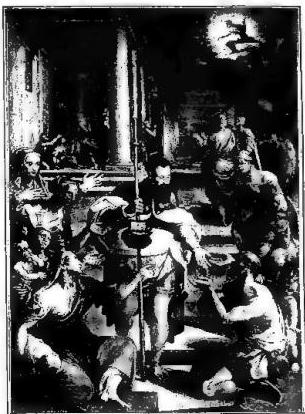
(photo by Alinari)