
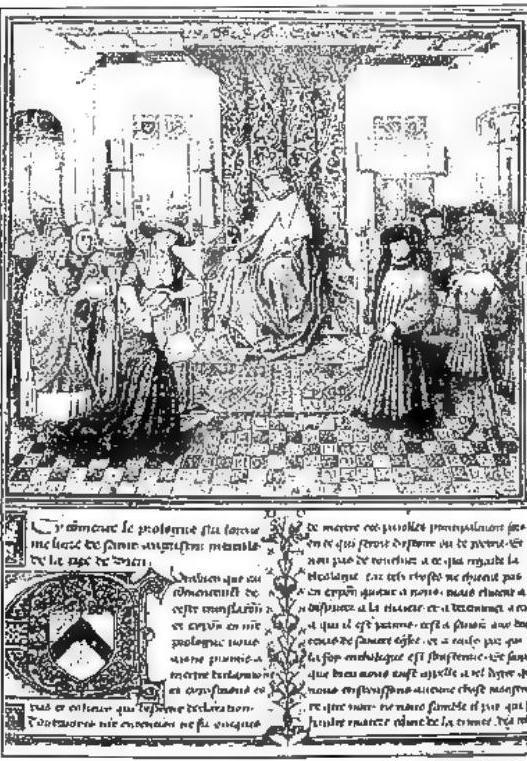
translated into French. Illuminated manuscript c. 1445 for J. Chevrol,
Bishop of Tournai, by the friar Cottin of Tournai kneeling at
the feet of the sovereign’s throne — Brussels, Royal Library, no. 901, fol. 16.
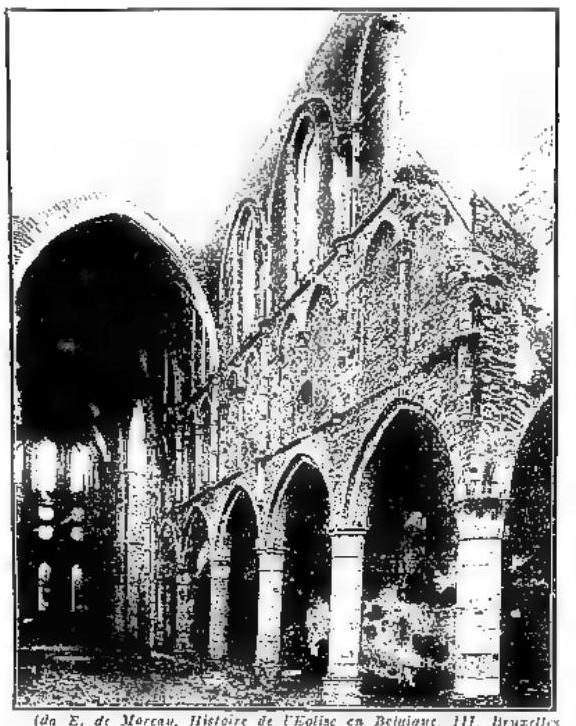
Flemish, early — Church of Villers (12th–13th c.).
d. before 1519. In architecture during the Renaissance, Italian influence grew stronger, especially in the Jesuit churches of Ghent, Antwerp, Bruges, Louvain, and Namur. Architects such as Vincent Cochem (1561–1634; church of Montignies), Pieter Huyssens (1577–1637), and Jacques Francquart (1582–1651) continued into the late Renaissance, especially in Antwerp. The architectural forms that Lombard and Floris (works at Tournai, Ghent, etc.) had prepared were further developed. The same applies to Renaissance sculpture and, consequently, to the Baroque period, which produced notable artists such as Jean Mone (late 15th c.–c. 1540), Jacques Dubrocque (c. 1500–84; works at Hal, Mons), Artus Quellinus the Elder and the Younger (1609–68; 1625–1700), the Verbruggen family, François Duquesnoy (1594–1643), active also in Rome, and Laurent Delvaux (1696–1778), influenced by Bernini.
Yet it was painting that gave Flemish art its preeminent place in 17th-century Europe. Peter Paul Rubens (1577–1640; v.)—a pupil of Otto van Veen (1558–1629)—and his greatest followers, including Anthony van Dyck (1599–1641) and Jacob Jordaens (1593–1678), formed schools and groups of artists who expressed themselves with penetrating naturalism, a strong sense of movement, and a rich, often nude palette. Among landscape painters, the Brueghels, Valckenborch, Coninxloo, and Vinckeboons deserve mention, along with Jan Frans de Momper (1564–1635), Gillis de Witte, Sebastian Vrancx (1573–1647), Roeland Savery (1576–1630), Jan Wildens (1586–1653), Lucas van Uden (1595–1672), Jan Siberechts (1627–1703), Jan Frans Rillaerts (1642–1679), and Cornelis Huysmans (1648–1727). Portraitists included Frans Pourbus (1569–1622), Cornelis de Vos (1585–1651), Philippe de Champaigne (later active in Paris; 1602–74), and Gonzales Coques (1614–84). Sacred and genre scenes were painted by Gerard Seghers (1591–1651), Gerard de Craeyer (1584–1669), Theodoor Rombouts (1597–1657), Cornelis Schut (1597–1655), Gérard Douffet (1594–1660), Theodoor van Thulden (1606–76), and Adriaen Brouwer (1605–66). David Teniers the Younger (1610–90) worked alongside artists such as David Ryckaert, Jan Craesbeeck, and Gillis van Tilborch; Abraham van der Meulen (battle painter; 1632–90) and Gerard de Lairesse (1640–1711) also contributed. Among animal and still-life painters, Frans Snijders (1570–1657), Paul de Vos, and Jan Fyt (1611–61) stand out. Important as well were the engravers and woodcut artists associated with Rubens, including Lucas Vorsterman, the two Bolswerts, Christoffel Jegher, Dirk Vellert, Pieter Pontius, and van Dyck himself. Meanwhile, the art of tapestry weaving continued in Brussels, Tournai, Oudenaarde, and Antwerp, partly based on designs by Rubens, his school, and Teniers. Stained glass was produced from designs by Dirk Vellert, and porcelain and lace were manufactured in Tournai and Brussels.
For the 19th century, only a few names can be cited: as painters of historical scenes, Gustave Wappers (1803–74), Antoine Wiertz (1806–65), Henri Leys (1815–69), and Charles De Groux (1825–70); as a naturalist painter, Alfred Stevens (1823–1906); as an illustrator, Félicien Rops (1833–98); and as a sculptor exploring new social themes, Constantin Meunier (1813–1905). James Ensor (1860–1948) emerged as a leading figure in modern painting and graphic art. Among the sculptors, mention should be made of George Minne (b. 1866). Architecture, after the historicism of Léon Suys and Joseph Poelaert, turned toward Holland, Germany, and France with Henry Van de Velde, Victor Horta, Paul Bourgeois, and Octave van Rysselberghe. V. plates LXXXI–LXXXII.
The mission was in full development when the revolution of 1947 halted its progress, destroying 117 churches and about fifty houses and schools. The area covers 68,000 sq. km with a population of about 650,000, of whom, in 1948, approximately 184,608 were Catholic, 95,000 Protestant, and 350,000 pagan. There are 71 Jesuit missionaries, including one Malagasy and over two indigenous diocesan priests. There are 37 lay brothers, 17 of them Malagasy, and 103 sisters, 32 of them Malagasy. Catechists number over 750, and of the 300 teachers, many are university graduates. There are 26 districts, 1 Lenten parish, 800 secondary schools, and over 220 churches. Three periodicals are published with regional circulations. There are 140 elementary schools with 9,443 pupils; 120 middle schools with 10,285 pupils; and 11 higher schools with 4,253 pupils. Various charitable works are active, and Catholic Action is organized.