
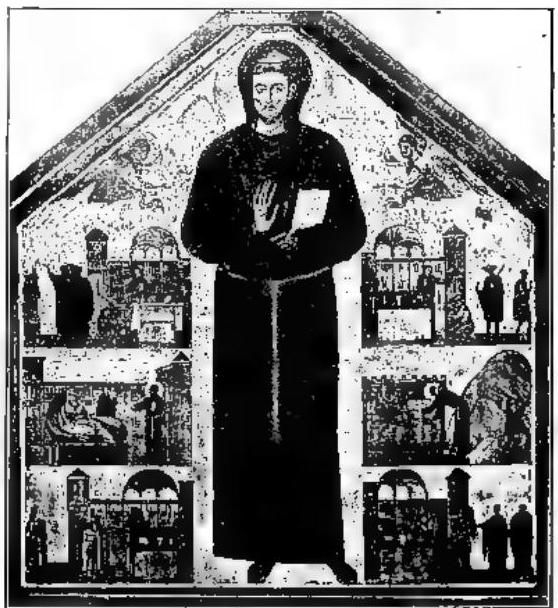
FRANCIS of Assisi, saint — Image of St F. flanked by scenes from his life. School of Giunta Pisano (c. 1250). Pisa, church of S. Francesco.
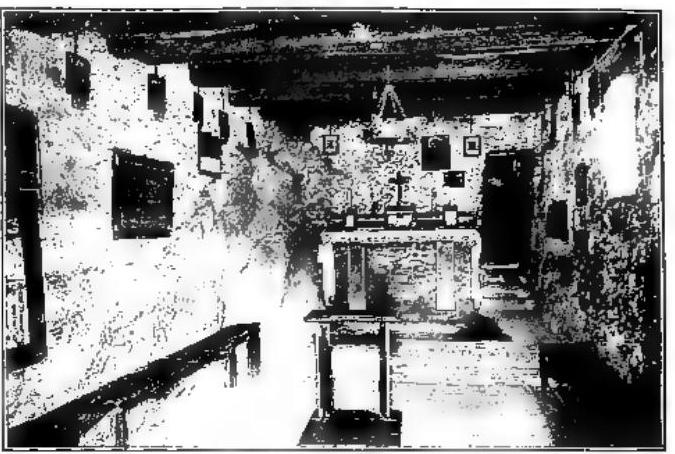
FRANCIS of Assisi, saint — The oratory of the cells with, at the far end, the cell of St F. — Cortona, Celle.
VI. The final years. The stigmata. — St F., a type too ideal and perfect, soon felt himself unequal to personally directing the vast movement he had founded, and already after the disturbances of 1220 (q.V. Friars Minor), he had resigned the office of superior or Minister General of the Order, instituting at the Chapter of 1220 a vicar, Brother Peter Cattani, who died in 1221, whereupon he elected Brother Elias to succeed him. From that moment, though he always retained great personal authority within the Order, deriving from his role as founder, he increasingly withdrew from direct administration, devoting himself more to his mystical life, marked above all by mortification, renunciation and sacrifice in imitation of Christ. Thus it was that in 1224 he attained the ineffable miracle of La Verna, the sacred mountain that had been given to him in 1213 by Count Orlando of Chiusi, where “from Christ he received the final seal, so that his limbs bear two weapons”: the stigmata.
After the miracle of La Verna, F. lived two more years; but his body, already weakened by continual fasts and harsh penances, was tormented by incessant pains of stomach and liver, to which was added a most troublesome eye disease that reduced him to almost total blindness. In vain he sought relief in the valley of Rieti, filled with so many painful memories, such as the dear solitude of Fonte Colombo, where he had composed the Rule of 1223, and the wood of Greccio, witness to the first representation of the Nativity on Christmas night 1223. Nor did gentle Siena avail him, nor the retreat of the Celle at Cortona, where he was struck down by dropsy, so that foreseeing the approach of “sister death,” he had himself carried once more to his native city, to end his religious life where he had begun II. He longed to go straight to his beloved Porziuncola, but yielded to the insistence of his sons, who wished to take him to the bishop’s residence for better care.
VII. Death
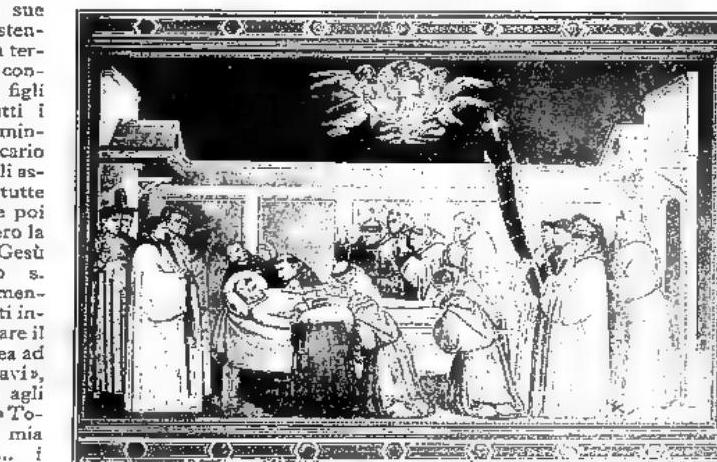
Filled with spiritual joy at the prospect of death and eager to meet it at S. Maria degli Angeli, he ordered his companions to carry him there, and there prepared for his serene passing with all the affection of his great soul. The incomparable Little Flowers of St F., the most precious jewel of popular literature of the 14th century, has preserved the text of the saint’s blessing upon his beloved native city, which he beheld for the last time.Before dying he wished to see his great Roman benefactress Giacomina dei Settesoli, whom he was wont to call “Brother Jacopa,” and for this purpose he had a letter sent to summon her. While means were being sought to dispatch the letter, the noblewoman arrived unexpectedly at the Porziuncola with her sons and other companions, thus being able to attend the passing of the Saint. For his living and future friars he composed his testament, in which he summed up all his earlier exhortations on the Catholic faith and the observance of the Rule, especially regarding poverty, his mystical spouse: “he commended his dearest lady and commanded that they love her faithfully” (Dante, Par., XI, 123). Finally, on 3 Oct., desiring to die naked like Christ, he had himself stripped of his poor garments and laid upon the bare earth; then, taking leave of his sons, he blessed all present, beginning with the vicar of the Order, and thus departed to be present in all nations. He then asked that the Passion of Jesus Christ according to St John be read to him; and with those present he began to recite the psalm “Voce mea ad Dominum clamavi,” proceeding as far as the final verses: “Take my soul out of prison... the just wait for me,” whereupon his earthly tongue fell silent forever; that most holy soul, freed from the flesh, was absorbed into the abyss of eternal light, and his body fell asleep in the Lord (I Celano, 110). At the moment of his passing, according to the testimony of St Bonaventure (Leg. maior, 14), a flight of larks came to rest upon the little roof of the Porziuncola, then took flight at dusk, filling the horizon with their trills. When the devotion of the friars and the people who had come to venerate the body of this saint was satisfied, on the following morning (4 Oct.) the precious remains were borne in triumph to the city, the funeral cortege pausing before the little convent of S. Damiano so that Clare and her daughters might gaze for the last time upon the face and sacred wounds of their Father. Then the procession moved slowly on, and the sacred body was temporarily interred in the church of S. Giorgio.
VIII. CANONIZATION AND CULT
Scarcely two years had passed since his death when, on 15 July 1228, Gregory IX, the great friend and protector of F., coming from Perugia (where the papal court was then temporarily resident), canonized the Poor Man of Assisi in the church of S. Giorgio, himself delivering the eulogy of the Saint and fixing his feast for 4 Oct. The next day the Pope himself laid the first stone of the great basilica (S. F.) intended to receive the Saint’s remains, entrusting its care to Brother Elias. The lower church was already ready in 1230, and on the occasion of the General Chapter specially convened at Assisi, the solemn translation of the Saint’s body took place on 25 May. As the exact site of the seraphic saint’s tomb had with time been forgotten, after futile attempts in 1570, 1607 and 1806, it was finally rediscovered in 1818 and the relics subjected to examination. Without removing the urn, the crypt was opened and the tomb adorned with bronze and marble.Especially solemn were the last Franciscan centenary commemorations: that of his birth in 1881 and that of his death in 1926, on which occasion Pius XI issued the encyclical Rite expiatis (AAS, 18 [1926], pp. 153 ff.). Benedict XV had already declared him in 1916 patron of Catholic Action, and Pius XII, on 18 June 1939, designated him “principal patron of Italy together with St Catherine of Siena.”
The *Alcoranum Franciscanorum seu blasphemiarum et nugarum Lerna de stigmatizzato Idolo quod Franciscum nominant* (Frankfurt 1542), a book that enjoyed wide diffusion in various editions, poured scorn upon him. He was likewise despised by the encyclopedists and rationalists of the 18th century; Goethe, in his Italian Journey, records that he did not wish to see the basilica of St F. In the Romantic reaction of the 19th century, St F. was reevaluated, especially by J. Görres, from a new perspective, above all as a poet and troubadour.
From that time onward Franciscan literature has continued to multiply; it found an ardent and able cultivator especially in Paul Sabatier, who may be said to have given a new scholarly direction to studies on the life and soul of the Poor Man of Assisi.
X. THE FIGURE OF ST F
He is one of those gigantic figures of history that appear rarely, destined by God to effect a marvelous spiritual reversal in society. After seven centuries he still lives in the soul of the peoples, indeed his profile grows ever greater day by day, thanks to his fruitful apostolate of gentleness, simplicity and evangelical poverty, founded on love and universal brotherhood. He walked the earth as an “alter Christus,” embodying the divine figure of the Saviour as was granted to no other saint, rising moreover to become the prototype of the Italian race for his gentle, intelligent, simple and poetic character, so that some modern writer has ventured, perhaps with debatable exactitude, to say: “F. is the holiest of Italians and the most Italian of saints.”Batt.: I. Ponti; a) Writings of St. Francis. The authentic parchment documents are reduced to the following: two Rules of the Friars Minor (one long from 1221 and the definitive one from 1221); the Testament; some fragments inserted in the Rule of the Clareni; 24 Admonitions; the Salutatio virtutum; the short work De religiosa habitatione in eremo; 6 letters; and the prayers: Laudes Dei, Laudes Domini, Salutatio B. Virginis, the Office of the Passion, and the Canticle of Brother Sun. The first edition was