
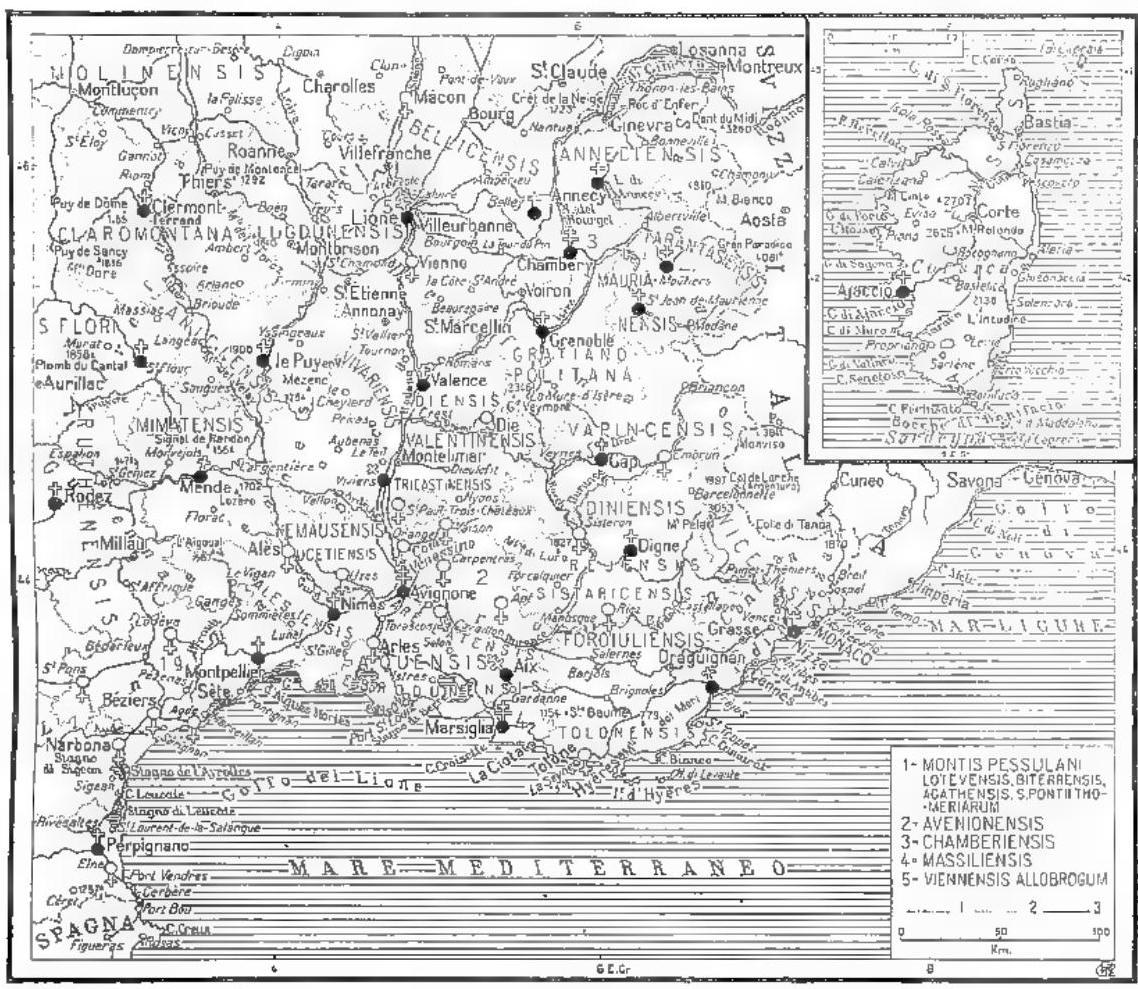
FRANCE — F. of S.-E. — Ecclesiastical Circumscriptions. 1) Provincial boundaries; 2) Boundaries of ecclesiastical circumscriptions; 3) Railways. Top right, map of Corsica.
**
He sought to provide for the development of his family state on the Lower Rhine. Subsequently, the history of France in the 15th century was marked by disasters and turbulence; from 1415 to 1429, the Hundred Years' War resumed with a slow recovery until 1453, followed by a period of arduous reorganization in which absolute monarchy, the high nobility, and the Estates-General were pitted against one another. This difficult and laborious work, pregnant with future developments, was abandoned at the end of the century in pursuit of the ambitious dreams of the Italian campaign and European primacy, which, after 66 years of war, left France defeated and the monarchy weak and discredited.
Upon the death of Philip of Burgundy in 1404, uncle of the king and de facto regent, his son John was sidelined by Louis of Orléans, brother of the king and husband of Valentina Visconti, a poor administrator himself. On 23 November 1407, he fell victim to an ambush by the Burgundian cousin, who took control, favoring Paris and its merchants, thereby provoking a reaction from the nobility, which rallied around the sons of Orléans under the leadership of the Count of Armagnac, from whom the faction took its name. A long civil war ensued, while in Paris the arrogance of the mob and the butchers' guild under their leader Caboche led to a reaction that handed the city to the Armagnacs.
Upon this bloodied and divided France fell the English invasion of Henry V, who sought a diversion from his domestic difficulties through a popular and successful war. For 14 years, French disasters followed in quick succession: the fall of Harfleur, the defeat at Agincourt (1415), the fall of Rouen, the assassination of John, Duke of Burgundy, and the subsequent Treaty of Troyes (1420), by which the king disinherited the Dauphin Charles and recognized Henry V as his heir, betrothed to his daughter Catherine. The new Duke of Burgundy adhered to the treaty, so that all the territory south of the Loire, including Paris, fell into English hands. In 1422, upon the death of both kings, the Dauphin (Charles VII) was proclaimed at Bourges, and the infant son of Henry V was proclaimed at Saint-Denis as king of France and England.
In 1429, France was at its lowest ebb: the English prepared to cross the Loire at Orléans when a young maiden, Joan of Arc, convinced by her visions of a divine mission to save France, went to Bourges, shook the king and his court from their lethargy, and led an expedition to Orléans, routing the English. She then escorted the king to Reims for his coronation. Though captured by the English and burned as a witch, she truly initiated France’s recovery, so that by 1453 only Calais remained under English control.
From these ruins, the monarchy rose to new prestige, using it to establish a royal and absolute administration, free from the constraints of feudal rights, municipal privileges, and the Estates-General. It now possessed its own finances, army, and justice superior to that of the feudal lords, along with control over local administrations. The Concordat of 1516, while satisfying the papal desire to suppress the *Praemunire* of Bourges with its Gallican and conciliar principles, placed the Church of France in the hands of the monarchy, which presented candidates for bishoprics and abbeys for papal investiture. Thus, there were 92 bishoprics, 527 abbeys, and other priories, enabling the king to reward ministers with rich prebends, favor younger sons of noble families, and even foreign diplomats. Moreover, by incorporating younger nobles into the new militias that Charles VII created in 1445 to replace the old mercenary companies, the king curbed the restlessness of noble families, while the greater nobles were removed from the provinces and made courtiers dependent on the king, thus saving them from economic ruin.
It would fall to Louis XI (1461–83) to engineer the downfall of the high nobility, to whom provinces had been distributed as appanages for royal cadets. He responded to the deceitful methods of his former companions with equally false and cruel tactics to evade the obligations imposed upon him and the promises extorted from him by their rebellious coalitions, even when they were called the League of the Public Weal. His tragic duel with Charles the Bold, Duke of Burgundy, who dreamed of an independent kingdom between France and the Empire, ended at Nancy (1477) under the pikes of Swiss mercenaries secretly paid by Louis XI. Louis absorbed the French territories of Burgundy and gradually reconstituted the territorial unity of France, reclaiming Maine and Anjou, wresting Normandy and Guyenne from his brother, exterminating the houses of Armagnac, Alençon, Nemours, Saint-Pol, subduing the Duke of Brittany, and occupying Artois, the Franche-Comté, the Charolais (which Charles VIII later foolishly returned), Picardy, and the counties of Burgundy and Boulogne, most of which were already Burgundian. Having tamed the nobility, he imposed his will on the Estates-General, convening them ever more rarely. Thus, when in 1484 his daughter Anne of Beaujeu, regent for the minor Charles VIII, disregarded a proposal to limit the *taille* (which had become the monarchy’s main source of revenue and was arbitrarily set by the king), the monarchy, secure in its revenues, could truly be called absolute.
Though beset by internal resistance and the Burgundian threat, Louis XI did not cease intervening abroad. Indeed, Charles the Bold’s aggressiveness spurred him to counter such actions by every means, in Switzerland, Lorraine, and Italy, reducing the Duchy of Savoy to a kind of vassalage, though it resisted under its regent, his sister Yolande. He also interposed between Florence and Naples and frequently asserted his influence in Rome, using both the Pragmatic Sanction and ecclesiastical ordinances. He occupied the Cerdagne and Roussillon as security for a loan and aspired to Catalonia. After the death of Charles the Bold, this policy became even more assertive, though without direct intervention. His death came as the inheritance of Provence, which brought him the ports of Marseille and Toulon, confronted him with Mediterranean issues.
During the regency of Anne de Beaujeu (1483–91), she was forced to suppress new revolts by the high nobility but still managed to secure the duchy of Brittany for the Crown through the marriage of the young king to the heiress of the duchy. It would be the young and romantic Charles VIII (1483–98) who would cross the Alps in pursuit of the dream of conquering Naples (as heir to the Angevin claims) as a stepping stone to Jerusalem.
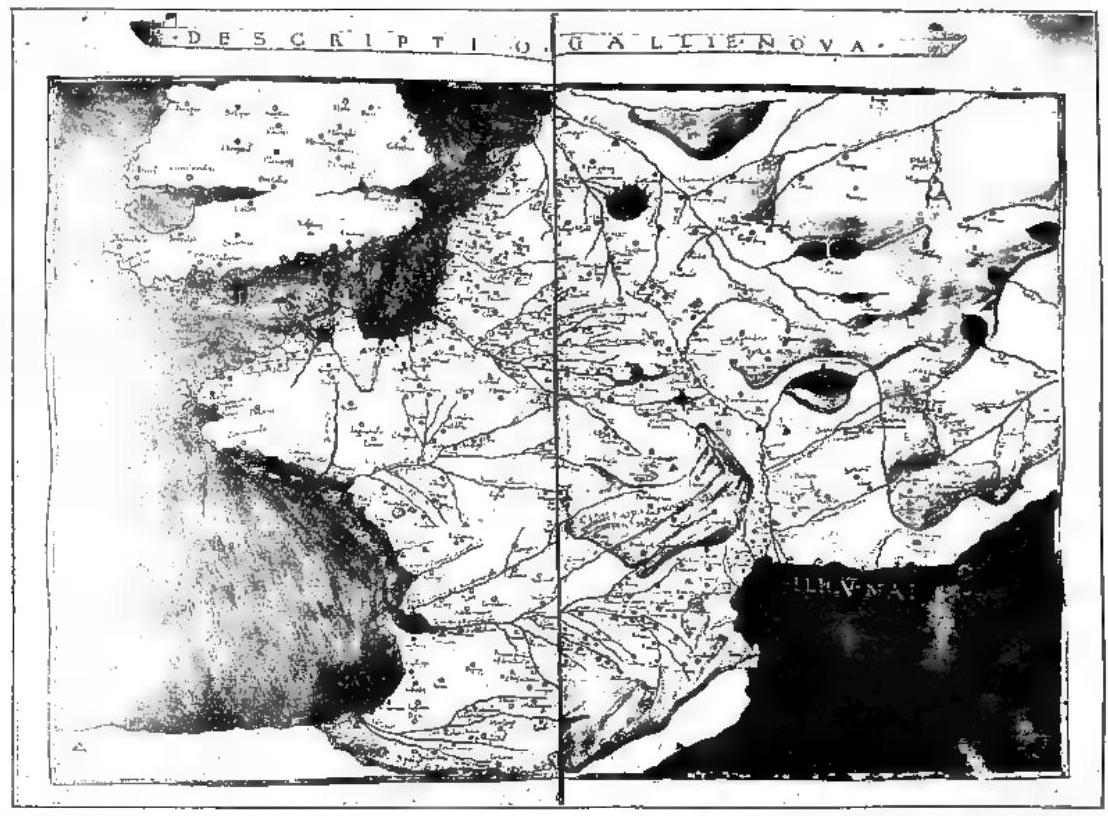
France — Map by Jacopo Angelo da Scarperia (1472) — Biblioteca Vaticana, Urb. lat. 277, f. 123v–124r.
CONSTANTINOPLE. Once the Breton crisis had been liquidated with the disastrous concessions already noted, Charles VIII, from Senlis in May 1493, sent his embassies to the Italian states to request their cooperation. In Italy, no one believed in the expedition, and the responses were evasive—except for Milan, which, on account of Genoa, was almost a vassal. The king’s childish obstinacy overcame internal opposition, and by July 1494, fighting had already broken out at Rapallo, with Genoa serving as a French base. In October, the French army was in Piedmont, and by early November, in the Lunigiana under Sforza control, easily crushing Florence’s resistance because the city was traditionally pro-French, even though Piero de’ Medici had aligned himself with the Aragonese of Naples. After extorting money from Florence, the march proceeded easily to Rome: on 22 February, the king entered Naples without ever having fought a real battle.
The Italian states now realized their mistake in revealing their political and military weakness and, urged on by Venice and the Aragonese (who feared for Sicily with Naples under French control), formed an Italian and European league. The king had to return to France with the intention—maintained until his death—of returning to Italy. Unfortunately, the French monarchy committed itself so thoroughly to this course that, to the detriment of its true interests, it united all of Europe against itself, a coalition that persisted until 1559. His successor, Louis XII (1498–1515), as the grandson of Valentina Visconti, immediately organized the conquest of Milan with the help of Venice and Alexander VI. Milan was soon occupied, and France thereby held the key to Italy, but Louis XII repeated Charles VIII’s error by aspiring to Naples. The southern kingdom was quickly occupied and partitioned with Aragon, but it was soon lost once the first rivalries arose, and Louis XII thus convinced Spain that Naples could not remain Spanish with Milan in French hands.
Louis XII’s Italian policy continued against Venice with the League of Cambrai, but Venice’s resurgence led to that anti-French coalition which was logical in European terms, the expulsion of the French from Milan (1512), and the invasion of France by the English and imperial forces. By 1515, on his deathbed, Louis XII saw all his conquests lost.
His cousin and successor, Francis I of Valois-Angoulême (1515–47), regained Milan with the victory at Marignano (1515), but only for six years, for the war with Spain—now an instrument of Charles V’s imperial ambitions—was reopened, and France would lose Milan forever. New expeditions failed, and the most serious defeat was that at Pavia (1525), after which Francis I, taken prisoner, in order to regain his freedom renounced Italy and Burgundy. Later, to save this province, he made use of the League of Cognac (1526) with the Italian states as a scarecrow, ultimately abandoning his allies in the Peace of Cambrai (1529).
Italy was already lost, even though in 1536 Francis briefly occupied Piedmont under the pretext of his mother Louise of Savoy’s inheritance. The struggle against Charles V’s universal ambitions shifted from Italy to the Low Countries due to the resolute neutrality of Venice and Paul III, despite French intrigues, and France, in search of balancing allies, had to turn to the Ottomans, their corsair fleets in the Mediterranean, and the German Protestant princes who curbed the imperial power of Charles V. Thanks to a balance of forces, France was not invaded by the Emperor, but the final attempts of Francis I and his son Henry II (1547–59) came to nothing. At Cateau-Cambrésis in 1559, the agreements of thirty years earlier at Cambrai were confirmed; the Italian territories occupied in Corsica, Tuscany, and Piedmont were definitively evacuated, and the only improvement was the recovery of Calais and the occupation of Metz, Toul, Verdun, and the marquisate of Saluzzo.
To the ruinous wars was added poor administration. Louis XII had sought to lighten taxes and remove injustices, earning the title of “father of the people,” but under Francis I, the needs of war were compounded by those of a dazzling and extravagant court that traveled constantly with a retinue of more than ten thousand horses. The budget, despite the introduction of the *taille*, struggled to balance even in ordinary years, and because war was almost constant, recourse was had to loans, especially from Italian merchants in Lyon, and to the disastrous sale of offices, which were multiplied for this purpose and later made transferable—thus providing immediate capital but permanently depriving the state of the corresponding revenue. The tax burden, the debasement of currency that reduced the value of censuses and wages, disrupted economic life. By the end of the period, there was growing discontent over economic hardship and the increasing centralization of administration, which, though not always beneficial, nonetheless disturbed established habits and interests.
The Italian wars and the Peace of 1559 were followed in France by forty years of unrest and civil wars that took on a religious guise—that is, struggles between the Reformed (Huguenots) and Catholics—but in reality these wars had far more complex origins, such as the discredit of the defeated monarchy and the weakness of the government under three minor or virtually minor kings (Francis II [1559–60], Charles IX [1560–74], Henry III [1574–89], the three sons of Henry II). This weakness allowed the feudal lords to attempt a revanche against the monarchy by using religion as a pretext, while the monarchy pursued a policy of tolerance and balance between the two factions. The French monarchy lacked the interest in the Reformation that German princes had in seizing ecclesiastical property, since the king could dispose of such property in other ways, and there were no true ecclesiastical principalities in France. Even Francis I, though allied with the German Protestants, after an initial uncertain stance later became severe and suspicious toward the Reformed, many of whom were forced into exile, including John Calvin.
The Reformed party, which had initially spread among the discontented lower classes, changed character when in 1558–59 the Bourbons and the Condés—representing the last branch of the royal family besides the reigning line—joined II. This occurred after the marriage of Anthony of Bourbon (brother of Louis of Condé) to Jeanne d’Albret, queen of Navarre, and from this adhesion the party took on a political character, representing a revival of the feudal struggle against the monarchy. It demanded not only freedom for the new cult but also recognition of the rights of the princes of the blood, particularly in opposition to the Guise dukes, of Lorraine origin, who, thanks to the prowess of Marshal Francis, dominated the government and led the Catholic party. During the minority of Charles IX, the regent Catherine de’ Medici (who ended up hated by both parties and whose Italian origins were constantly reproached) issued a conciliatory ordinance at the Estates General of 1560. But in 1562, a serious incident provoked by the Guise at Vassy sparked the civil war. The Peace of Amboise (1563) and that of Longjumeau (1568) were merely truces. After the Peace of Saint-Germain (1570), the Calvinist leader Coligny sought to win over Charles IX by proposing
After Philip II’s conquest of rebellious Flanders, the brief episode of the Huguenots with the monarchy was tragically interrupted by the massacre of St Bartholomew’s Night (24 Aug. 1572), in which, with the king’s consent, numerous Huguenots were killed on the charge of plotting against the crown. This was followed by a new civil war and an anti-monarchical stance among Calvinists, and the vain peace of 1576, because the great majority of the French and the States-General were opposed to the edicts of toleration. The civil war worsened when, in 1584, the king’s brother died childless, making the succession pass to the Huguenot Henry of Navarre. The Catholic League, led by Henry of Guise, accepted the declaration of Pope Sixtus V that Navarre, as a heretic, could not succeed to the throne; in Paris it assumed a hostile attitude toward the king himself, who had Guise assassinated in his rooms at Blois on 23 Dec. 1588. In retaliation, on 19 Aug. 1589, Guise’s adherents murdered the king under the walls of Paris while he was besieging the city with Henry of Navarre.
Though designated by the dying king, Henry IV (1589–1610) was only partially recognized in Paris; he invoked the aid of Philip II and received a Spanish garrison. Four years of confused warfare followed, but slowly the national sentiment prevailed: Henry IV, already convinced of the necessity of conversion, abjured in 1593 and was crowned king the following year in Paris. The war now turned against Spain, which in the Peace of Vervins (1598) confirmed the frontiers of 1559; shortly before, the king had issued the Edict of Nantes (30 Apr. 1598), granting the Protestants freedom of conscience and limited worship, and as a guarantee the possession of certain strongholds, including La Rochelle—a political concession that Richelieu would later restrict as dangerous. With a firm hand Henry IV restored the royal authority that had declined, repaired the damage of civil war, improved the finances, reduced the taille, fostered industry and colonization in America, and by renouncing Saluzzo obtained from Charles Emmanuel of Savoy the Bresse and the Bugey (1601). Once the major wounds were healed, France returned to its old dream of European primacy; the resistance of German Protestants to Catholic advances offered an opportunity for revenge against the Habsburgs. Yet the very idea of agreements with Protestants alarmed Catholics, and the king fell victim to a fanatic (14 May 1610), leaving as heir a nine-year-old boy (Louis XIII, 1610–43) under the regency of Queen Marie de’ Medici.
With the disappearance of so great a personality, policy became weak toward the nobility and the Huguenots, who grew more insolent, while the treasury was squandered to placate discontent. The States-General—“the augurs of misfortune” for the monarchy—were summoned, and the government fell under the sway of the queen’s Florentine favorites, chief among them Concini, husband of one of her ladies. In 1617 the young king freed himself by having Concini assassinated and banishing his mother, only to fall under the control of incompetent and dishonest men. Abroad, France drew into close union with Spain, arranging even the marriage of the king to Philip III’s daughter, and witnessed in its early phase the Thirty Years’ War and the imperial triumphs. Only with the advent of Richelieu in 1624 did France acquire a government and a policy of its own, which Louis XIII, though weak, had the merit of supporting against the entire court. Richelieu resumed the methods of Henry IV, subduing the feudal lords, the Huguenots, and the Parlements, and crushing without pity the intrigues of the queen mother and the king’s brother. In foreign policy he gradually resumed the struggle against the House of Austria, first expelling it from the Valtellina, then installing a French prince (Gonzaga-Nevers) in Mantua and Casale, and securing from the Savoys the cession of Pinerolo to gain a foothold in Italy. Later, though a zealous bishop of Luçon and an effective polemicist against the Protestants, he did not hesitate to use them on the political plane to counter imperial absolutism, first aiding the Swedes and then intervening directly in Germany and the Low Countries. His policy was then brought to a successful conclusion by Cardinal Mazarin, his successor after Mazarin’s death in 1661 and that of the king in 1643, during the regency of Anne of Austria. With the Peace of Westphalia in 1648, the Empire ceded to France Alsace (except Strasbourg) and recognized the semi-independence of the German princes. After successfully ending the German war, Mazarin still had to overcome the war with Spain and the opposition of the Parlement of Paris to new taxes, which degenerated into a genuine popular revolt; once this was quelled, he faced the opposition of the princes when he had the Prince of Condé arrested for claiming to be arbiter of the government (the Fronde parlementaire). Mazarin had to go into exile (1651–53) and returned only when the discord among his enemies and the steadfast confidence of the queen mother allowed him to do so. He then sought to repair the grave losses caused by the Fronde and succeeded, with the alliance of England under Cromwell, in forcing Spain to the Peace of the Pyrenees (7 Nov. 1659), which gave France the Cerdagne and the Roussillon, most of Artois, and towns in Flanders, while the marriage of Louis XIV to the Spanish Infanta, Maria Theresa, virtually mortgaged the Spanish inheritance. Two years later Mazarin died (1661), leaving France in the first rank in a Europe half-destroyed by war.
With Louis XIV (1643–1715), the great century, the golden age of France, is realized: not only does the power of Louis XIV dominate Europe, but the court of Versailles, with its splendor, serves as the model for European courts; French fashions are imposed everywhere, and literature and culture are celebrated and imitated in all learned circles of Europe. The reign of Louis XIV (a man of high intelligence and remarkable energy) began with great triumphs but ended disastrously because of the continuous wars that provoked ever-growing coalitions against him. In the first war against Spain, he obtained Flemish cities, including Lille; in the second against Holland, he secured in the Peace of Nijmegen (1678) Franche-Comté, and then, during the peace with the Chambers of Reunion, he occupied new cities, including Strasbourg (1682). These and other pretensions, including the bombardment of Genoa (1685), prompted the League of Augsburg (1688–97), which forced Louis XIV to return much of what he had occupied. In the final war, the War of the Spanish Succession (c. 1703–13), by accepting the Spanish throne for his grandson Philip V, he found almost all of Europe arrayed against him and was compelled to sue for peace, accepting the dismemberment of the Spanish dominions in favor of Austria (Utrecht, 1713). In 1715, the king died, leaving behind a five-year-old great-grandson under the regency (1715–1723) of the Duke of Orléans.
Internally, in economic life, despite the initial efforts of the great minister J. B. Colbert, France was in ruinous condition. Royal despotism had suppressed all autonomy and freedom. In religious matters, not only had the Edict of Nantes (18 Oct. 1685), which regulated relations with the Reformed, been revoked, but its enforcement through military means was attempted, provoking the exodus of thousands of Frenchmen. Relations with the Holy See were repeatedly strained by the arrogance of Louis XIV, particularly in 1662 under Alexander VII regarding the Corsican Guard incident in Rome and again in 1687 concerning the so-called privileges of ambassadors, which the king refused to relinquish despite the abuses they had occasioned and the renunciation of other powers. Far more serious, however, were two theological controversies that agitated public opinion. The first was that of the famous Gallican Liberties, which sought to limit papal authority and, as a consequence, its infallibility. Reopened since 1651, it culminated in March 1682 with the proclamation by the Assembly of the French Clergy of the Four Articles, promptly sanctioned by the king. The second controversy, distinct from the first, was that of Jansenism (v. GIANSENIO and GIANSEVASIO), which, through its various phases and condemnations, drawing support from the Four Articles, contributed to the disruption of ecclesiastical discipline and the due dependence on the Holy See. Nor should the struggle against Quietism (v.) be forgotten. The seventy-year period from the death of the “Great King” to the Revolution was nothing but a continuous slide toward the final crisis.
The ever-graver decline of the monarchy through unsuccessful wars, the scandalous life of Louis XV (1715–74) and the morals of the court, and the disastrous financial policies—while public opinion increasingly embraced the conviction that a necessary renewal of the political and social constitution was required—drove France toward a catastrophic collapse. Yet France remained the center of Europe in art, literature, philosophy, and fashion; its influence was immense in every field, despite the decline of its political prestige. The War of the Polish Succession, intended to place Stanislas Leszczyński, father of the queen, on the throne, failed in its aim but secured for France the temporary cession of Lorraine (Nancy) to Stanislas, while in Italy it forced Austria to relinquish Naples and Sicily; the latter, in the War of the Austrian Succession, which was disastrous, served only, as was then said, to benefit the King of Prussia, who gained Silesia. In the third war, the Seven Years’ War, the reversal of alliances, attributed by public opinion to Madame de Pompadour, cost France Canada, Senegal, and Louisiana. Shortly afterward, to counterbalance English predominance in the Mediterranean, Corsica was occupied (1768). Public opinion grew ever more hostile due to the scandals of the king’s private life, the extravagances it occasioned, and the weakness of foreign policy, in which, ensnared by Austrian intrigues, he allowed the first partition of Poland to occur. Criticism of the old constitution, the remnants of feudal privileges, intensified in literature, while the Third Estate aspired to a share in government proportionate to its economic importance.
Great hopes were placed in Louis XVI (1774–92), but his good and honest nature did not match his intellect or will, and the task of reforming a state so disordered was enough to daunt even Henry IV. The king’s defects were exacerbated by Queen Marie Antoinette of Austria, who, though not guilty of the crimes attributed to her in libelous pamphlets, was frivolous, fond of luxury, and prone to meddle in politics to favor her friends or the interests of her House. Among the new ministers, Turgot was honest and capable, with a high degree of economic competence, but