
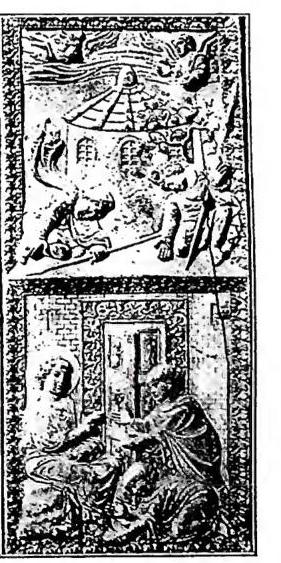
from A. Grabar, *Martyrium*, Paris 1943, Album, pl. 16, no. 1
Gendus, British Museum.
à Jerusalem, ibid., new series, 11 (1914), pp. 71-94; H. Vincent-F.-M. Abel, *Jerusalem*, II, 1, Paris 1914; II, 2, 1922; III, 2, 1926; F.-M. Abel, *La sculpture de St Jacques de Mineur*, in *Revue biblique*, 28 (1919), pp. 450-461; H. Vincent-F.-M. Abel, *La Sainte-Sion et les sentinelles de second ordre à l'intérieur de la ville*, Paris 1923; id., *Ste. sime et les sanctuaires hors de la ville*, ibid., 1926; G. Dalman, *Jerusalem und seine Gebäude*, Gütersloh
1930. For the Madaba map: M
J. Lagrange, *Jerusalem d'après la mosaïque de Madaba*, in *Rev. biblique*, 6 (1897), pp. 450-461; A. Schulten, *Die Mosaikkarte von Madaba*, Berlin 1900; A. Jacoby, *Das geographische Mosaik von Madaba* (*Studien über christliche Denkmäler*), 3, Leipzig 1905; P. Thomson, *Das Stadtbild Jerusalem auf der Mosaikkarte von Madaba*, in *Zeitschrift d. deutschen Palästina Vereins*, 1929, pp. 149-161; id., *Der Künstler der Mosaikkarte von Madaba*, in *Byzant. Zeitschrift*, 10 (1930), p. 599. For the Holy Sepulchre: Ch. Clermont-Ganneau, *L'autenticité du Saint-Sépulcre*, Paris 1888; C. W. Wilson, *Golgotha and Holy Sepulchre*, London 1906; H. Savoy, *Le Saint-Sépulcre. Étude historique et archéologique*, Fribourg 1908; A. Baumstark, *Die modenistischen und die konstantinischen Bauten am heil. Grabe zu Jerusalem*, Paderborn 1915; H. T. Duckworth, *The church of the Holy Sepulchre*, London 1922; L. Marangoni, *La chiesa del S. Sepolcro in G. Problem della sua conservazione*, Venice 1937; E. Weigand, *Zwei neue Hypothesen über die konstantinischen Bauten am Heiligen Grabe in Jerusalem*, in *Byzantinische Zeitschrift*, 40 (1940), pp. 78-88; L.-H. Vincent, *Histoire de la basilique du Saint-Sépulcre*, in *J. S. Sepolcro di G. Bergamo* 1940, pp. 23-77. For Gethsemane: H. Meistermann, *Gethsemani*, Paris 1920; G. Orfali, *Gethsemani*, ibid., 1924; A. Grabar, *Martyrium*, ibid., 1943, V. indice.VI. ART
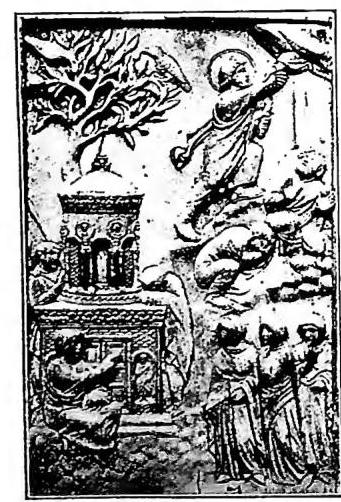
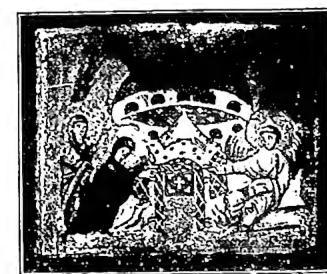
The Bordeaux pilgrim saw the basilica of the Holy Sepulchre just completed and admired its wondrous splendor (*Itinera Hierosolymit.*, ed. P. Geyer [CSEL, 38], p. 23); at the end of the 4th century Egeria speaks of gilded, mosaic, and marble revetments (*ibid.*, p. 76). It is believed that the octagonal church of the Ascension on the Mount of Olives must have had externally a representation of the Ascension, just as the buildings of the Holy Sepulchre bore that of the Resurrection, because the metal or terracotta ampullae purchased by pilgrims in these sanctuaries (“in the holy places of Christ”) reproduced these scenes, as did those of the Nativity from the basilica of Bethlehem. In other ampullae, however, the sacred building itself is represented, albeit schematically, from which the memory of the oil that burned in its lamps was taken. Thus, for example, in an ampulla now in the abbey of Bobbio, the interior of the Anastasis is depicted.
Another series of souvenirs of pilgrimages to the Holy Places consists of bracelets with scenes, for example, of the Crucifixion (*J. Maspero, Bracelets-amulettes d'époque byzantine*, in *Annales du service des Antiquités de l'Egypte*, 9 [1908], pp. 246-58). In the first half of the 6th century, St Dositeus saw at Gethsemane a scene of the punishment of the damned (*M. Brun, La vie de St Dositheé*, in *Orientalia Christiana*, 26 [1932], pp. 104-109).
Jerusalem is also the heavenly city, inhabited by the witnesses of Christ, the martyrs. This concept is expressed in the graffito read by G. B. de Rossi before the crypt of the popes in the cemetery of Callisto: “Ierusalem civitas ornamentum martyrum Domini.” The heavenly city is represented, according to Wilpert, in the background of the apse mosaic of S. Pudenziana (Mosaiken, pl. 42-46) and later at the center of the triumphal arch of S. Prassede from the time of Paschal I and in the contemporary apse mosaic of S. Cecilia in Trastevere (*ibid.*, pp. 1068-69, pl. 116). Jerusalem is sometimes personified in a female figure to symbolize the “Ecclesia ex circumcisione,” as in Rome in the churches of S. Pudenziana and S. Sabina; or its name is read in the representation of a turreted city, indicating the Church (q.v.) of Israel. Thus in Rome in S. Maria Maggiore and at SS. Cosma e Damiano; in Ravenna in S. Vitale and in S. Apollinare Nuovo.
From the heavenly Jerusalem the Apostles emerge in some sarcophagi (*Wilpert, Sarcofagi*, pl. XIV, 1-3; XX, 6; CL, CLI, 1; CLIV, 2 and 3). This subject was represented in the precious piece of goldsmith work offered by Valentinian III for the altar of St Peter in the time of Sixtus III (432-40); it still existed in the time of Hadrian I (772-95), who mentions it in a letter to Charlemagne; it was plundered by the Saracens in 846 and replaced in the 13th century by Limoges enamels, of which some fragments still remain in the Confession of St Peter.
In 1105 a violent earthquake had seriously compromised the stability of the buildings of the Holy Sepulchre, causing damage that the Crusaders hastened to repair. The edicule of the tomb retained its traditional form with its small columns supporting the arches and the vestibule as it had been modified by Monomachus. The upper terrace was covered with gilded bronze slabs, and above the upper walkway a dome with gilded silver revetments was erected, supported by clusters of small columns. The edicule housed a life-size silver statue of Christ.
In the rotunda two strong piers were built to support a great triumphal arch.
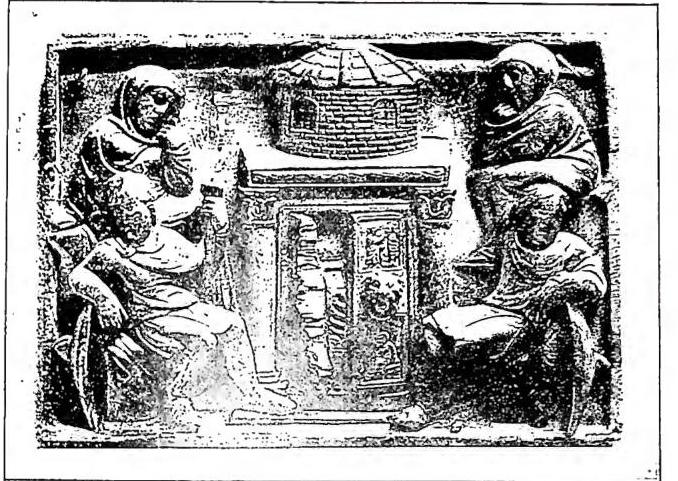
Gervasalemme – the Holy Sepulchre and its door depicted on an ivory of the 5th–6th century – Milan, Trivulzio Collection.
In place of the eastern apse a Romanesque-style basilica was built, with a transept, ambulatory, and minor naves; the central nave had three bays. The rock of Calvary was incorporated into the minor naves, while to the north there remained the remains of the portico and the oratories of the Commission of the Virgin and of Christ’s prison. The apses built into the semicircular wall replaced the three exedrae of the last Byzantine restoration.
Calvary was reduced to a double chapel whose vault was supported by piers. Two doors facilitated communication: the northern one with the rooms to the east and with the ambulatory, the southern one with the chapel of Our Lady of the Seven Sorrows or of the Franks.
In the central apse there were two other symmetrical openings. The choir or residence of the canons occupied a level above the site of the Constantinian Basilica. To the north of the rotunda the patriarch’s palace was superimposed on the Monastery of the Anastasis. A grand four-storey bell tower was erected over the oratory adjoining the rotunda.
From the 13th century to the present. – But in 1187 the defeat at Hattin brought Jerusalem once more under Muslim rule.
The sacred buildings and monasteries of Jerusalem were confiscated and turned into mosques or put to other uses.
Saladin, however, following the example of Caliph Omar, allowed the Holy Sepulchre to remain a Christian sanctuary, though under Muslim control. It seems that in 1212 custodians of the Basilica were local priests, while in 1217 the buildings were found closed by the pilgrim Thietmar. It appears that the Latins were readmitted in 1192. Frederick II, in 1220, during a brief truce, came to be crowned in the Basilica. But in 1244 the Khwarezmians sacked the city, massacred the Christians, and the buildings of the Holy Sepulchre were devastated.
In response to protests from the Christian world, Innocent IV received in 1246 assurances from the Sultan al-Malik al-Salih Ayyub that damages would be repaired and Muslim guards would grant entry to the Sanctuary to all pilgrims, who, despite the hardships of the journey, were always numerous—especially from the East—and were accommodated in various monasteries. Queen Tamar secured tax exemptions only for Georgians; others were subjected to real hardships. Fidentius of Padua (1266–91) attests that each pilgrim had to pay about 80 gold francs to enter the Holy Sepulchre.
In 1216, Cardinal James of Vitry, traveling to the Holy Land, found the Friars Minor already established there under the leadership of Brother Elias. Later, Dominican pilgrims such as Burchard of Mount Sion (1283) and Ricoldo of Monte Croce also arrived.
Roberto d’Angiò and Sancia of Majorca (1309–45) obtained from Sultan al-Malik al-Nasir a residence in Jerusalem for the Latin community, which Pope Clement VI (1342–52) entrusted to the Franciscans.
From the diary of Friar Nicholas of Poggibonsi (1346–50), we learn that various regions had their own altars: that of the Armenians was near Calvary, those of the Ethiopians and Indians near the Edicule, while the Jacobites, Greeks, and Syrians had theirs elsewhere.
The Franciscans, favored by good relations between Sultan Barsbay and Philip the Good, Duke of Burgundy (1419–67), succeeded in the 15th century in securing the keys to...
The question of the Holy Places arose following the Turkish occupation by Selim I in 1517; from then on, the Greeks, as Ottoman subjects, sought to strip the Franciscans of their privileges. Around the mid-16th century, an earthquake demolished the bell tower, which was replaced by another structure. The disputes grew more bitter during the 17th century. In the 18th century, the Greeks, with Russian support, managed to restrict Latin privileges and usurp many of their prerogatives.
On 12 October 1808, a disastrous fire devastated the renowned monument, sparing only the Latin chapel of the Madonna, the crypt of St Helena, part of Calvary, and the small Franciscan convent. Restoration was entrusted to Comminos of Mytilene, who was granted the title of royal architect for the occasion. The internal colonnade was partially removed and partly enclosed within masonry pillars. The rotunda was covered over; the tombs of the kings of Jerusalem were destroyed and dispersed, and the Franciscans were expelled, returning only in 1853 and receiving only part of their buildings. In 1868, at the expense of France, Turkey, and Russia, the poor restorations by Comminos were modified.
After Palestine was taken from the Turks in 1917, it came under British mandate, and everything was placed under the authority of the British High Commissioner for Palestine, who decreed that nothing should be altered from what had been established by the Sultan in 1852. The buildings of the Holy Sepulchre suffered significant damage in the 1927 earthquake, especially in the Crusader basilica. Efforts to restore the Katholikon dome threatened further ruin, and work was suspended; to this day, urgent and long-overdue restoration of the most venerated monument of Christianity has not begun. — See plates XIV–XVI.