
GIACOBBE (Heb. 'fa'qābh). — Patriarch (q.v.), also called Israel (q.v.), from whom the Hebrew people were formed through his twelve sons, the founders of the twelve tribes. The name occurs in Egyptian scarabs from the Hyksos period (1680–1580 B.C.) in the form: 'j'qābh, which probably corresponds to 'fa'qābh-ḥ', and some wish to regard it as a geographical name.
The name would originally have been theophoric; as such it appears in the list of Palestinian cities conquered by Pharaoh Thutmosis III (1501–1447 B.C.). E. Meyer considers it a tribal name and explains it as “God follows.” Others, such as P. Jensen, deny any connection between the supposed theophoric name and the patriarch Jacob. Still others explain the name as “God compensates”; M. Noth: “God has protected.” G. Jacob, following Lagarde and Horowitz, suggests an Arabic bird name: 'ja'qub, the male of the haqal, a name given by the Bedouin of the Sinai highlands to the mountain partridge (Ammoperdix Heyi); the name means “he follows,” and since it is a graceful bird, the Arabs would have given this name to children as well.
The Bible explains the name Jacob as derived from 'qābh “heel,” and the meaning as “supplanter.” This explanation is supported by the biblical account in which the child (the future Jacob) grasps “the heel” of his twin brother (Gen. 25:26), and by the story of the deceits Jacob employed to obtain the birthright (Gen. 27:36; cf. Hos. 12:4; Jer. 9:3). B. Jacob (Genesis, Berlin 1934, p. 544), referring to Gesenius’s Thesaurus, notes that the name imitates adjectival forms denoting colors and appearances, and to Hos. 6:8, and to the fact that in Genesis Jacob is situated between Esau (red) and Laban (white), and that later he fuses various colors in the rods he places in the watering troughs for the sheep, thinks that the name Jacob may mean roughly “spotted”; according to Horst, “containing traces”; cf. W.
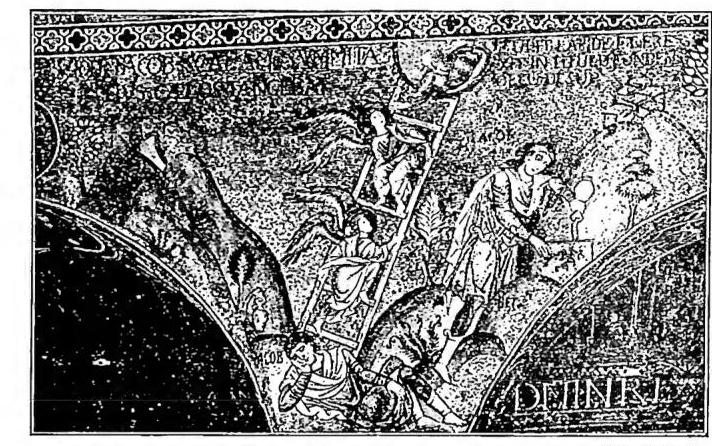
(Giacobbe — Jacob’s Ladder (Gen. 28:12) and the altar at Bethel (ibid. 18). Mosaic from the Palatine Chapel (12th cent.) — Palermo.)
Iconography. — Although catacomb painting does not include representations, already in the Vienna Genesis (5th cent.) alongside other Old Testament scenes there is a complete illustrative cycle of the most important events in Jacob’s life, drawn from the biblical account, namely: Esau sells the birthright to Jacob, Jacob’s father goes to Abimelech, Jacob and Rachel, Jacob’s flight and struggle with the angel, the destruction of idols, the birth of Benjamin, the burial of Rachel, and the death of Isaac. This cycle enjoyed considerable fortune in Christian art; suffice it to recall the panels of S. Maria Maggiore (5th cent.), probably derived from Hellenistic models, and the mosaic complexes of Monreale, the Palatine Chapel of Palermo, and the baptistery of Florence (12th–13th cents.). It is found again in the decoration of Raphael’s Logge in the Vatican.
Yet two scenes from Jacob’s life—the dream and the struggle with the angel and the meeting with Rachel—may be considered independent of the figurative cycles of the patriarch’s life. In the Brescia Casket (4th cent.) Jacob wrestles with a man represented as Jahweh. In the frescoes of S. Maria Antiqua the opponent is specified as the angel. The scene also appears in Romanesque sculpture of the 11th century, as in the capitals of the collegiate church of S. Orso in Aosta. The scene of the struggle is usually accompanied by that of the dream. Jacob is depicted lying down, and before him rises a great ladder on which one or two angels ascend or descend per step, and sometimes it is supported by Jahweh depicted as Christ. Sometimes, as in a strange miniature in the Bible of Charles V (1371), Jacob is shown old and lying in the center, with two ladders rising diagonally. The Renaissance likewise cherished this theme, passing it on to Baroque painting, as seen in a painting by Ribera now in the Prado in Madrid, and in a fresco by Tiepolo in the Archbishop’s Palace in Udine.
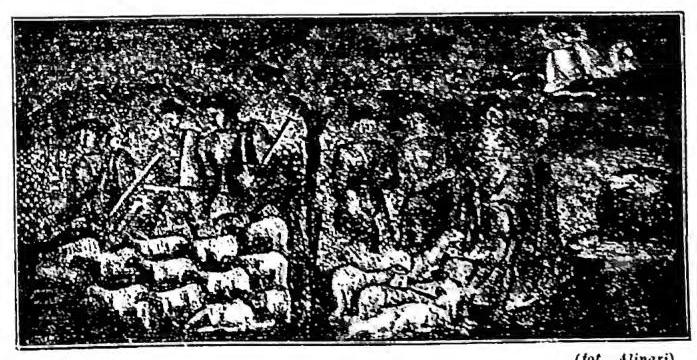
The meeting of Jacob with Rachel, precisely because of its bucolic character, was especially favored by courtly Gothic painting, as seen, for example, in the Bible moralisée of the Oxford Library (13th cent.), where the two young people join hands, and in some Tuscan 15th-century works, such as those by Benozzo Gozzoli and Filippo Lippi.