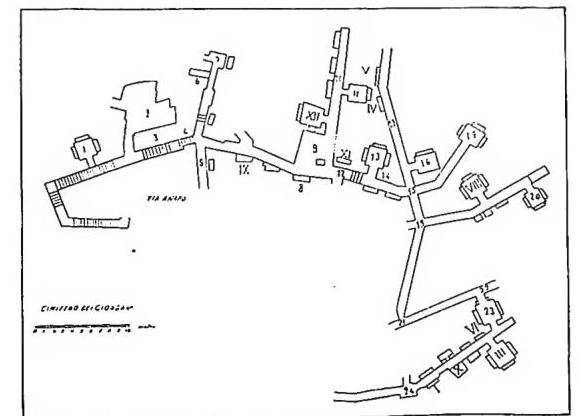
GIONDA, CEMETERY OF. — On the new Via Salaria. Nothing certain can be said about the plural form of the name of this cemetery, which has led some to think it a corruption of *Germanorum*, others to connect it with the river *Iordanus*, and still others to see in it the name of an association. It contains the tombs of the martyrs Martialis, Vitalis, and Alexander, whom legend identifies as three of the seven sons of St. Felicitas (q.v.). Commemoration of these martyrs was celebrated from at least the first half of the 4th century, as indicated by the *Depositio Martyrum* on the "VI idus Iulias," a date also found in the Leonine Sacramentary and the *Martyrologium Hieronymianum*, which records in the same cemetery and commemorates on December 31 a group of seven virgins: Donata, Paulina, Rogata, Dominanda, Serotina, Saturnina, and Ilaria. Both these virgins and the three martyrs mentioned above were venerated in the 7th century, as attested by the Itineraries.
The cemetery, restored by Pope Symmachus (498–514), may have had an open-air oratory dedicated to St. Alexander, one of the three martyrs; this was damaged during the Gothic siege, restored by Pope Vigilius, and is mentioned in the *Capitularia Evangeliorum*. The final restoration was carried out by Pope Adrian I (775–92). After the general abandonment of Roman cemeteries in the 9th century, following the transfer of relics into the city, the Cemetery of the Gionda was accidentally rediscovered on May 31, 1578, when workers digging in a vineyard on the new Via Salaria suddenly came upon the cemetery galleries, with their tombs still sealed by inscriptions, and painted cubicles and arcosolia. This discovery drew not only the curiosity of visitors, including St. Peter Canisius and Cardinal Cesare Baronius, but also of scholars who transcribed the inscriptions and copied the paintings, such as the Fleming Filippo De Winge (q.v.) and the Spanish Dominican Alonso Chacón (q.v.).
However, the cemetery was ruined in 1590–91, and even Antonio Bosio, who began his explorations in November 1593, was unable to enter it, confining himself in his *Roma Sotterranea* to copies of the inscriptions and paintings provided by Chacón and De Winge.
The galleries were again unexpectedly brought to light in December 1921 during the construction of a small villa between the new Via Salaria and Via Anapo.
This is a two-tiered cemetery dating to the late 3rd and early 4th centuries, in which the paintings already seen between 1578 and 1590 were rediscovered and faithfully copied by Filippo De Winge, with the exception of two: one depicting the Apostle Paul, and the other showing St. Tryphon at work. Among the paintings are scenes from the Old Testament: Noah in the Ark, the Sacrifice of Abraham, the story of Jonah, Daniel among the Lions, the Three Youths in the Furnace, Moses Striking the Rock; from the New Testament: Christ Teaching among the Twelve Apostles, the Good Shepherd, the Multiplication of the Loaves, the Raising of Lazarus; as well as male and female orants, genii, and a hunting scene with deer and boar. Many of the paintings were barbarously defaced before 1591.
Of the inscriptions discovered in 1578, only two have survived; but as early as that time, as noted in a letter by St. Peter Canisius, many had been removed or broken. Indeed, of the 120 inscriptions traced, almost all had been reduced to fragments. Two belong to sarcophagi, three are painted in red on tiles, and the rest are on marble. Notable among them is the inscription of a "Demophilus," who was a bishop for more than 23 years, though it is unknown of where, and that of a fossor named "Aelius Auxanon," who in his lifetime prepared "suis