
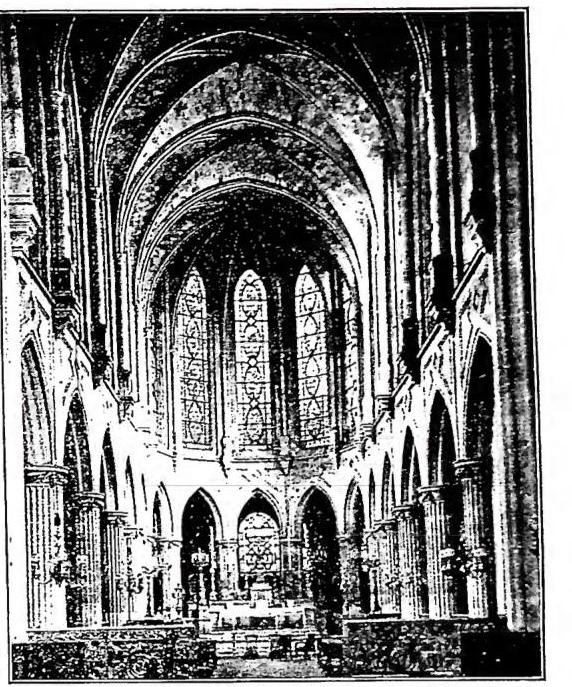
He then studied eloquence and law in Rome. He served as an advocate in the courts of a prefect (it is not known whether of the city or of the praetorium), later becoming rector of a province, which was probably the Fourth of Lyons, to which Auxerre belonged. His election by the clergy and people, as in the case of St Ambrose, compelled him to abandon political magistracy and assume the episcopate in his native city about 418, after the death of Bishop Amator.
He held the office for thirty years, living an extremely austere life and championing the monastic movement. He was certainly in touch with the Lerin monks and with St Hilary of Arles. He combated Pelagianism in two journeys to Britain: one in 429, sent by Celestine I (he remained there until about 431), and the other probably after 444, when the Saxons had already seized part of the island. He also exercised some influence on the Church in Ireland, especially through the mission of St Patrick to that island.
Besides spiritual interests he attended to the material needs of his diocese: in 435 he obtained from the prefect Auxiliaris a reduction of taxes; he saved the Arvor from the Alani invasions; and he went to Ravenna to Galla Placidia and her son Valentinian III to obtain pardon for a revolt of the Armoricans. It was on this occasion (448?) that he died at Ravenna, his body being afterwards, at his wish, conveyed to Auxerre. His relics were profaned and dispersed by the Huguenots in 1567. His cult spread rapidly and he is one of the most popular saints of France.
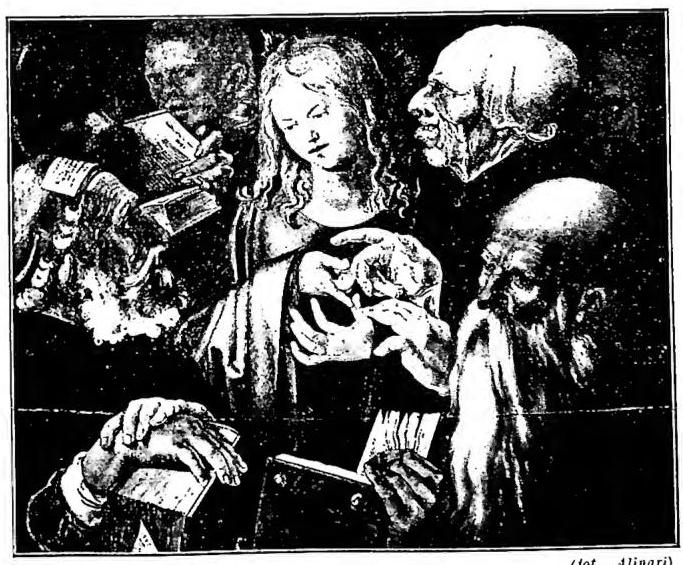
GERMANY — *Dispute of Jesus with the Doctors* by A. Dürer (1506). Rome, formerly Barberini Gallery.
St Germanus left four dogmatic letters, the first three of which are of great importance for the iconoclastic controversy; the fourth combats Monothelitism. There is also a theological treatise *De vitae termino* and a historical work *De haeresibus et synodis* composed about 737. Of the nine sermons of St Germanus, seven are of special importance for parology; three of these, preached on the *dormition*, manifest belief in the Assumption of Mary.