
JUDITH (Heb. 'Jehâdhth', Vulg. Judith). — A pious and heroic widow who delivered Bethulia; the name 'Jehâdhth' had already been borne by the wife of Esau, daughter of the Hittite Beeri (Gen. 26:34). She gives her name to the sacred book that recounts her deeds.
Here is the book’s content. King Nebuchadnezzar of Assyria defeats the Medes and sends Holofernes to exact vengeance on the western peoples who had refused to aid him (1–2:20). The lands are devastated; Phoenicia and Philistia surrender. Holofernes advances to Esdraelon against the Jews, who alone resist (2:21–4:15). The Ammonite Achior explains to Holofernes the reason for this resistance—God’s protection of Judah—and advises caution (5:1–21). Enraged, Holofernes has Achior bound and delivered to the Jews. He then besieges Bethulia, cutting off its water supply and reducing it to desperation (5:21–7:32).
Faced with the leaders’ resolve to surrender, Judith intervenes with ardent faith; she prays, mortifies herself, promises deliverance, and conceives a bold plan (8–9). Carefully adorned, she leaves with her maidservant for the Assyrian camp; she captivates Holofernes and secures freedom of movement for her religious observances (10–12:9). Invited to the feast and left alone with Holofernes as he lies in drunken sleep, she severs his head and returns with her trophy to Bethulia (12:10–13:20).
Judith arranges everything for victory. The Assyrians, learning of their leader’s death, scatter in panic as the Jews pursue them on all sides (14–15:7). The people exalt Judith, who bursts forth in a song of praise and thanksgiving to God (15:8–16:17). Her virtuous life, long years, and death follow (16:18–25).
The original Hebrew text (L. Soubigou [see BIBL.], pp. 483–86) is lost; it survives in three Greek versions, the best (mss. BAS) forming the basis of the critical text (ed. A. Rahlfs, I, Stuttgart 1935, pp. 951–73). The other two, mss. 58 (Old Latin and Syriac) and mss. 19, 108 (Lucianic recension), derive from the former (A. Miller [see BIBL.], p. 17 ff.). The Vulgate, a hurried and rather free adaptation by St Jerome (PL 29, 39 ff.) from an Aramaic exemplar, is about one-fifth shorter than the Greek and occupies a secondary place (A. Vaccari [see BIBL.], p. 304). In most and most serious cases the texts agree: an index of authentic, original reading (Vaccari).
The most important question concerns the historicity of the book of Judith. The text contains data that are plainly contradictory: Nebuchadnezzar (605–562), king of Nineveh (destroyed in 612), is said (Judg. 4:3; 5:18 ff. [Vulg. 22 ff.]) to have acted after the exile and the rebuilding of the Temple (538–438). Nebuchadnezzar is said to have fought Arphaxad (unknown), king of the Medes, and captured Ecbatana—though it is known that he neither fought the Medes nor ever took Ecbatana. Besides these geographical oddities, Bethulia, the high priest Joakim (or Eliakim), and Judith herself are unknown elsewhere in the Old Testament. For non-Catholics, beginning with Luther (and some Catholics: J. Jahn, F. C. Movers, F. Lenormant), the book is merely didactic and parenetic (cf. E. Schürer [see BIBL.]; G. Luzzi [see BIBL.], pp. 225–28), without any historical foundation. The author teaches that Israel has in Yahweh a sure, omnipotent protector; a timely and useful theme for sustaining the Jews during the Maccabean period and immediately before.
All the ancients, however, upheld its historicity; among moderns: G. Brunengo, F. Vigouroux, etc.; G. Brunner; and the Protestants J. von Gumpach, O. Wolff. It may now be said that the intermediate position is common among Catholics: the book is a didactic composition with a historical foundation, or rather a free narrative of a historical event for didactic-parenetic purposes (Miller, Soubigou, Vaccari, etc.). In reality, if one looks closely, the difficulties arise from the names chosen by the author for persons and places—choices connected with the main purpose already noted. For example, Nebuchadnezzar, destroyer of Jerusalem, serves as a type of the enemies of the theocratic nation; Nineveh, whose fall was foretold by Nahum and so terribly fulfilled, becomes an expression of Yahweh’s power, a motive of trust for Israel. “Everything suggests that the sacred author, for reasons of expediency or symbolism, wished to give places and persons names different from the true ones. To contemporaries this would have been easy to understand, but for us it is very difficult to see what lies hidden beneath the veil of these strange names” (Vaccari [see BIBL.], p. 304).
The starting point for determining the historical core is the identification of Nebuchadnezzar. About twenty substitutions have been proposed, from Adad-nirari III (870–782) to Demetrius I Soter (161–151), with attempts reaching as far as Trajan (G. Volkmar), even though the book of Judith was already known to St Clement of Rome (c. AD 95): cf. A. Condamin (see BIBL.), cols. 1560 ff.
The identification now generally accepted, especially in the past, is with Ashurbanipal (668–626), who fought his brother Shamash-shum-ukin, regent of Babylon, and the western allies including Manasseh (F. Roubïou, Brunengo, E. Kalt, L. Dennefeld, etc.), but this conflicts with certain post-exilic events (Soubigou, p. 490 ff.).
The more widely held modern view identifies Nebuchadnezzar with Artaxerxes III Ochus (358–337): already Sulpicius Severus (5th cent.; PL 20, 137 ff.), Condamin, Miller, Soubigou, Vaccari, etc. The period is after the exile (Judith 4:3, 13 ff.; 5:18; 9:1, 13; 16:17 ff.); there is no trace of idolatry (8:18); strict observance of the Law prevails (12:2–9, etc.; Miller, pp. 7–13). The phrase “to prepare the land and water” to denote aid given to troops (2:7; Soubigou, p. 513) is characteristic of the Persians (Herodotus, II, 48 ff.). Holofernes (2:4, etc.) and Bagoas (12:10; etc.), the Septuagint’s Bagōas, are exactly named by Diodorus Siculus (Bibliotheca historica, XVI, 47:4; XVII, 5:3; XXXI, 19:2 ff.); they served as subordinate commanders in the campaign against Egypt and the rebellious western satraps (c. 353–351). The episode of Judith fits this period (Soubigou, pp. 492, 512 ff., 556; cf. Schürer, p. 169 ff.). Brunner identifies Nebuchadnezzar with Araka, rebel against Darius I (c. 520); Araka indeed took the name of Nebuchadnezzar IV (Behistun inscription, lines 49 ff.). This better explains why the Jews, loyal to Darius, were not molested after Holofernes’ death; but no other evidence supports it (A. Miller, in Biblica, 23 [1942], pp. 95–100).
The author, who wrote in the 3rd century BC, wishes to show how fidelity to Yahweh saves Israel from every danger (8:11–27; 16:1–7); the example of Judith, chaste and pious (8:4 ff.; 12:2–9; 16:22 ff.), who triumphs over the mighty enemy, is an effective proof. Judith’s stratagem does not exceed what was then considered permissible in warfare against an enemy. “The impure desires that might have arisen in Holofernes’ heart Judith neither sought nor feared, sustained as she was in God (13:16–19). By cutting off the enemy’s head without impairing her own honor, she won a double triumph, moral and civic alike. For this reason Catholic piety saw in Judith a figure of the Immaculate One, who, untouched by the impure breath of the tempter, crushes the serpent’s head” (Vaccari, p. 305).
The book of Judith is absent from the Hebrew canon after the end of the 1st century AD; this exclusion was arbitrary (see ECCLESIASTICUS). Both the Fathers and ecclesiastical documents attest to its divine inspiration.
Recent commentaries: M. Löhr, in *E. Kautzsch, Die Apokryphen, I, Freiburg 1900, pp. 147-64; A. Piffard, Lille 1901; *T. André, Les Apocryphes de l’Ancien Testament, Florence 1903, pp. 158-63; A. E. Cowley, in *R. H. Charles, The Apocrypha, I, Oxford 1913, pp. 24-267; J. Keulers, Bruges 1927; *N. B. Coleman, in *C. Gore - H. L. Goudge - A. Guillaume, A New Commentary, II, 2nd ed., London 1929, pp. 58-62; *G. Luzzi, Apocrifi dell’Ant. Test. (La Bibbia), 10, Florence 1930, pp. 221-265; A. Miller, Bonn 1940; A. Vaccari, La S. Bibbia, III, Florence 1948, pp. 303-43; L. Soubigou (La Ste Bible, ed. L. Pirot), 4, Paris 1949, pp. 483-575.
Studies: G. Brunengo, Il Nabuchodonosor di G. Rome 1888; *G. Klein, Über das Buch Judith, Leiden 1893; P. Riessler, Chronologische Fixierung der Heldentat Judiths, in Der Katholik, 74, II (1894), pp. 1-8; F. Vigouroux, La Bible et les découvertes modernes, IV, 6th ed., Paris 1896, pp. 99-131; *E. Schürer, Geschichte des jüdischen Volkes, III, 3rd ed., Leipzig 1898, pp. 167-74; *F. Steinmetzler, Neue Untersuchungen über die Geschichtlichkeit der Judith-Erzählung, 1907; A. Biolek, Die Ansicht des christlichen Altertums über den literarischen Charakter des Buches Judith (Wiener Studien, 4), Vienna 1911, pp. 324-68; C. Meyer, Zur Entstehungsgeschichte des Buches Judith, in Biblica, 3 (1922), pp. 193-203; id., Utrum Judith laudanda an reprehendenda sit, in Verbum Domini, 3 (1923), pp. 173-79; *E. E. Voigt, The Latin Versions of Judith, Leipzig 1923; I. de Vuippens, Darius I, le Nabuchodonosor du livre de Judith, in Estudis franciscans, 39 (1927), pp. 351-69; H. P. Chayes, Das Buch Judith, in Jüd. Jahrb. für Österr., 1 (1932-33), pp. 103-12; H. L. Jansen, La composition du chant de Judith, in Acta Orient., 15 (1936), pp. 63-71; *F. Zimmermann, Aids for the Recovery of the Hebrew Original of Judith, in Journal of Biblical Literature, 57 (1938), pp. 67-74; *G. Brunner, Der Nabuchodonosor des Buches Judith, Berlin 1940; J. Schwarz, Un fragment grec du livre de Judith (sur ostracon), in Revue biblique, 53 (1946), pp. 534-37; A. Colunga, El género literario de Judit, in Estudios bíblicos, 6 (1947), p. 449; and in Ciencia tomista, 74 (1948), pp. 98-125; F. Stummer, Geographie des Buches Judith, Stuttgart 1947 (cf. Revue biblique, 55 [1948], p. 138 sq.); A. Vaccari, Note critiche ed esegetiche. Judit 16, 11, in Biblica, 28 (1947), pp. 401-404; 29 (1948), p. 34 Francesco Spadafora.
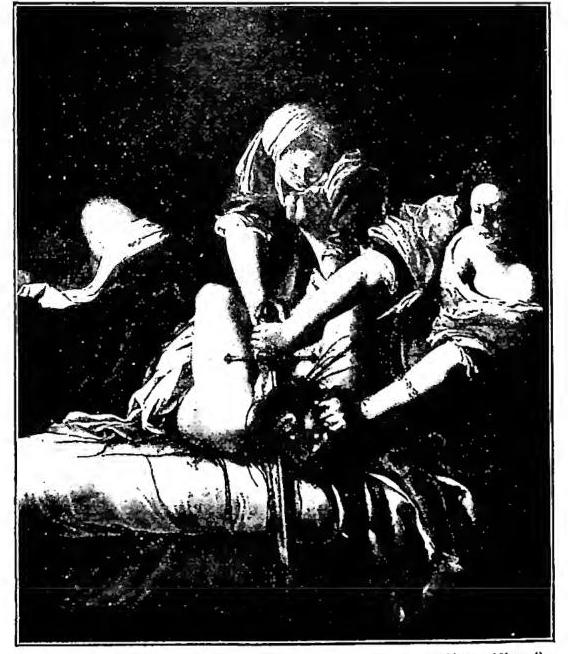
JUDITH – G. beheads Holofernes. Painting by A. Gentileschi (1590–1642) – Florence, Uffizi Gallery.
Iconography. – G. was depicted, together with Esther, in the 5th-century basilica of St Felix in Nola (St Paulinus of Nola, Carmen, 28, 26: PL 61, 663).