
JUSTINIAN, EMPEROR OF THE EAST - Institutiones, II, 24.
Parchment codex from Monte Cassino (9th century).
legislative and administrative. Although the results in the military sphere were not very lasting, and those in the religious sphere were negative, through his codification he saved and transmitted to posterity a treasure of materials and doctrine, whose inexhaustible richness has nourished and continues even now to nourish juridical thought in every country.
Born on 11 May 482 A.D. at Tauresium, a village in the Vardar valley, near Scupi (modern Uskub), he belonged to a humble family of Roman or Romanized Illyrian stock (the claim that he was of Slavic stock is a legend invented in the 16th century), and had been given the name Sabbatius. A maternal uncle of his, Justin, born in the same region at Bederiana, had enlisted, during the reign of Leo I (457–74), in the imperial guard and had risen to the rank of comes excubitorum. Perhaps even then he summoned his nephew to Constantinople, where he had him given a refined legal and theological education. He subsequently adopted him, thereby causing him to assume the name of Flavius Petrus Sabbatius Iustinianus (which we find in the consular diptychs), from which there later derived the imperial name of Imp. Caesar Flavius Iustinianus.
At the death of Anastasius (518 A.D.), Justin, setting aside the legitimate descendants of the deceased Emperor, succeeded, with popular support, in ascending the throne; he then raised his adopted son to the highest offices, making use of him as adviser and guide. During these years J. had met Theodora, a circus dancer, whom he later married (after Justin had abolished the prohibition against marriage between senators and actresses) and who, despite the scandalous accusations we read in Procopius, must be regarded as a woman of great intelligence and firm will, qualities she revealed during the most critical moments of her husband’s long reign. The wedding was celebrated on the very day on which J. was associated with the throne by his uncle (1 April 527); thus, at Justin’s death (1 May 527), J. and Theodora were acclaimed legitimate sovereigns.
The new Emperor’s program of government aimed at implementing a system rigorously constructed upon several precise principles. Its cornerstone was the idea of the divine origin of political power, insofar as this was expressed in a universal monarchy: whoever is invested with it is therefore God’s representative on earth, the sole creator and interpreter of the law, indeed the living law himself. The universal monarchy is the respublica romana, which J. wished to restore to its ancient greatness and power. But if the Roman Empire is the universal Empire willed by God, and if universality likewise belongs to the Church, then the sphere of the latter and that of Roman identity coincide. Therefore, the Emperor’s task is the defense and exaltation of the one faith: wherever Roman law reaches, the rule of the universal Church must also reach; the same institutions, the same arms, and the same art must serve both; the triumph of each is the affirmation of one single principle, of an identical political conception.
The implementation of this idea of an absolute and universal monarchy by divine right necessarily presupposed the reconstruction of the Empire’s territorial unity, the achievement of legislative and administrative uniformity, and the establishment of religious unity. J. undertook this threefold and arduous design with energy and without hesitation.
A few months after his accession to the throne, by the constitution Hace quae necessario (13 February 528), he began his legislative work, ordering the compilation of the first Codex, which was followed by the other parts of the compilation, Digesta and Institutiones, and finally by a second edition of the Codex (v. CORPUS IDIUS CIVILIS).
At the same time, J. began his reform of the administration, both by introducing greater rigor into tax collection and by seeking to combat abuses by officials, especially their venality, which had become customary. In the religious sphere, with the aim of drawing closer to the Roman Church, he directed his policy in a manner favorable to orthodoxy, also in order to prepare the ground for the planned reconquest of the West. Through numerous constitutions of 527 and 528, he sought to eliminate the last remnants of paganism, imposing severe sanctions on its adherents, for whom he left no choice other than exile or conversion; in 529 he then ordered the closure of the school of Athens, which was regarded as a center of pagan propaganda. By other measures he introduced new penalties against heretics (Montanists, Manichaeans, Nestorians, Monophysites), who were removed en masse from public offices, while dissident bishops were deposed or exiled.
These measures, however, provoked a fierce reaction that gave rise to a veritable insurrection against the Emperor. As early as 11 January 532, the factions of the circus—that is, the “Greens” (Monophysites and supporters of Anastasius and his dynasty) and the “Blues” (the orthodox, favored by J.)—had come to blows. When the Emperor decided to punish the leaders of both factions, they united against him, demanding the deposition of his ministers John of Cappadocia and Tribonian, whom they regarded as the instigators of the measures concerning finance and religion. The appeals for calm personally addressed by J. went unheeded by the rebels, who grew stronger inside the hippodrome, which had become their headquarters, and proclaimed Hypatius, nephew of Anastasius, emperor. After much hesitation, J., urged on by Theodora, decided to suppress the revolt by force; it was subdued by Narses after a bloody battle for control of the hippodrome. Once Hypatius and the leaders of the revolution had been eliminated, and many senators killed or exiled, their property being confiscated, peace returned to the capital.
Having secured his position at home, J. could now put into effect his plan for the campaigns in the West, necessary both from the political and from the religious standpoint (the Catholic populations of the West were constantly threatened by the Arians), for one who intended to restore the Empire’s material and spiritual unity.
These new enterprises had been preceded by intense diplomatic activity. In order to have a large army at his disposal, J. had concluded peace with Persia in 532; in Africa he hoped to be able to count on the support of Hilderic, deprived of the throne by King Gelimer; in Italy he had, with cunning duplicity, established relations both with Amalasuntha (in conflict with the Gothic leaders because of her sympathies toward the Romans), who sought his protection and promised him aid against the Vandals, and with Theodahad, Amalasuntha’s opponent, who, in order to obtain J.’s support against her, declared himself willing to surrender part of the peninsula; in every region of the West he conducted intense propaganda against the barbarian rulers, appealing to religious beliefs.
Thus, despite the objections of the highest officials, the western enterprise was decided upon. On 22 June 533 Belisarius sailed from Constantinople for Africa, where, having landed in September, he resolutely confronted the enemy, defeated them in the battles of Decimum and Tricamarum, and in 534 captured Gelimer. J. immediately undertook the reorganization of the administration of Africa, which was nevertheless often disturbed by uprisings among the subjected Vandals, supported by the restless Berber element.
In the following year, while he was energetically continuing the reform of the administration (Novellae 8 and 17 of 15 and 16 April 535), G. began the campaign against the strongest enemy, the Goths of Italy. Here too the first phase of the campaign was entrusted to Belisarius, who landed in Sicily in the summer of 535. Pressed from the south, threatened in the east by a Byzantine army concentrated in Dalmatia and in the west by Theudebert, king of the Franks, who had reached an agreement with G., the Goths asked to negotiate, declaring themselves willing to renounce sovereignty over Italy, provided that they could remain as federates. Shortly afterward, however, taking advantage of Belisarius’s absence, since he had gone to Africa to suppress a rebellion there, they broke the truce and resumed the war, which lasted another four years, until the Byzantines, who had to fight their way up from Calabria to the Po Valley, succeeded in capturing Ravenna.
Yet, after these successes, G. had had to turn his attention to the East and recall part of his troops from Italy in order to defend himself against the Persians, who had broken the treaty of 532 and launched an offensive, and to hold in check the hordes of Huns, Bulgarians, and Slavs who were ravaging Moesia, Thrace, and Illyricum (the incursions were renewed in 544 and in the following years; particularly serious were those of the Huns in the years 550 and 558, when the latter reached, on the second occasion, as far as the suburbs of Constantinople). The war against the Persians lasted five years, until an armistice was reached in 545, renewed several times until the peace of 562.
Meanwhile (544), in Italy, the Goths, emboldened by the reduced pressure of the Byzantine troops, had resumed the counteroffensive under the leadership of Totila, aided by G.’s inability to meet the demands for men and money repeatedly addressed to him by his generals. Only in 550, having secured his position on the Persian front, could G. organize a new expedition under the command of Narses, who entered Italy in 551 from the eastern frontier, while a Byzantine fleet led by Artabanus reoccupied Sicily. Narses’s strategy, with the battles of Tagina and Monte Lettere, brought about the total defeat of the Goths, whose kings Totila and Teia fell heroically in battle. Italy, completely reoccupied, once again became the center of the prefecture, whose administration was to heal the wounds inflicted on the country by Gothic rule and the repeated wars. The Pragmatic Sanction of 554 was largely intended for this reconstruction; among other things, it extended to the reconquered regions the constitutions issued after the Justinian compilation, previously sent to Italy.
In the West, however, Gaul was still largely dominated by the Franks, just as Spain was by the Visigoths. Nothing was attempted against Gaul. In Spain, an expedition led by the patrician Liberius succeeded in reoccupying the southeastern region (Carthagena, Malaga, Cordova), but was subsequently forced to halt in the face of the Visigoths’ tenacious resistance. Nevertheless, the result achieved was not negligible: as a consequence of this occupation, following that of Africa and Sicily, the western Mediterranean had once again become a Roman sea; while the restoration of Byzantine rule in Dalmatia and Italy, and the maintenance of the statu quo in the Balkans and in Asia Minor, ensured the Empire dominion over the eastern Mediterranean as well.
In the East, moreover, after the peace with Persia in 562, Lazica (the region south of the Caucasus centered on present-day Batumi) returned to the Empire in exchange for an annual tribute to be paid to Persia; Persia, however, granted freedom of worship to Christians living within its borders, in return for Constantinople’s undertaking to renounce religious propaganda in Persian territory.
It is therefore unjust to assert that G.’s activity in the field of foreign and domestic policy failed in every respect. On the other hand, the failure of the Emperor’s efforts directed toward the religious unification of the Christian world must be acknowledged; this was another of the objectives contained in his program.
The Emperor, faithful to the orthodox creed, had at first hoped to attain his goal by insisting on agreement with the Church of Rome, which he recognized as caput omnium sanctarum ecclesiarum, and by seeking to repress the activity of dissidents, pagans, and heretics; this attitude had been advantageous on the occasion of the reconquest of the West. But the measures were met by the tenacious resistance of the Monophysites, who were especially numerous in Syria and Egypt and were also entrenched at court, where they enjoyed powerful connections as well as the protection of the empress Theodora. In a first attempt, G., without renouncing his principles or undermining the laws that had been enacted, believed that he could conciliate the Monophysites by easing the application of the severe measures and resorting to an expedient by which he hoped to induce them to accept the Chalcedonian formula. In 535, after the death of Epiphanius, patriarch of Constantinople, G. chose as his successor Anthimus, bishop of Trebizond, a secret sympathizer with the Monophysites; the new patriarch, in turn, summoned to Constantinople the former patriarch of Antioch, Severus, spiritual head of the Jacobite Church, in order to devise with him a compromise formula with the bishops of Syria and Egypt. But this maneuver was thwarted by the intervention of Pope Agapetus, who, having arrived in Constantinople in 536, excommunicated and deposed Anthimus. G., after attempting to save his patriarch, had to yield and ratify the measure (agreement with the Pope was necessary for the Emperor’s planned expedition to Italy). Shortly afterward, a synod was convened at which the measures against the Monophysite leaders were reaffirmed, although these measures were applied very leniently.
The conflict therefore remained unresolved; and G., certainly pressed by Theodora, thought of choosing another path, arranging for a less intransigent cleric to be called to the papacy.
After Agapetus died in Constantinople, and Pope Silverius was deposed and exiled (537) on the accusation that he had collaborated with the Goths, G. succeeded in having Vigilius, who had been nuncio in the East, elected. But the new Pontiff proved no less rigid than his predecessors. Then the Emperor, inspired by an astute prelate, Theodore Askidas, thought that a way might be found to overcome orthodox intransigence by undermining the foundations of the Council of Chalcedon without directly attacking its decisions. The expedient was the posthumous condemnation of three representatives of Antiochene theology: Theodore of Mopsuestia, Theodoret of Cyrus, and Ibas of Edessa, a condemnation that undermined the validity of all the Chalcedonian decisions. This condemnation, issued at the end of 543 or the beginning of 544, gave rise to the controversy known Three Chapters (v.) and to a decade-long conflict between the papacy
and the East. The measure, in any event, revealed G.’s intention to regard the Church as a subordinate entity, as well as his claim to decide causae fidei through imperial edicts; and the content of the condemnation, which aroused such opposition on the part of Rome, had moreover satisfied not even the Monophysites.
The religious unity to which G. aspired had not been achieved; and the conflict between the orthodox and the Monophysites became the torment of the Emperor’s final years, as he allowed himself to be completely absorbed by questions of religious policy: his final constitution, of 26 March 565, deals solely with ecclesiastical matters and is a profusion of quotations from the Gospel and the holy Fathers.
G. died on 14 November 565, after a most troubled forty-year reign, afflicted not only by the events described but also by continual concern over the disorder of the administration (see the Nov. 134, which renewed the provisions of the Nov. 8 and 17), and by the efforts
efforts aimed at promoting economic progress, especially in agriculture (to him is owed the introduction into Europe of silkworm breeding), and at developing trade between East and West, as well as by the fervor with which he had sought to stimulate artistic activity, to which are owed such magnificent churches as Hagia Sophia in Constantinople, S. Vitale and S. Apollinare in Classe at Ravenna, and the cathedral of Poreč. Nor can it be denied that it was chiefly on account of his legislative work—so the later generations who exalted his figure, like Dante (Par., V), were right—that he was assigned such a lofty position in the history of civilization.
JUSTINIANIC SACRED BUILDINGS. — During the fifth century and the first half of the sixth, the East had sought, in addition to perfecting the construction of basilicas (v. , for example, the basilica of S. Menna; the Church of the Nativity at Bethlehem — second period —; basilica A at Philippi; the cross-shaped churches, such as the basilica of the Theologian (S. Giovanni at Ephesus; Kasawijjeh), various solutions for a central place of worship surmounted by a vault: alongside round and polygonal buildings (such as the round basilica at Scitopoli-Bejsän; the church of S. Maria on Mount Garizim; the churches of S. Giorgio at Esra), there are also combinations of basilicas with domes—on the one hand, with plans oriented toward the west and a dome toward the east (as at Högah Qal'esi; Meryemlik; Athens, the basilica of the Ilissos), and on the other, in the scheme of barrel vault, dome, and barrel vault (e.g., the Justinianic church of S. Irene; the basilica of S. Maria at Ephesus — second period —; Qasr ibn Wardän)—and finally also rectangular buildings with a semicircular expansion of the central parts of the sides (as in the church on Mount Horeb), whose interiors are for the most part characterized by an arrangement of pillars and columns in a fourfold crossing (e.g., the cathedral of Bosra; the martyrium at Rusäfah and at Antioch Pieriae). Now, all these elements of ancient and partly also Eastern forms attained their highest expression in the architectural activity of G. The types created at that time, however, were not further developed in the subsequent period, so that Hellenistic-Roman architecture culminates and ends precisely in them.
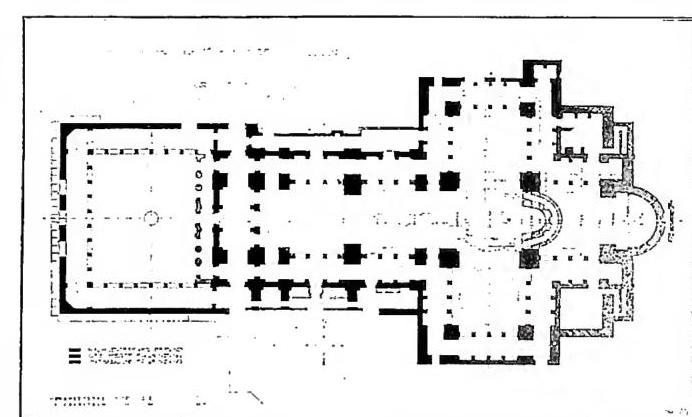
(from J. Keil, in Jahreshefte des naturr. arch. Institut, 67 [1938], Berbott, fig. 45) JUSTINIAN, EMPEROR of the EAST — Plan of the church built by G. over the tomb of the apostle S. Giovanni, according to the latest excavations.
Of the numerous churches erected on G.’s commission, described in part in great detail by Procopius (De aedificiis), only a few have been preserved, though fortunately these include the most important. The following constructions in a purely basilical style have been established as foundations of G.: the church on Mount Sinai, the two churches at Zenobia-Halebijjeh, and the basilica of Carthage-Dermesch, which is very probably identical with the church of S. Prima (Procopius, De aedificiis, VI, 5, 9). Among the centrally planned buildings must be included the church of SS. Sergio and Bacco, known as the small (kütschük) Constantinople (v.). Its carefully balanced vaulting system, also joined to the vault of the ambulatory, is characteristically Constantinopolitan—in comparison, for example, with the Syrian octagons. The supports of the lower level are covered by a massive architrave bearing the foundation inscription; the upper level, by contrast, displays arcades. The architrave of the lower level emphasizes the horizontal arrangement that would later be found in the church of S. Sofia, whereas the Western example, S. Vitale at Ravenna, emphasizes the vertical line with equal force. This latter building, consecrated in 547 and probably erected with G.’s support, retains the octagon also in its exterior part and represents the definitive form of this type, since it makes the arrangement of the pillars and columns lighter inside by means of the exedrae. The aforementioned vertical arrangement, which conceals nothing of the construction, creates a space of extraordinary structural compactness; although this space cannot be conceived without the Constantinopolitan model, it nevertheless remains faithful to the Western-Roman conception of space.
The unsurpassed masterpiece of the age, whose design goes back to G. himself (Procopius, De aedificiis, I, 1, 70), is Hagia Sophia, the patriarchal and imperial church dedicated to the second person of the Most Holy Trinity.
Whereas the Justinianic church of S. Irene (the rebuilding of A.D. 740 extensively modified the roofing and the arrangement of the interior) probably followed the scheme of barrel vaults, dome, barrel vaults, and consequently concentrated the space in an unsuitable manner through the union of the contrasting elements of barrel vault and dome, in the church of S. Sofia, by contrast, the barrel vaults were replaced by semi-domes, so that upon entering one immediately has a complete view of the entire interior up to the apex of the dome: the fusion of the longitudinal space with the central one was entirely successful, and the mutual interpenetration of these apparently contrasting elements confers upon the interior its singular vitality.
The upper and lower side aisles are arranged in a completely independent manner, although they are connected by means of alternating openings with the central space, from which they receive light. The polychrome covering of marble and mosaics with gold backgrounds conceals the skeleton of the construction and dissolves the materiality of the walls into colour and light. The shallow plastic relief of the cornices is likewise subordinated to this effect of dissolving matter, though it is sufficiently pronounced to achieve the horizontal effect of the building’s structural scheme.
This horizontal line, together with the upper and lower colonnades, in fact accentuates the basilical character of the plan and repeatedly directs the gaze from the dome—which is the nucleus of the construction and the source of the dynamic effect of the architecture—toward the front, that is, toward the altar. The Emperor and his contemporaries were fully aware of the exceptional singularity and symbolic importance of this church, and posterity too recognized in it the “model of the dominion of the Romans” (Cantecuzeno, Hist., IV, 4).
The second monumental building of the age is of an entirely different character: the church of the SS. Apostles, which is no longer preserved, but of which an idea may be formed because the church of the Theologian at Ephesus is an imitation of II. Here we have a basilica of a more ancient type, built in the form of a cross and subsequently translated into the architectural language of the Justinianic age. It is true that in this instance the space did not assume a central form, although the centre of the transept (the dome is higher and illuminated by windows placed at its edge) is particularly emphasized in relation to the arms. In compensation, however, the arms are divided into individual rectangles surmounted by domes, while each of these spatial elements is clearly separated from the others by a rib. Despite the effect of the space, this is much more concentrated and homogeneous than in the preceding basilical types, because the two-story ambulatories firmly join the various parts to one another. The columns placed between the individual squares further accentuate the longitudinal and transverse directions of the plan and, as in the church of S. Sofia, give the dome space the effect of an openwork structure. — Vedi tav. LX.