
I discepoli di G. B., che non erano organizzati come gli Apostoli, dopo la morte del maestro forse passarono al cristianesimo. Secondo Act. 19, 1-7, un gruppo di 12 fedeli di Efeso aveva ricevuto solo il battesimo di G. B.; famoso è il caso di Apollo (Act. 18, 24-26). Più tardi si parla delle sette dei gioanniti, degli emerobattisti, ecc. (cf. Buzy, pp. 370-72). G. B. occupa un posto mandei (v.). Roma gli ha dedicato la sua Cattedrale (S. Giovanni in Laterano «omnium urbis et orbis ecclesiarum mater et caput»).
La critica razionalista ha tentato di mettere in dubbio la storicità della nascita miracolosa di G. B., trattandola quale «preistoria», e di minimizzarne il ministero e di considerarne il martirio come leggenda popolare (Goguel). Ma la storicità dei dati evangelici non si può mettere in dubbio, presentandosi con abbondanza di particolari, e con tutti i requisiti di credibilità; è confermata del resto da Fl. Giuseppe.
Secondo i cattolici, il battesimo di G. B. si distingueva da quello di Gesù perché doveva servire a stimolare alla penitenza ed a simboleggiare la purità interiore e rimetteva i peccati non ex opere operato ma ex opere operantis, cioè in virtù delle disposizioni individuali, intuitu meritorum Christi.
G. B. non era uno ioghi indiano (Renan), né un esseno (Graetz, Rubinstein). Rappresenta il Vecchio
Testamento che si purifica nel deserto di Giuda come al tempo di Mosè nel Sinai, e vi dimora nello stato di vigoria e di semplicità come Adamo ed Eva nel Paradiso terrestre, e ne esce con la potenza del leone, predicando la necessità della purificazione e delle opere buone per andare incontro al Messia che fonda il Regno di Dio. G. B. non è la luce, ma il prisma che la riflette (Io. 1, 8); non è il Messia, ma colui che ne ripercuote la voce (Io. 1, 20-23); non è lo sposo, ma il paraninfo che gli presenta la sposa (Io. 3, 29); non ha il Battesimo nello Spirito (Mt. 3, 11), ma battezza colui che vivifica nello Spirito (Mt. 3, 13-17); è « il più grande tra i nati di donna » (Mt. 11, 11).
Bonaventura Mariani
LITURGIA. - The eulogy of s. G. B. given by Our Lord (Mt. 11, 11) and the singular circumstances of his imprisonment and death (ibid. 14, 1-12) gave the cult of the Precursor an exceptionally universal character as early as the 4th century, a status also due to the discovery and rapid spread of his relics, real or presumed, and to the interest that monks had in their prototype. In keeping with his mission as the Baptist, oratories in baptisteries were preferably dedicated to him. In Palestine, since the end of the 4th century, the existence of sanctuaries is attested in places sacred to the Precursor, such as, for example, at the location where he baptized Christ at Qaṣr el-Jehūd and at the tomb believed to have existed at Sebaste (cf. s. Girolamo, Comm. in Osee and Comm. in Michaeam, I, 1: PL. 25, 825, 1156). From the same period onwards, in both East and West, the number of sacred buildings dedicated to him began to increase, multiplying in an extraordinary way during the Middle Ages. In Constanti-
nopol, for example, there were about fifteen sacred buildings including oratories, baptisteries, and churches, among which was that of Heldomon where the Emperor Theodosius reportedly had his head deposited; in Rome there were at least ten: the oratory of the Lateran Baptistery should be remembered, and subsequently the basilica of the same name, dedicated to the Savior, of whose the Precursor became co-patron; in the late Middle Ages it was believed that his head was held in S. Silvestro «in capite». At Ravenna, under Galla Placidia, a basilica was erected to him; s. Benedetto and Theodolinda dedicated ones to him at Montecassino and Monza.
As for his festive cycle, it must be borne in mind that it was established in relation to Christ's Nativity on Dec. 25. The Conceptio (Sept. 23 in the East, Sept. 24 in the West), recorded in the Martyrologium Hieronymianum and in the Synaxaria, is today a purely Eastern feast. Mozarabic calendars record the Decollatio on Sept. 24 (cf. J. Vives-A. Fabrega, Calendarios hispanicos anteriores al siglo XII, in Hispania sacra, 2 [1949], p. 27; id., ...anteriores al siglo XIII, ibid., pp. 22, 28, 34, 40, the articles have their own numbering). The Natale genuinum, the birth (June 24; note the parallelism of the calendars: VIII Kal. Iul. = June 24, VIII Kal. Oct. = Sept. 24, VIII Kal. Ian. = Dec. 25), and the Passio, the beheading (Aug. 29, a date commemorating not the beheading, but a translation of relics), are feasts still common to both Churches and are already attested by s. Agostino (Serm. 196, 287, 288-93; PL. 38, 1021, 1301-35), by the Martyrologium Hieronymianum, by the Roman Sacramentaries (the Leonianum has only the 24th, not the 29th; the Gelasianum has both), and by the Synaxaria and Menologies. The Synaxaria also record a synaxis in his honor the day after Epiphany. The Council of Agde (can. 21) of 506 ranks the feast of June 24 among the major feasts, and it remained an obligation of precept until the beginning of the 20th century. The feast, already preceded by a vigil with fasting and followed by an octave, was, especially in Rome, polyturgical until about the 11th century (double nocturnal Office, cf. Amalarius, Liber de ordine Antiphonarii, 59, three or two Masses of which one ad fontem, cf. the various Sacramentaries). The hymns of the office are by the Cassinese monk Paul the Deacon (d. 799); from the first one Guido d'Arezzo extracted the names of the musical notes.
In the apse of the oratory of S. Venanzio at the Lateran (G. B. De Rossi, Musaici cristiani delle chiese di Roma anteriori al sec. XV, Rome 1899, pl. 19) and in the mosaic of the cathedral of Parenzo, G. B. has a nimbus, wears a tunic and pallium, makes the rhetorical gesture with his right hand, and clasps a long Cross with his left (Wilpert, Mosaiken, p. 928, fig. 442).
In a miniature of the codex of Cosmas Indicopleustes in the Vatican Library (8th-9th cent.), G. B. is depicted nimbate, bearded, with long hair, in a tunic and pallium; he clasps a long Cross in his left hand (C. Stornajolo, Le miniature della topografia di Cosmas Indicopleuste, Milan 1908, fol. 76).
On the ivory cathedra of Maximian in Ravenna, surrounded by the four Evangelists, stands the Precursor; he is bearded, in a tunic and pallium, and over this wears a camel skin; in his left hand he holds a disc on which the divine lamb is engraved. He is also in sacred attire on an ivory in the Museum of Lyon (G. De Jerphanion, La voix des monuments, Paris 1930, pl. 33); he additionally has a nimbus in the frescoes of Deledjlar Kilissé (id., op. cit., pl. 34), of Elmale Kilissé and Toqale Kilissé and of Djémil in Cappadocia (id., op. cit., pl. 35, 1 and 2); in the miniatures of the Gospel of Iviron,
in the Vatican-Urbino Evangelary; in Syriac MS 535 of the National Library in Paris, and on the baptismal font of Liège. Nimbate with a beard and long hair, and in a tunic and pallium, he appears in the apse mosaic of the Lateran from the year 1290 (G. B. De Rossi, Musaici cristiani, pl. 37).
The martyrdom of G. B. is represented in the Sinope Gospels (6th cent.), today in the National Library of Paris, illustrating the Gospel of St. Matthew which gives the account of Herod's crime (14, 6-12); later in a miniature of a Chartres Missal from the 9th cent. (J. Psichari, Salomé et la décollation de st Jean-Baptiste, in Revue de l'histoire des religions, 72 [1915], pp. 131-58). Strzygowski proposed to recognize the head of the Precursor in a fragment of papyrus on which is painted a head severed from the body placed upon a platter (Eine alexandrinische Weltchronik, in Denkschriften der Kaiserlichen Akademie der Wissenschaften, Philosoph. Histor. Klasse, Vienna, 51 [1906], p. 153, fig. 12 and pl. 8). Salome is also represented in the mosaics of S. Marco in Venice in the act of bearing on her head the platter with the head of G. B.
The scene of his martyrdom was also represented in the mosaic of the atrium of the Lateran Basilica, dating from the time of Alexander III (1159-81; Wilpert, Mosaiken, p. 212).
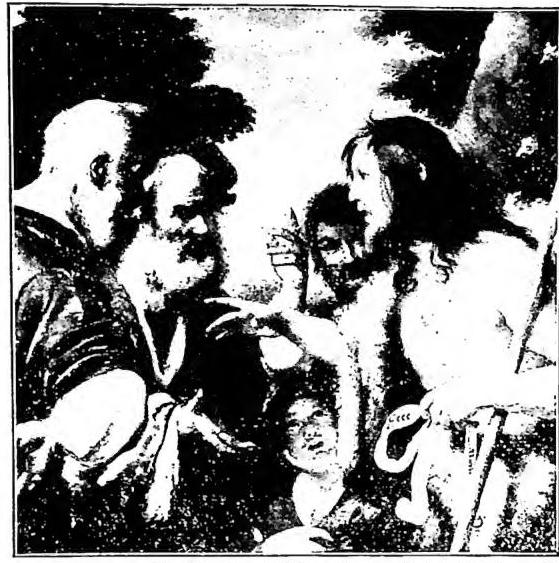
The figure of the Precursor enjoyed particular popularity during the Renaissance, the cause of which may also be found in the preference that artists of this period had for naturalistic forms, so much so that, as has been noted, the Baptist is the most frequently represented after s. Sebastiano and s. Girolamo. In this preference is also to be sought the reason that leads the figure of the Baptist, in Italian art, to become humanized, to definitively lose the hieratic quality with which it had been treated by the Byzantines - a humanization already exemplified in the 14th century in those representations of the young St. John led into the desert by the angel, such as that of the small panel from Rimini in the Pinacoteca Vaticana.
Representations of the isolated Baptist are extremely numerous, from the sculptural one by Ghiberti at Orsanmichele, to that by Benedetto da Majano in the Museo Nazionale in Florence, to the various ones by Donatello; in painting one may cite those by A. Vivarini at the Accademia in Venice, the solemn one by Cima da Conegliano, the heroic nude by Titian at the Accademia in Venice. As a preacher in the desert, famous is the representation by Veronese in the Galleria Borghese or that of D. Dossi at Brera. Also frequently represented during the Renaissance is the young St. John who becomes part of the numerous Holy Families, in which the little Saint, often with the characteristic signs of his future activity, plays and jests with the Christ Child, as in the most famous works of Raphael and Leonardo da Vinci.
Cyclical representations, frequent especially in baptisteries (v. S. Marco in Venice), present the unfolding of the Baptist's life from his birth (often confused, because iconographically very similar, with that of the Virgin) to his decapitation; certainly among the most well-known and artistically highest are the frescoes by Masolino at the Collegiata of Castiglion d'Olona. Among the other most important cycles are
cited those of Filippo Lippi in the cathedral of Prato, of D. Ghirlandaio in S. Maria Novella, of A. Del Sarto in the Chiostro dello Scalzo in Florence.
In the painting of the Baroque era, interesting depictions of events from the Baptist's life were left by, among others, Bazzani, the two Tiepolos, and, outside Italy, P. Trogher.
In a vast area of Central Europe, reaching as far as the Alps, disks of burning wood (known in Garnia as cidulis) are hurled down mountain slopes amid shouts of joy and good wishes; in certain countries of West-Central Europe, large burning and garlanded wooden wheels are rolled down. It is a widespread belief that on the night of St. John waters and herbs acquire supernatural powers: the dew of that night is therefore considered particularly beneficial for the cure of various illnesses; common folk consequently roll on the meadows wet with that dew and have cattle and flocks pass over them; women expose their garments and fabrics in general in the open, believing that the dew will preserve them from moths for the whole year. The waters of rivers and particular fountains acquire extraordinary healing powers, and people plunge into them repeatedly, or plunge their herds; sea water becomes sweet and produces the same beneficial effects. Various species of herbs also possess exceptional healing virtues that night: the common people gather and preserve them to use when needed. It is customary to place such herbs to soak in a basin exposed to the nocturnal sky, which is believed to increase their efficacy; in the morning, one washes with that water. The herbs of St. John vary according to different places; among the most common are: St. John's wort (hypericum perforatum), mint, verbena, chamomile, thyme, linden, melilot, elder, and mugwort.
On this night, lots are also cast, especially by marriageable girls. The methods are the same as those used for New Year's or the Epiphany, such as throwing pieces of molten lead into water and deducing the profession or status of the future spouse from the shape they acquire. One also listens at crossroads to the words of passing people, drawing auspicious or inauspicious horoscopes from them.
Among friends or female friends, or even between people of different sexes and among children, it is customary to contract spiritual kinship (comparatico). This is accomplished through special rites and forms: in Sardinia, as early as April 1st, a young man asks a girl to be his comare, and on the day of St. John they go together in procession to the church outside the village and with a series of festive customs
(libations, songs, dances) celebrate the comparatico. In Sicily, children take each other by the little finger of the right hand, each plucks a hair from the other, knots it, and throws it away while singing a little song that recalls the duties of compari. In many regions, especially in Southern Italy, the comparatico contracted on St. John's day is a very strong moral bond, and breaking it is considered a sacrilege.
It is believed that extraordinary phenomena occur on the night of St. John. Animals are satisfied with nothing: horses speak. The fern blooms and withers within a few hours. Water turns into wine. Hidden treasures reveal their presence. Lamentable voices come from the bowels of the mountains. Submerged cities and castles become visible; lit torches are seen revolving around bell towers and then vanishing.
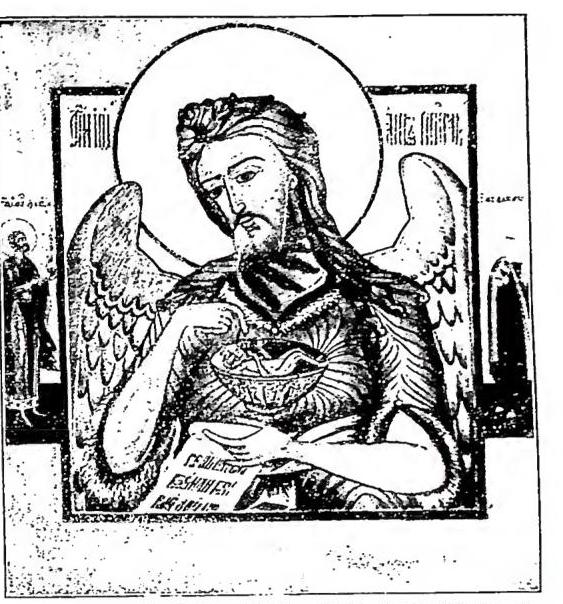
On the same night, witches are about, endowed with extraordinary powers; some tarantellas, Roman popular songs that were sung on the night of St. John, allude to this belief. A similar belief is widespread in Norway regarding trolls, malevolent spirits that emerge from the cavernous depths of the mountains that magically open on that night. In regions facing the sea, people anxiously await the moment when the sun will rise from the waves; it is said that the sun, upon emerging, dances on the sea, and not only when it appears, but up to a certain height; or even that it plunges three times into the sea and each time a small white cloud dries its face. In the sun's orb, the face of St. John is seen washing himself in the sea in a golden basin, or even his blood-dripping head.
By that principle that ethnologists call the "ambivalence of the sacred," St. John can also bring mourning and unforeseen accidents, almost as if the extraordinary forces acting on this day could also be exercised in a maleficent sense. Misfortunes, drownings, etc., are therefore feared. It is also believed that there will be a storm on St. John's day, and special formulas are recited to avert II.
For a long time, the theory held sway according to which the feast of St. John had supplanted a previous solar cult and very ancient rites for the summer solstice; the most recent researches tend to strip such opinions of validity and explain the complex of popular customs as a residue of agrarian rites of purification, prophylaxis, and propitiation. However, in some countries where Christianity took root late, especially in Northern Europe, traces of pre-Christian rites are still visible, and references to pagan deities or mythical figures are found there: Kupalo in Russia, Ligo in Latvia, Balder in Norway.
In Italy in ancient times, the feast of St. John gave rise in some cities to grandiose manifestations. In Florence, preparations began as early as May and the feast lasted several days, with palios, exhibitions, gifts and public tributes to the chapter of St. John, processions, illuminations, the lighting of fires in Piazza della Signoria, and sacred representations. In Rome, the Pope pontificated at St. John in Laterano and blessed the people from the loggia. In Ravenna, an annual, highly frequented fair took place. Now all these customs are rapidly disappearing or fading away, but revivals and updates are also noted, such as, for example, in Rome through the initiative of popular entertainment institutions: in the St. John district, the feast is still celebrated with songs, floats, pinwheels, libations; a characteristic food is snails.
The Church has sought to frame the main manifestations as far as possible within liturgical forms, with processions, blessing of fires and fonts, etc. — See plates XLII-XLIII.