
The parents of G. B. ZACCARIA, SANTO (v.), who belonged to the priestly class of Abijah, and Elisabetta, herself descended from a priestly lineage, at least on her mother’s side (Lc. 1, 5), and related (ἡ συγγενέ = aunt or cousin?) to the b. Virgin (Lc. 1, 36). Both were old but just and blameless (Lc. 1, 5-6); they had no children. Like that of Samson and Samuel, the birth of G. B. took place in a miraculous manner. Lc. 1, 5-25 describes its details. The angel Gabriel appears to Zaccaria in the “Holy Place,” at the right of the altar of incense, while he is offering the incense, and informs him that, since his prayer (to hasten the coming of the Messiah?) has been heard, he would be the father of the Forerunner of the awaited Messiah.
Gabriel reveals that G. “will be great before God, a perpetual nāšir and full of the Holy Spirit,” that is, freed from original sin, adorned with sanctifying Grace and with all the gifts of the Holy Spirit (not merely with the gift of prophecy: Konrad), while still in his mother’s womb (and not “from the moment of birth or childhood”: Konrad, Loisy, Plummer), according to Buzy at the moment when he “leaped” for joy. His mission resembles that of Elijah, whose spirit and power he was to possess (I Reg. 17-20), in order to restore the bonds of domestic society and lead unbelievers back to sentiments of justice and piety, as foretold in Mal. 3, 23-24 (Lc. 1, 17), so as to prepare a “perfect people” for the coming of the Messiah.
The angel assigns the name to be given him: Ἰωάννης is the Hebrew Ṭēhōḫānān, “Jahweh is gracious.” To Zaccaria, who asks for a “sign” of confirmation (probably because of a lack of faith), he predicts that he will be mute until the child’s birth. Elisabetta conceals her pregnancy for three months, attributing the merit of her motherhood to God. Then she receives the welcome and august visit of the b. Virgin, who, as soon as she learned from Gabriel himself (v. ANNUNCIAZIONE) that her aged and barren relative was six months pregnant through the intervention of God’s dynamis (“for nothing is impossible to him”), hastened to her aid in order to serve her. With a wealth of detail, Luca relates the scene of the meeting between the two relatives and G. B.’s “leaping” for joy in his mother’s womb, when she was “filled with the Holy Spirit” as she acclaimed Maria. Maria S.ma remained with Elisabetta for three months, and therefore until the birth of G. B. The place of the visitation is indicated in general terms: εἰς πόλιν Ἰούδα, to be translated “to a city of Judah,” situated in the hill country. Various locations have been proposed (Macheronte, Sebaste, Betlemme, Gerusalemme, Hebron, Juttah, Giuda di Nephthali, Bethzachara, Beit-Sa'kar), but the most probable is the traditional one of S. Giovanni in Montana, 'Ajn Kārim (v.), 6 km west of Gerusalemme, where two sanctuaries are venerated: that of the Birth of G. B. and that of the Visitation. In 1941-42 excavations were carried out there by the Franciscan Fathers.
Eight days after his birth, G. B. was circumcised and given his name, while Zaccaria, having recovered his speech, intoned amid the wonder of his neighbors the Benedictus (v.), in which he exalts the mission of the Forerunner, understood as preparing the ways of God and teaching the people the way of salvation through the remission of sins (Lc. 1, 68-78). According to Io. 1, 7-8, G. B. was to “bear witness to the light, so that all might believe through him.” Lc. 1, 80 describes the child’s physical, intellectual, and moral development: “he grew and became strong in spirit.” Thereafter he went to dwell “in the deserts.” This expression indicates a nomadic manner of life, spent now in one desert, now in another, that is, in the region extending between el-'Āṣūr and the southeastern shore of the Dead Sea, where the deserts of Ziph, Engaddi, Maon, etc., are found. However, the name “desert” may quite properly indicate a solitary region, even if not desolate. A tradition later than the twelfth century places him 5-6 km from 'Ajn Kārim, in a picturesque spot near the village of Soba. It is not known at what age G. B. went to live in the deserts. According to the legend preserved by the apocrypha, Elisabetta is said to have taken him there at the time of the massacre of the innocents, and God is said to have protected her there by miraculously concealing her and the child inside a rock. Lc. 1, 80 could also mean that this occurred at an early age (cf. the liturgical hymn: Antra deserti teneris sub annis - civium turmas fugium, petisti). Moreover, the parents of G. B., already advanced in age, could not have survived him for long.
In the deserts the young nāšir led an austere life. At the beginning of his ministry he wore either a loincloth of hard leather around his hips and a rough cloak woven of camel hair, thrown over his shoulders; or a tunic woven of camel hair, tightened at the waist with a coarse leather belt. His food consisted of locusts (lawful food: Lev. 11, 22) and wild honey (from bees, and not plant exudate from the tamarix: μέλι ἄγριον), that is, foods obtained by chance, on which the Bedouins also subsist. He remained in the deserts until the fifteenth year of Tiberius Caesar, while Ponzio Pilato was procurator of Judea. If the fifteenth year is reckoned from the death of Augustus (19 August 767 of Rome), it corresponds to A.D. 28-29; if, instead, from his association with Augustus (January 765 of Rome), it corresponds to A.D. 26-27.
G. B. received directly from God the command to begin his mission (Lc. 3, 1-2), and established himself in the desert of Judah, near the Jordan, that is, between the mountains of Judah, Jericho, and the Dead Sea. With the spirit and power of Elijah, and with the authority derived from his asceticism and divine vocation, G. B. “prepares the ways of the Lord,” leveling the tells, filling the wadis, widening and straightening the paths, by preaching the necessity of conversion (μετάνοια) and “of a baptism of repentance for the remission of sins,” since the “Kingdom of God” was near. He addressed various social classes and inveighed against the hypocritical Pharisees and Sadducees, proclaiming that belonging to the lineage of Abraham was not sufficient for salvation, but demanding positive fruits in the form of good works. In a climate of anxious messianic expectation, G. B. aroused great enthusiasm; crowds came from Gerusalemme, Judea, and the region of the Jordan, and G. B. baptized them by immersing them in the Jordan while they confessed their sins. This movement of the masses gave rise to the suspicion that G. B. was the Messiah (Lc. 3, 15), notwithstanding that he did not belong to the lineage of David.
While G. B. Bethania (v.), beyond the Jordan, the Jewish authorities (the Sanhedrin?) sent an embassy from Gerusalemme consisting of priests and Levites, among whom were some Pharisees, to ask him whether he was the Messiah, Elijah, or the Prophet (Io. 1, 19-28). G. B. denied this, proclaiming that he was only “the voice crying in the wilderness foretold by Isaiah” (40, 3), and bearing witness to the superiority of Jesus’ mission, as he had done earlier (Io. 1, 15-18) and would do thereafter (Io. 1, 29-37). Indeed, he regarded it as so sublime that he did not consider himself worthy to “untie his sandals.” His Baptism is as far superior to John’s as spirit and fire are superior to water. Lamb (v.) of God (because of his meekness and expiatory power), the one who takes away the sin of the world. He is the Messiah and the Son of God. He possesses a consuming fire; he holds in his hand the winnowing fan and the sieve with which to sift the deeds of humanity, which he must judge.
Jesus wished to present himself to G. B. in order to receive baptism from him. The marvelous scene, with the descent of the Holy Spirit in the form of a dove, is described vividly by the Synoptics (Mt. 3, 13-17; Mc. 1, 9-11; Lc. 3, 21 sgg.).
According to Mt. 3:13–14, G. B. knew Jesus and his mission from the moment he presented himself to him for baptism. Thus he sought to excuse himself; according to Io. 1:33–34, however, G. B. did not know him; rather, he recognized him by the sign of the descent of the Holy Spirit. St. John Chrysostom and St. Augustine, followed by other authors, have proposed various so-
lutions (cf. Buzy [V. BIBLICA.] pp. 191–95). It seems possible to reconcile the two Evangelists by understanding that, when G. B. was beginning his ministry as Precursore, the One who was to baptize in the Spirit was revealed to him, and, as confirmation, he was given the sign of the descent of the symbolic dove; «he did not know Jesus» because before that revelation he was unaware of his mission: οὐκ ἦλεν αὐτὸν does not refer to the moment immediately preceding the request for baptism, but to the period before the revelation, and concerns not the person of Jesus, whom he must have known, but his mission.
G. B. formed a group of disciples: from among them Jesus recruited the first Apostles (Andrea, Simone, Giovanni, Filippo, Natanaele), all Galileans, which shows that the influence of G. B. extended far afield. They were steadfast in following G. B. In addition to having received his baptism, they imitated his asceticism (fasting and prayers: Mt. 9:9–14; Mc. 2:13–18; Lc. 5:27–33; Mt. 11:1), followed him to Aennon, Bethania, Macheronte, etc.; nor did they look favorably upon his being eclipsed by Jesus. G. B., however, on various occasions reaffirmed his inferiority before Jesus and directed them to him.
The beginnings of the preaching of Jesus and of G. B. are reported in the same terms (Mt. 3:2; 4:17). G. B. began in the Gôr; then he crossed Bethania (v.), where he received the embassy of the members of the Sanhedrin (Io. 1:28). While Jesus preached in Judea (Io. 3:22), surrounded by disciples, G. B. Aennon (v.) near Salim, rich in water (Io. 3:23), where a discussion took place between the disciples of G. B. and a Jew concerning purification. Then they went to G. B. to point out to him, with poorly concealed envy, Jesus’ remarkable successes. G. B. again responded by affirming his superiority and considering his own mission completed; he concluded with generous humility: «He must increase: I must decrease» (Io. 3:25–36), inviting them to follow Jesus.
Goguel’s opinion (La vie de Jésus [V. BIBLICA.], p. 255 sgg.), according to which Jesus had been a disciple of G. B., from whom he later separated as a result of disagreements concerning purifications (Baptism), and who therefore regarded him as an unfaithful disciple and almost a renegade, has no foundation. Nor are there contradictions between Io. 3:26; 4:1 and 3:32; between 3:22; 4:1 and 4:2; nor are there traces of reworking in the account of G. B. in Io. 3:22–4:31.
G. B. continued his mission with courage and frankness, reproving vices and inviting people to repentance. But because he publicly reproached the tetrarch of Galilee, ANTIPAPA (v.), for his incestuous and adulterous marriage with Erodiade, his niece and the wife of his still-living brother Filippo, the tetrarch, perhaps fearing that G. B.’s powerful eloquence might provoke popular uprisings (the people were certainly scandalized by his conduct), had him arrested (at Tiberiade or at Livias?) and thrown in chains into the prison—according to Fl. Giuseppe—of Macheronte (el-Mukāwer, in the mountains of Moab, between the Zerqā Mā'in and the Arnon, at an elevation of 1,100 m above the level of the Dead Sea). It is not known how long he remained there.
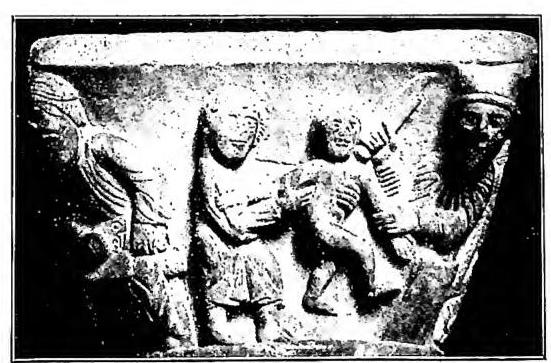
(from G. De Jorphanion, Un curieux chapiteau du Baptiste au Musée de Lyon, in Miscellanea Mercati, vol. V, tab. 1. Città del Vaticano 1921)
GIOVANNI BATTISTA — Circumcision of G. B. Capital from Modena, now in the Museum of Lyon (12th century).
since the time of the baptism, cannot now begin to believe in it (Loisy). His attitude, however, is interpreted in different ways. Some believe that, in the desolation of the prison at Macheronte, he may have entertained some doubt about the mission of Jesus, or perhaps some impatience to see the Kingdom of God realized as soon as possible (cf. Buzy, pp. 286–306); or that he may have wished to urge Jesus to manifest himself with greater decisiveness and clarity. The most common opinion is that G. B. wished to elicit from Jesus an explicit declaration of his messiahship in order to convince his disciples of II. This accords with the praise Jesus bestows on G. B. after the departure of the envoys. Indeed, he proclaims him the herald of the Messiah, superior to the saints of the Old Testament, the link between the Old and the New Testament; he is not a reed shaken by the wind, nor a delicate man, but an ascetic; he is more than a prophet; he is Elijah!
Antipa willingly listened to G. B. in prison, becoming increasingly troubled by him. But Erodiade hated him to the death and had decided to silence him forever. Antipa would not allow this because he venerated him and feared the people, who regarded him as a prophet. When Antipa’s birthday was celebrated, during the banquet given to the senior officers and the aristocracy of Galilee at Macheronte, the daughter of Erodiade (Salome) performed dances that pleased Antipa so greatly that he swore to grant her whatever she asked, «even half the kingdom». The girl consulted her mother, who suggested that she immediately have the head of G. B. brought to her on a platter. Antipa was saddened, but because of the oath he had made before the guests, he considered that he ought not to disappoint her. The executioner beheaded G. B. in the prison and brought his head to Salome, who handed it to her mother. S. Ambrogio, in poetic accents, highlights the value of G. B.’s martyrdom and the cruelty of those who ordered it (De Virg., III: PL 16, 233 sgg.).
The disciples took care to retrieve and bury the body. Antipa and the people later believed that G.
B. had risen again and was working miracles in the person of Jesus (Lc. 9, 7-9; Mc. 6, 14-16). The crime of Antipa, according to Fl. Giuseppe (Antiq. Ind., XVIII, 7, 2), deeply affected the people, who considered him a «good man», and many, when the army of Antipa was bloodily defeated by Areta, king of the Nabataeans and father of the wife of Antipa, who had been set aside in favor of Erodiade, saw in it a punishment from God for the killing of G. B.
The history of his relics was varied (Sebaste in Palestine, Alexandria in Egypt, Samaria, Constantinople). The places where he had preached were soon venerated by the faithful (Aennon, Sapsas, Giordano, Sebaste, 'Ajn Kārim, Zifata).