
ILARO, POPE, saint
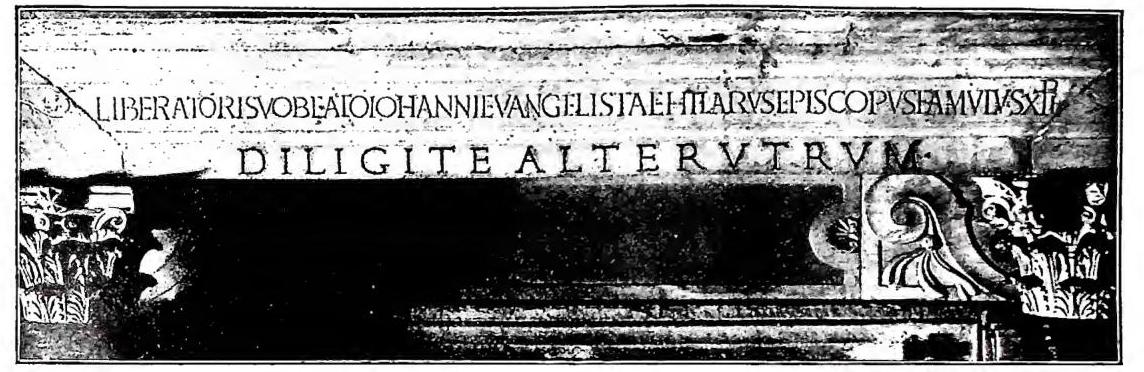
Inscription placed by Pope Hilary on the architrave of the oratory erected in the Lateran Baptistery to St John the Evangelist. The *Diligite alterutrum* is an addition from the 17th century — Rome.
Hilary (Hilarius), a native of Tabenna in Palestine, was a disciple of St Anthony. After a sojourn in Alexandria, he returned to his homeland and, finding his parents dead, distributed all his goods to the poor. At barely fifteen years of age, he retired to a solitary place seven miles from Maiuma. For five years he lived in a hovel, then built himself a narrow cell; frugal in food and austere in dress, he spent his time in penance and prayer. As his fame for virtue and miracles spread, many joined him in this way of life. In 320 he built the first monastery, thus giving rise to cenobitic life in Palestine, which soon saw the multiplication of monasteries. Irritated, however, by constant visitors, Hilary left the monastery in search of a quieter place; he then went to the Thebaid, where he visited the sites sanctified by Anthony; subsequently he went to Alexandria, Sicily, Dalmatia and finally to Cyprus, where he died at about eighty years of age. His body was later stolen by his disciple Hesychius and taken back to Maiuma.
A biography of Hilary was written soon after his death by St Jerome, around 391; all later lives depend on this, including the earliest versions, the oldest of which, in Greek, dates to the first half of the 5th century and is by a certain Sophronius, a friend of St Jerome himself. The anecdotal character of the Jerome biography, replete with more or less legendary and rhetorical details, led some critics to deny it any historical foundation, arguing that it was a completely fabricated novel, including its protagonist. It is certain that St Jerome wished to present a model of monastic virtue for the edification of pious souls, and for this purpose he wrote the life of Hilary; but this does not justify denying the historical existence of the subject. Indeed, the life of the disciples and the veneration accorded to Hilary in Maiuma are attested, independently of St Jerome, by the historian Sozomen. In the Roman Martyrology he is commemorated on 21 October.