
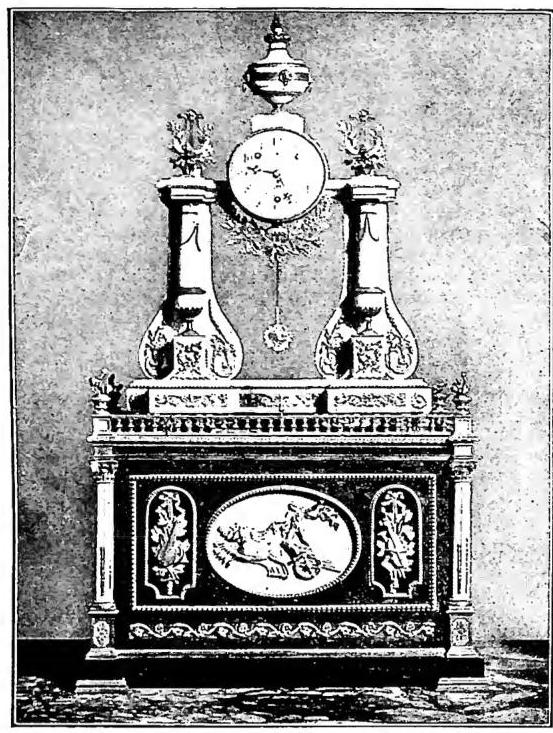
The term "Empire style" can at first deceive as to the actual contribution of originality in the style. This style, represented by imposing buildings and urban layouts abroad (Paris, St. Petersburg, in the latter of which Italian genius was able to assert itself with Quarenghi and Carlo Rossi), has no significant monuments in Italy (the best-known architect who worked in Rome, Valadier, is a mediocre figure; yet notable buildings include the Teatro San Carlo by Niccolini, and the church of San Francesco di Paola by P. Bianchi in Naples, the Cistern by Piccianti in Livorno, the Arco della Pace by Cagnola and several palaces in Milan, in the Emilian region, the Tempio Canoviano in Possagno, etc.). In painting, our Appiani is not a name as representative as the French David, but for sculpture Italy boasts Canova, who was supreme in his time. — See pl. CIII.
IMPERIO, STILE
Bibl.: Examples of sacred art will be found in P. Ruga, Invenzioni diverse di mobili ed utensili sacri e profani, Milan [first chapter on interior decorations, with additions by G. Borsato, Venice 1843; for funerary monuments V. G. Zecchi, Collezioni dei monumenti sepolcrali del cimitero di Bologna, 4 vols., Bologna 1852-27; Normand fils, Monuments funéraires choisis dans les cimetières de Paris, Paris 1832. Also J. Foliesciz, Innenäume und Hausrat der Empire- und Biedermeierszeit in Österreich-Ungarn, Vienna 1918; P. Marmottan-J. Vacquier, Le style empire, architecture et décors d'intérieurs, 5 vols., Paris 1920-30; F. Luthmer, R. Schmidt, Empire- und Biedermeiersmöbel, Stuttgart 1922; H. Schmitz, Deutsche Möbel des Klassizismus, 6 vols., Paris 1923; G. Pauli, Die Kunst des Klassizismus und der Romantik, Berlin 1925; A. Nekrasov, Russkij Ampir [in Russian], Moscow 1935; P. Francesat, Le style empire, Paris 1930; A. M. Brizio, Ottocento, Novecento, Turin 1939; M. Praz, Gusto neoclassico, Florence 1940; E. Hessling, Empire-Möbel, Leipzig n.d.; E. Lo Gatto, Gli artisti in Russia (L'opera del genio italiano all'estero), Rome 1943, especially vol. III. For painting see especially W. Friedländer, Hauptströmungen der französischen Malerei von David bis Cézanne, Leipzig 1930. Mario Praz