
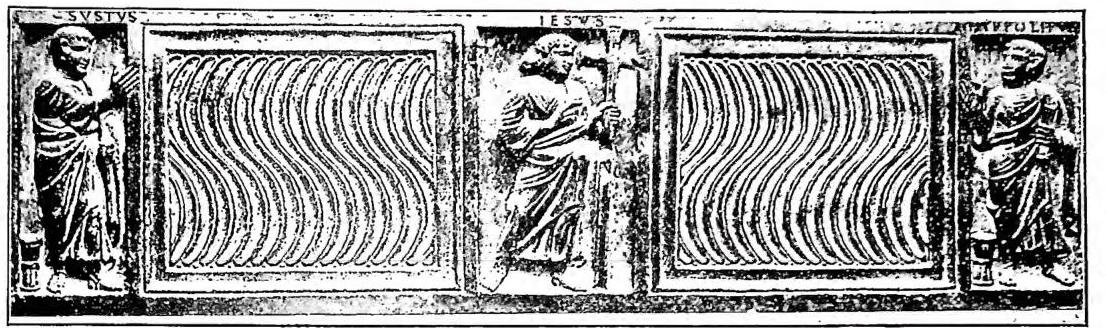
HIPPOLYTUS of Rome, saint, martyr — Christ between the martyrs Sixtus II and H. Front of a 4th-century sarcophagus — Apt, Cathedral.
Rebellious in spirit even under the pontificates of Urban and Pontian, the episcopal dignity which a good part of authors from the 4th century onward concede to him, and indeed the very Roman see assigned to him by Apollinaris of Laodicea (cf. A. Mai, Script. veterum nova collectio, I, II, Rome 1881, p. 173), is the echo of his activity as an antipope, which was brought to an end by the persecution edict of the emperor Maximinus the Thracian, directed chiefly against the leaders of the Churches. In fact, the Liberian Catalogue attests that both Pontian and H. were deported to the “noxious” island, Sardinia; united in misfortune, they reconciled and both died for the faith. An echo of this reconciliation is found in the Damasian poem and in the Peristephanon of Prudentius. From the Liber Pontificalis (I, p. 145) we learn that Pope Fabian, once the persecution had ceased, had the body of Pontian transferred to Rome; it is probable that at the same time provision was also made for the transfer of that of H., since the Depositio Martyrum assigns the deposition of both to August 13.
The cult of H., attested not only by the aforementioned Depositio and by the cemetery sanctuary, is also evidenced in Rome by the erection, at the end of the 4th century, of an oratory on the Vicus Patricius by the priest Illicius (cf. C. Huelsen, Le Chiese di Roma nel Medio evo, Florence 1927, p. 263). H. and Pontian are commemorated in the Martyrologium Hieronymianum and have two Masses in the so-called Leonian Sacramentary: the preface recalls only the martyrdom of H. In the other sacramentaries, the Gelasian, the Gregorian, and the 8th-century Gelasian, as indeed in the present Roman Breviary and Missal, Pontian disappears and only H. remains (in the prayers he is simply called “the martyr”). Already in the 6th-century Calendar of Carthage (ed. H. Lietzmann, in Kleine Texte, Bonn 1911, p. 5) he appears alone, as also in the Visigothic oration on August 11 (ed. J. Vives, Barcelona 1946, pp. 370–72, prayers to be attributed to Eugenius of Toledo). In the 5th and 6th centuries, H. is often recalled or depicted with the martyrs Sixtus and Laurence, as in the Ambrosian Canon (cf. F. Savio, Gli antichi vescovi d'Italia. La Lombardia, I, Milan–Florence 1913, pp. 922, 930; in the 5th century a chapel dedicated to H. was adjacent to St Laurence: ibid., pp. 185, 200), in some gold-glass objects (Florence; Vatican Library), in the mosaic of S. Apollinare Nuovo in Ravenna, in that of S. Lorenzo al Verano in Rome, and in the sarcophagus of Apt; in catalogues of relics, even in Africa, and in the dedication of the church of Fossombrone, recorded in the Martyrologium Hieronymianum on February 2, August 6, and November 2 (cf. H. Delehaye, La dédicace de la basilique de Fossombrone, in Rendiconti Pont. accad. rom. di arch., 6 [1930], pp. 102–11). It is probable that there was also a basilica dedicated to our H. in Porto. In the Synaxaria, H. “πάπας 'Ρώμης” is commemorated on January 30.
WORKS. — H. was above all an exegete. His exegetical writings survive in fragments and in a very small part in the original Greek, the rest in Slavonic, Georgian, etc. translations, for, like all the works of H., they were soon forgotten in the West but read and spread in the East. We possess, partly in the Greek text and partly in Slavonic translation, the Commentary on the Book of Daniel, and, partly in Greek and entirely in Georgian, that On the Song of Songs, and likewise in Greek and Georgian, that On the Blessings of Jacob, and in Georgian that On the Blessings of Moses — perhaps originally a single work — and that On David and Goliath. The most important among these are the commentaries on Daniel and that on the Song of Songs: from the latter especially one can gain an idea of H.’s exegetical method, which is concerned with the typological sense of Scripture (the bridegroom is for him a figure of Christ, the bride the Synagogue from which the Church must emerge, the bridegroom’s leaps represent the Incarnation, the Crucifixion, the descent into hell, the Resurrection and the Ascension; the title is explained as the song in which is gathered the essence of all the songs composed by Solomon). In the commentary on Daniel certain historical questions about the family of Susanna and Joakim are resolved and some allegorical interpretations are given: Susanna is the Church, the two elders are the two enemies of the faith, the Jewish people and the Gentiles; Daniel in the lions’ den is seen as the condition of Christians before the persecutions, the fourth beast of the vision is the Roman people. The other exegetical works, of which little or nothing survives, are the commentaries on the Hexaemeron, on Exodus, on the Fragments of Ezekiel, on Genesis, on Zechariah, on the Psalms, on Isaiah, on the Apocalypse, on Proverbs, on Ecclesiastes, on Saul and the Witch of Endor, recorded by Eusebius and St Jerome, and on the Little Daniel and Susanna, recorded by Ebedjesu.
Of the dogmatic works, brief fragments survive in Greek and Syriac of the treatise On the Resurrection; the treatise On the Antichrist survives entire in Greek. In this work H. sets out to examine what the Antichrist is, at what time his coming will occur, from which tribe he will come, what name he will bear, how he will deceive men, how the Saviour’s return and the cosmic fire will bring his kingdom to an end, what the heavenly kingdom that will follow will be, and how the wicked will be punished.
H. also composed works of a disciplinary nature. St Jerome, in Epistle LXXI, 6, says that H. had
written “on the Sabbath,” whether fasting was required on that day, and on the Eucharist, “whether it should be received daily.” It is impossible to determine in which works Hippolytus treated these subjects, if indeed he did so in special treatises; in the list inscribed on the statue mention is made in succession of an *Itepe Xa-pia-màtov* and an *Apostolikh napaBOSIS*, which might even be a single work. This *Apostolica traditio* has been identified by Connolly with the so-called Egyptian Church Order, which survives only in Coptic, Arabic, Ethiopic, and Latin translations (the Verona palimpsest, which contains various fragments of it). It deals—hence its documentary importance—with the ordination of bishops, priests, deacons; it treats of confessors, lectors, subdeacons, widows, virgins; and it provides a great number of precepts and regulations concerning ecclesiastical ritual and liturgy (Baptism, the agape, fasting, the Eucharist, prayer, the gatherings of the faithful, the catechumenate, the commemoration of the dead, etc.). Objections have been raised by various scholars to the identification proposed by Connolly, but while the problem of defining the relationships of dependence among the ancient disciplinary collections remains far from a decisive solution, the view of those who see in Hippolytus’ *Apostolic Tradition* the earliest known constitution of the Church and the source of Book VIII of the Apostolic Constitutions, the *Epitome* of that work, the *Testamentum Domini*, and the Canons of Hippolytus seems preferable to the opposing thesis.
These *Canons of Hippolytus* (a disciplinary collection of 38 canons surviving in Arabic and Ethiopic translations, largely identical in content to the Egyptian Church Order but with numerous additions, abbreviations, and transpositions) can hardly—even if they may contain fairly ancient parts—be considered a work of Hippolytus. Among the reasons that preclude this attribution are the low value of the Arabic subscription that assigns them to him, the presence in them of elements (though not so explicit or decisive as some have claimed) betraying a later period than that of Hippolytus, and the incompatibility between the (intransigent) doctrine of Hippolytus, as it appears in his (or at least generally attributed to him) *Refutatio*, on the reconciliation of penitents, and that expounded in the *Canons*. It is impossible, moreover, to establish the name of the author of the *Canons*, although their Western origin and chronology seem probable; scholars variously date them between 200–250 and 300.
V. VI.
A work of chronology is probably the treatise *On Easter*, in which, according to Eusebius, the Paschal cycle was established; a portion of it, relating to the years 222–23, was, as has been said, inscribed on the statue found on the Via Tiburtina.
The polemical works represent a significant part of Hippolytus’ literary activity. A disciple of Irenaeus, he continued the battle waged by his master against heresies, though with different aims, since the positions of orthodoxy and heresy had changed by his time. The treatise *Against Marcion* may perhaps be identified with the treatise *On the Good and the Origin of Evil* (one of Marcion’s most important tenets); a *Proof Against the Jews* survives in a fragment, but the authenticity of the work is doubtful. In a work entitled *Apology for the Apocalypse and the Gospel of John*, against the thesis of a Roman priest, Caius (v.), who attributed these two writings to the heretic Cerinthus, Hippolytus defended their authenticity; it is uncertain whether this work of Hippolytus is to be identified with the *Chapters Against Caius*, from which the Syriac Dionysius Bar Salibi, metropolitan of Amida, drew quotations for a commentary on the Apocalypse: they may well be two distinct works. The attribution to Hippolytus of the fragments cited by Eusebius as coming from a treatise *Against Artemon* is also doubtful; this may perhaps be identified with the *Little Labyrinth* mentioned by Theodoret. Entirely lost is the *Treatise Against 32 Heresies* (*Σύνταγμα κατὰ αἱρέσεων λβ'*), cited by Photius, who calls it a “little book” (*βιβλιάδριον*); the refutation of the heresies began with that of Dositheus and ended with that of Noetus. This writing was very probably the source of the Pseudo-Tertullian in the appendix to *De praescript.*, of Epiphanius’ *Panarion*, and of Filastrius of Brescia’s *Liber de haeresibus*, and on this basis it is partly reconstructible (this *σύνταγμα* is probably the same as the *Ἥλιος ἀπάσας τὰς αἱρέσεις* mentioned by Eusebius and the *Adversus omnes haereses* cited by St. Jerome).
A lengthy fragment survives of a homily *On the Heresy of Noetus*; it is likely that this constitutes the end of the *σύνταγμα*, though it seems at odds with the brevity with which the treatment of the *σύνταγμα* must have been conducted. To this list of works others might be added: those indicated in the list inscribed on the statue (the *Chronicle*, which exerted a wide influence on medieval chroniclers, the *Protreptic to Severian*, the *Ἥλιος Ἕλληνας καὶ πρὸς Ἑλλάτων ἢ καὶ πρὸς τὸν πάντα*, the *Ἀλήθειαι εἰς πάσας τὰς γραφάς*), and the *Refutatio omnium haeresium*. Of this work only Book I was known, under the title *Philosophumena* and attributed to Origen, until the discovery in 1842 by Minodide Mynas of an Athos codex containing the remaining books up to X, with a lacuna at the beginning covering Books II and III. But to do this one would have to be quite certain that the statue represents Hippolytus and that the *Refutatio* is his; yet both attributions remain conjectural, even if supported by valid reasons. The statue has already been discussed; the attribution of the *Refutatio* to Hippolytus rests especially on the fact that the author is a contemporary and bitter enemy of Callistus, a scholar, and founder of a Church in opposition to that governed by Callistus’ successors, and that this author appears to be a man of great learning, a prolific writer of numerous works—conditions that seem to fit no one but Hippolytus. Nevertheless, this attribution has not been made without controversy, and even recently, after near-unanimous agreement had been reached on the name of Hippolytus, voices have been raised that have shaken confidence in the attribution generally accepted, even if the name proposed for the person represented on the statue and for the author of the *Refutatio*—a certain Josippus, indicated by Photius as the author of an *Ἥλιος παντός*, a thesis advanced by Nautin—falls far short of complete satisfaction (for even if substantial and formal differences between the fragment *Against Noetus* and the *Refutatio* are granted, one must still ask how it is that no trace survives of this Josippus, alleged author of the *Refutatio* and of the works listed on the statue, a man of consequence, a learned figure, founder of a schismatic Church, save in the questionable attribution of a single work). All the same, for now one can speak of the *Refutatio* only as a work attributed to Hippolytus.
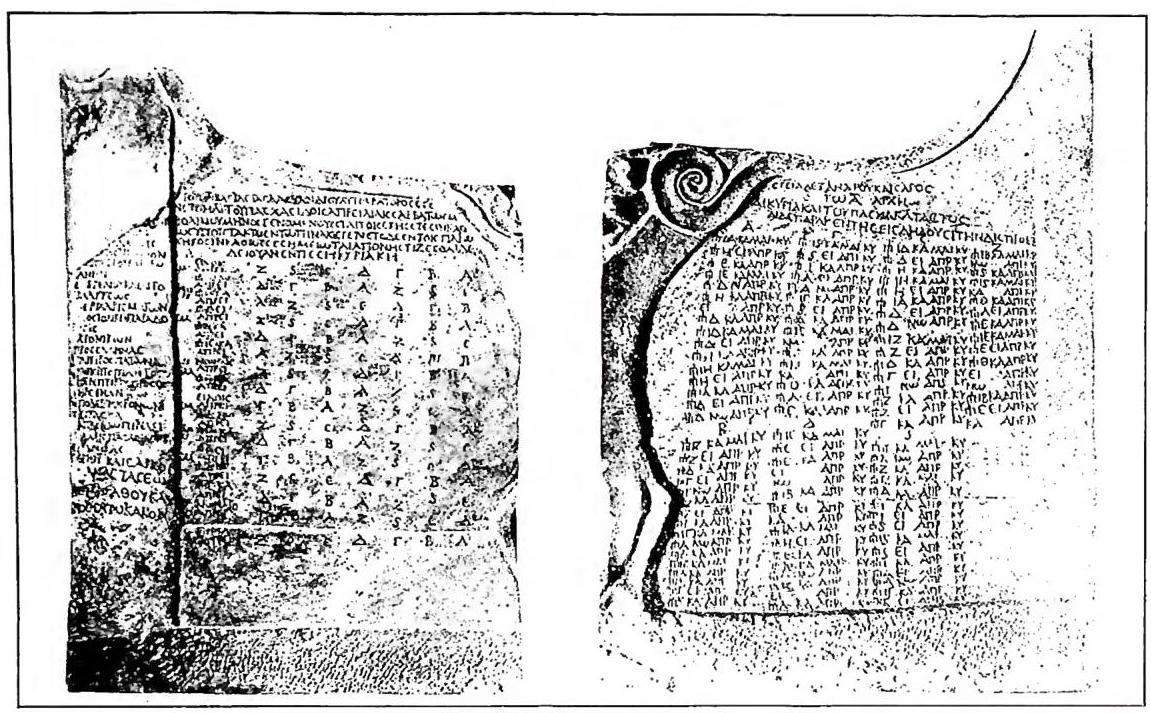
Hippolytus of Rome, Saint, Martyr – Catalogue of works and Paschal cycle inscribed on the sides of the marble throne of St. Hippolytus – Rome, Lateran Museum.
The work has a clear line of development in its purpose of demonstrating that the germ of all heresies was to be found in the doctrines of the pagan philosophers. Book I is an exposition of the doctrines of the Greek philosophers; the two lost books that follow were to have been an exposition of the rites of the mysteries; in Book IV, astrology, geometry, and magic are treated; from Book V onwards, the heresies begin to be expounded and criticized; in Book X there is a recapitulation of the material dealt with in the preceding books, and an exposition of the true doctrine. It is possible that—even without accepting the hypothesis of those who consider the author a victim of forgers—the sources of information are not always reliable, but in the exposition of the heresies closest to his own time, the tone becomes more personal and the information richer, even if not always as objective as it should be: a work, in conclusion, of little originality and not great speculative vigour, but not lacking in historical interest and the merit of clarity, even if the author sometimes indulges in the effects of sophistic virtuosity.