
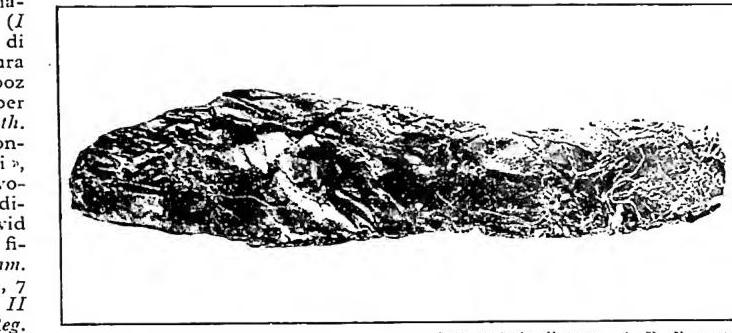
ISAI (Heb. Ἰσαΐ; Vulg. Iesse). — Third descendant of Boaz (v.) DAVIDE (v.), from Bethlehem. He had eight sons and at least two daughters. It was in his house that, Saul (v.), Samuel (v.) was sent to anoint another king: and the youngest, DAVIDE (v.), was chosen (1 Sam 16). When David later began his wandering life to escape Saul’s wrath, I. was taken by his son to the king of Moab (I.’s grandmother had been a Moabite: Ruth). Nothing is known of his death.
Although he was one of the “elders” of Bethlehem (1 Sam 16:4–5) and of not obscure family—his grandfather Boaz had been renowned for martial virtue (Ruth 2:1)—I. was in fact “one of the common people,” and Saul was only too happy to vent his contempt for David by calling him “the son of I.” (1 Sam 20:27, 30–31; 22:7–8; cf. 25:10; 2 Sam 20:1; 1 Kgs 12:16). Yet this designation, after Isaiah had used it in a splendid messianic prophecy—“A shoot shall come out from the stock of I., and a branch shall grow out of his roots” (Isa 11:1, 10)—would become famous; it is enshrined in the Christmas liturgy (“O Radiant Shoot of Jesse…”).
ISAI (Heb. Ἰσαΐ’[א] = “salvation [of] Yahweh,” Salten 1:1).
He felt himself co-responsible. But then one of the seraphim took from the altar a burning coal and with it touched the prophet’s lips, thus purifying them. Thereupon Yahweh himself communicated to him his mission: the task of hastening, by his word, the action of the divine judgment already under way against the rebellious people, until it should be reduced to a stump from which a new “shoot” was to spring—the messianic people (Isa 6:13). The mystery of the orphan and the widow (Isa 23; etc.). Personal violence is also spoken of, even to the point of murder: the prophet knows of “scarlet sins” (Isa 1:18); God hides His face from the gesture of prayer (stretching hands to heaven) because those hands are full of blood (Isa 1:15). Perversion extends even to moral conceptions: men call good what is evil and evil what is good (Isa 5:20). The denunciation of the most disgusting moral failings completes the rejection of external religiosity, which is often associated with them in jarring contrast to the urgent demands of divine holiness.
A characteristic of I.’s thought was the appeal to public activity and even politics to conform to the principles of Yahwist faith and morality. Israel is the people of God: it has a law, and God demands of it a way of life; its public life, like its private life, cannot therefore be like that of any of the gentile peoples. Its kings cannot follow the current that sweeps all kings and peoples into a politics of sheer utilitarianism. Moreover, Israel, as the possession of Yahweh, must preserve its spiritual heritage from every pagan degeneration; it cannot, even for occasional reasons, ally itself with idolatrous peoples. Hence the bitter opposition that I., before and more than any other prophet, showed toward political and military alliances with pagan peoples. In the struggle for hegemony being waged among the neighboring powers—Samaria, Syria, and Assyria to the north, Egypt to the south—Israel must take no part.
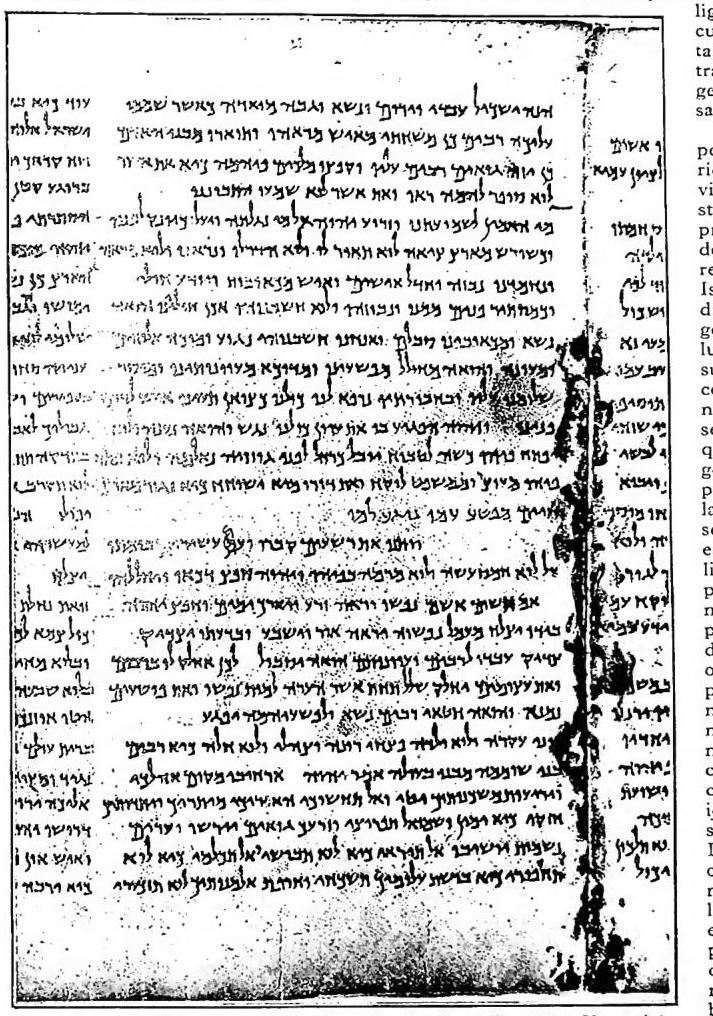
Isaiah 52:13–54:4: prophecy of the Passion (the last of the Servant-of-Yahweh songs). Scroll of I. found at “Ain Feshkah” (Dead Sea).
The year 701 B.C., which revealed the greatness of the prophet’s soul, also highlighted the “utopian” character of his religio-political views with the most “impolitic” of his proposals (his refusal of Sennacherib’s offer of terms when the Assyrian king, though in difficulties, was still riding from victory to victory). Had King Hezekiah not followed the advice of the aged prophet, he would have been overwhelmed—and with him Jerusalem itself. Amid the stormy sea of events, I. pointed to the unshakable rock of trust in the Lord to which the king and the people must cling: it was through trust in the Lord of I. that Jerusalem was saved.
As a result, like all men of God, he met opposition. His words were not always listened to with deference and respect: interests threatened, vices denounced sought revenge in calumny, hatred, and mockery (Isa 28:9–10), in scorn for his word (Isa 30:12), and at times brought him alternating popularity and unpopularity, favor and disfavor at court. To one such moment an unverifiable Jewish tradition, transmitted in late documentation, links the end of I., on which the biblical text is silent and which would have made the prophet a martyr.
II. THE BOOK OF ISAIAH
The book clearly falls into two parts, a division accepted identically by all scholars.
1. First part (chaps. 1–35) and historical appendix (chaps. 36–39). — The first part reflects the characteristic prophetic mentality of the 8th–7th centuries B.C., as known from other writings of that age, in this case accompanied by powerful thought and expressive perfection. The prophetic theme is essentially a grand divine judgment upon contemporary life and history: not only the pagans and not only the schismatic northern kingdom, but also Judah (Jerusalem) for its religious infidelities and moral failings is to be subjected to “judgment”; the instrument of punishment will be Assyria, moved by Yahweh. The people will be overwhelmed together with the ruling dynasty; from the disaster only a small “remnant” will be saved, which will be the germ of the messianic people. From the Davidic stock a shoot will sprout: ALZON, EMMANUEL D' (v.), the Messiah, who will reign eternally and universally in Zion.
Special considerations of content lead to a further distinction of smaller collections of Isaianic oracles (1st collection: chaps. 1–12; 2nd: chaps. 13–27; 3rd: chaps. 28–35, in which even more subtle distinctions are sometimes possible), which may for a time have existed independently before being incorporated into the present work. Because of this gradual formation, perhaps through successive accretions, the book is not arranged according to a single principle. Among the “minor” collections, two deal with Babylon (chaps. 13–14 and the first part of chap. 21) and one is a singular composition known as the “Apocalypse of Isaiah” (chaps. 24–27), whose authenticity is seriously questioned for reasons (set forth, e.g., by the Catholic J. Fischer [V. BIBLICA.], I, pp. 110, 148) of historical setting (the Neo-Babylonian power did not emerge until at least a century after Isaiah) and of form.
The historical appendix (chaps. 36–39) has a common origin with 2 Kgs 18:17–20:19, of which it is essentially a duplicate; there are grounds for considering it either the work of Isaiah (cf. 2 Chr 32:32), used by the author of the Book of Kings, or the work of the author of that book, from which it was excerpted and inserted into Isaiah because of the important role the prophet played in the events narrated.
2. Second part (chaps. 40–66). — Notable differences in content and form have, since the end of the 18th century (Döderlein, 1775; Eichhorn, 1824), raised strong doubts about the authenticity of this second part, whose author, without prejudice to the critical question and provisionally, so long as the serious problem remains unresolved, is almost universally designated by the name “Deutero-Isaiah.”
Some scholars then accept a further division of this part, proposed by Duhm (1892), into two collections by different authors, called the "Deutero-Isaiah" (chapters 40-55), from which the poems on the "Servant of Yahweh" are kept distinct, inserted at four different points (in chapters 42, 49-50, 52-53), and the "Trito-Isaiah" (chapters 56-66). Other, more minute and daring divisions, devised by isolated "critics," do not merit consideration.
The author, with the mentality, aspirations, and concerns of a Jew living at the end of the Babylonian exile, speaks mostly of the imminent liberation of Israel, its return to the Holy Land, and the inauguration of the "kingdom of God." Formally, there are poems, true literary "components," some of them lengthy, according to a technique that employs advanced and sometimes refined means. This brief note is sufficient to indicate the distant origin of the hypothesis that this "second part" should not be attributed to Isaiah, but to an anonymous writer of the 6th century B.C., possibly a scholar of Isaiah, and should be considered a biblical book in its own right. One must affirm the eminently historical-critical nature of the question, despite its rationalistic origins.
For Catholics, the (religious) value of the messianic prophecies contained in Isaiah 40-55 would remain intact in almost all cases, even if they were attributed to an author of the 6th century B.C. rather than to Isaiah of the 8th century B.C. (cf. H. Höpfl-A. Miller-A. Metzinger, *Introductio in Vet. Test.*, Rome 1946, p. 418), meaning they would still be true prophecies; the same can be said of the prophecies regarding the liberation of Israel from exile. Already, a well-known response of the Pontifical Biblical Commission of June 28, 1908 (*Ench. Bibl.*, nn. 287-91), without taking a decisive stance, limits the doctrinal-theological aspect of the question by affirming (in this followed by all Catholics) the character of true prophecy that the prophecies of the second part of Isaiah possess (Resp. I-III), while regarding the question of authenticity, on the critical level, it merely states that the arguments advanced up to that time to deny Isaianic authorship are not sufficient to abandon the attribution peacefully accepted by all Jewish and Christian tradition (Resp. IV-V). Catholics have not ceased, with the consent of ecclesiastical authority, to consider the possibility that the "Deutero-Isaiah" may indeed not date back beyond the 6th century and to study the arguments for and against this opinion, which even nearly half a century after the response cannot be said to have been demonstrated, although it has gained some adherents. A useful orientation on the more advanced position of Catholic thought is found in J. Coppens, *Histoire critique des livres de l'Ancien Testament*, Louvain 1942, pp. 182-83, 187-88. On the other hand, it is not without interest to note that even very recent non-Catholic scholars have spoken against the "Deutero-Isaiah" hypothesis and in favor of the unity of the book (see the list in H. Höpfl-A. Miller-A. Metzinger, *op. cit.*, p. 415, note 6).
Arguments in favor of the traditional unity are, in particular: that the author of the second part of the book did not live in Babylon, to which there are few references, interpretable even as not from direct vision, but in Palestine, whose civil conditions are also well depicted (Isa. 56 ff.); the fact that this would be the only example of an anonymous prophetic book, a remarkable and strange fact, certainly not in keeping with the Israelite religious-literary mentality; Jewish and Christian tradition; and other considerations of thought and form. In opposition, the following are advanced: the description of the exile as a present, not future, situation (Cyrus is a character presumed known and even designated by name); many peculiarities of language and even of general theological conceptions (divine majesty; wisdom; omnipotence; transcendence), peculiar to this book; the literary character of the whole, the work of a poet rather than a *nābî’*.
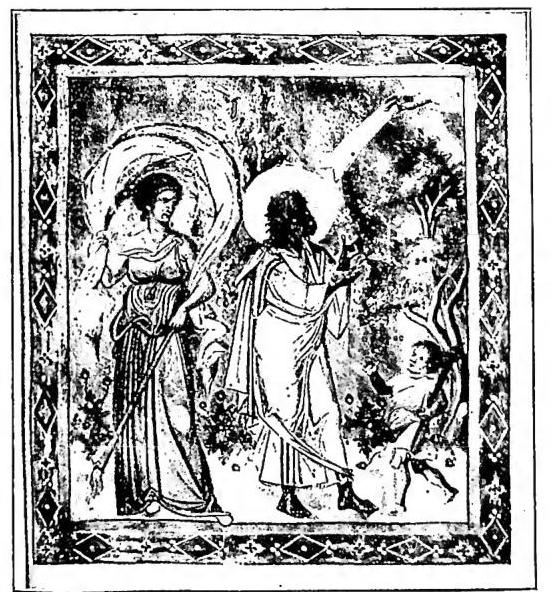
(From H. Omont, *L’ac-simile des miniatures des plus anciens manuscrits grecs de la Bibl. Nat. du VIe au XIe siècle*, Paris 1861, I, I. 1920. Isaiah in prayer. Miniature of the 10th century — Paris, National Library, cod. gr. 139, f. 435.)
3. The oracles of Isaiah — Among the Isaianic oracles of particular importance are: a) chapter 1, used as a general introduction to the book but perhaps composed after the Syro-Ephraimite war of 732: a vivid and moving representation, in beautiful imagery, of the painful conditions of that moment, from the religious, moral, and economic points of view
b) The introductory vision of chapter 6, which contains at least in germ all the characteristic themes of the prophet’s doctrine. — c) ALZON, EMMANUEL D' (v.) in chapter 7, with developments in a long series of subsequent prophecies ("Book of Emmanuel," chapters 7-12). — d) The poems of the "Servant of Yahweh" (42:1-7; 49:1-9; 50:4-11; 52:13-53:12), with prophecies of the passion and messianic belief. — e) The description of the new messianic Jerusalem (chapters 60-62).But the sublime power of the writer and his religious and prophetic value can only be truly appreciated through the direct reading of his prophecies. The "forms" he uses (cf. part 13) are those fixed by prophetic tradition: oracles of threat and promise regarding the future, and of reproach concerning the present. His loftiest theology, the violent passion that sometimes seizes him, the pathetic warmth of his appeals to faith and abandonment in God, the plastic power of his expression continually enriched by imagery, some of which might seem today even too bold, or hurled with a vigor explainable only by the depth of conception and immediate creative impulse, make him the greatest Hebrew poet and one of the supreme geniuses of ancient Semitic civilization.
The Hebrew University of Jerusalem possesses another fragmentary scroll of Isaiah (acquired by E. L. Sukenik). It contains parts of chapters 17, 22, and 23, and the last third of the book (chapters 44–66), all in poor condition. This text is being revived through infrared photography. It is very faithful to the "official" recension; Sukenik considers it to date from the 3rd or 2nd century B.C.
IV. Iconography
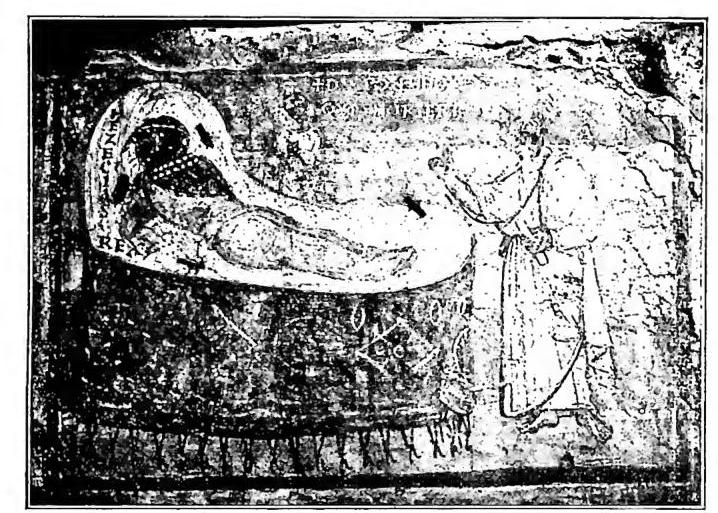
A fresco in the sand-coloured catacomb of Priscilla depicts the Madonna holding the Child to her breast; to the left, a figure in tunic and pallium holds a book in his left hand and with his right points to a star painted (now faded) above the Madonna’s head. G. B. De Rossi, who first published the fresco, identified the figure as Isaiah, who wrote: “Ecce Virgo concipiet et pariet Filium” (Is. 7:14); De Rossi saw in the star the true light, a symbol of Christ, foretold by the same prophet: “Surge illuminare Ierusalem, quia venit lumen tuum et gloria Domini super te orta est” (Is. 60:1–6). Garrucci instead proposed to identify the figure as the prophet Balaam, who foretold the star: “Orietur stella ex Iacob” (Num. 24:17). Wilpert upheld De Rossi’s view and provided a very important colour reproduction of the image, since the star is no longer recognisable (Pitture, pl. 22); the same author mistakenly believed he could identify a similar scene in a much-damaged fresco in the Domitilla catacomb (ibid., p. 175, fig. 14). Recently Fr E. Kirschbaum revived Garrucci’s thesis, while L. De Bruyne emphasised the allusions to Isaiah’s light (Conferenze della Società dei cultori di archeologia cristiana, in Riv. di arch. crist., 21 [1945], p. 243).It should be noted that Justin’s passage draws the public to Isaiah (Apol., I, 32; PG 6, 380), whereas the reference belongs to Balaam.
In the Christian topography of Cosmas Indicopleustes, a miniature depicts Isaiah’s vision; at the centre the Redeemer enthroned between two seraphim acclaimed “Agios,” while in the right corner the prophet is approached by an angel who purifies his lips with a burning coal (a similar scene also appears at the beginning of the book of Isaiah in the Bible of Charles the Bald in the Bibliothèque nationale de Paris). In the Greek Psalter no. 139 of the Bibliothèque nationale de Paris, a miniature depicts another vision of Isaiah; from the hand of God a ray emanates from above, striking the haloed head of the prophet standing between personified Dawn and Night.
A fresco in S. Maria Antiqua depicts the prophet Isaiah foretelling Hezekiah’s imminent death (Is. 38:1). In the chapel of al-Baqawāt in Egypt the martyrdom of the prophet was depicted. A miniature of Isaiah’s vision is found in fol. 67 of the manuscript containing the Sermons of St Gregory Nazianzen in the Bibliothèque nationale de Paris (Cod. Parisinus 510).
V. Ascension of Isaiah
Old Testament apocryphon of narrative and prophetic character, with the prophet Isaiah as its protagonist. The composite nature of the work is universally acknowledged. Scholars advance various hypotheses regarding the identification of sources or independent earlier writings and of editorial or later additions, which essentially agree in recognising a Martyrdom of Isaiah (chapters 1–3, or 2–3 up to V. 12, and the first half of chapter 5); an apocalyptic writing called by Charles the Testament of Hezekiah (chapter 3 from V. 13 and chapter 4); a Vision of Isaiah (from chapter 6 to chapter 10 and part of chapter 11).The first document narrates that Isaiah, accused of claiming to be superior to Moses for having said “I saw the Lord” (Is. 6:1), is sawn in two by the wicked King Manasseh with a wooden saw: this writing, already known to Origen (In Is. hom., 1.5), and according to some also to Heb. 11:37, which among the kinds of martyrdom recalls “being sawn asunder” (though it may only draw from parallel traditions), is judged to date from the end or middle of the 1st century B.C.
The second document narrates the resentment aroused in an adversary of the prophet by his great Messianic prophecies: the Incarnation, Passion and Death of Christ, the election of the Apostles, etc. It is of Christian origin, perhaps from the 2nd century A.D.
The third document narrates a journey of Isaiah through the seven heavens, where he learns the most hidden mysteries, also of a Christian character: this too may date from the 2nd century A.D.
The final compilation dates from the end of the 2nd century A.D. or the beginning of the 3rd. The original text was Greek, only partially preserved (2:4–4:4); there exists the complete Ethiopic version (5th century) and fragments of three Latin versions, one Slavonic, and one Coptic.
The narrative of Isaiah’s death enjoyed some popularity among the Fathers (E. Tisserant [V. BIBLICA.], pp. 62–74) and in Jewish writings; the book was esteemed by certain Gnostic sects. — See pl. XVI.
Studies: V. Burch, The literary unity of the book of the Ascension of Isaiah, in Journ. of theol. studies, 20 (1918–19), pp. 17–23; J. Felten, Storia dei tempi del Nuovo Testamento, II, Torino 1932, pp. 350 ff. Giovanni Rinaldi