Machine translation of the 1948–1954 Italian original. The original text is authoritative.
THE NAVAL BATTLE OF L. — Selim II, who succeeded his father Solimano (d. in 1566) as the great sultan of Constantinople, immediately showed his intention of seizing Cyprus, despite the peace treaty concluded with Venice, which was its sovereign. Venice prepared for the struggle and asked for help from Pope Pio V and the Christian rulers. But Filippo II, king of Spain and also lord of the duchy of Milan, the Kingdoms of Naples and Sicily, and Sardinia, jealous of Venetian predominance in the Levant, would have desired the humiliation of the Republic and, while promising his assistance, deliberately dragged out every measure. Meanwhile, the Turk landed in Cyprus in July 1570; on 9 September he seized Nicosia and on 4 August 1571, after
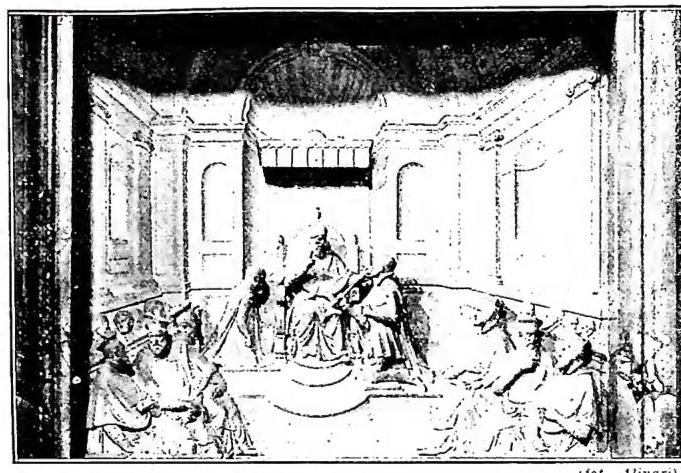
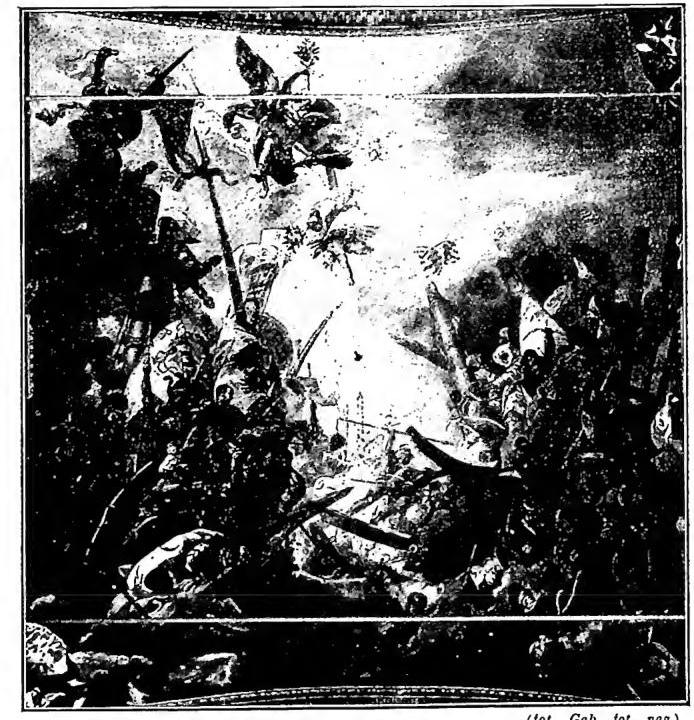
(Alinari photograph) LEPANTO - Don Giovanni d'Austria assumes command for the battle of L. Bas-relief by N. Cordier (ca. 1605). Detail of the monument to Pio V. Rome, basilica of S. Maria Maggiore.After a lengthy siege, also of Famagosta: thus the entire island was lost to Christendom. Only on 25 May 1571 was the league between the Pope, Spain, and Venice signed in Rome; accordingly, Don Giovanni d'Austria, brother of Filippo II, was appointed head of the common fleet. Sebastiano Venier was given command of the Venetian ships, and Marco Antonio Colonna that of the papal ships, with the rank of lieutenant to Don Giovanni. The fleet was ready at Messina only toward the end of August, and, having touched at Corfù, proceeded into the gulf of L. Of the 208 galleys and six galeasses, only fourteen were Spanish, all the others Italian, armed with Italian money; of the 34,000 combatants, only 5,000 were Spanish. The engagement took place before L. on 7 October. The Turkish fleet was commanded by Ali Pascià; on the right flank stood Mehmet Scirocco, and on the left, Lucciall, king of Algiers. The Christian fleet was commanded by Giovanni d'Austria; Agostino Barbarigo was on the left flank, and Gian Andrea Doria on the right. The fighting was fiercest in the centre and on the Christian left; on the right, Doria's conduct, as he kept out to sea, was judged variously. Nevertheless, he kept Lucciall engaged. The decisive day ended in a Christian victory, won at a heavy price; it saved Venice and Italy from greater evils, but not the East, because Turkish naval power was gravely wounded but not destroyed. Venice was compelled to ask the Turk for peace, while Filippo II vainly attempted an expedition against Tunis.
The victory of L. became popular: the fact that it had taken place on the day when the Confraternities of the Rosary offered special prayers associated the victory with that devotion; the Venetians, in particular, gave thanks to s. Giustina, whose feast fell on that day.
BIBL.: L. Serrano, La liga de L., 2 voll., Madrid 1918-20; A. Dragonetti de Torres, La lega di L., Torino 1931; A. Salimei, Gli italiani a L., Roma 1931; G. A. Quarti, La guerra contro il Turco in Cipro e a L., Venezia 1935; G. Castellani, L'assistenza religiosa nell'armata di L., in Civ. Catt., 1936, IV, pp. 470-81; 1937, I, pp. 39-49, 433-43; II, pp. 259-60, 538-47; F. Hartlaub, Don Juan d'Austria und die Schlacht bei L., Berlino 1940; F. Braudel, Le Méditerranée et le monde méditerranéen à l'époque de Philippe II, Parigi 1949, pp. 923-82. Pio Paschini
Cite this article
“LA BATTAGLIA NAVALE DI L.” Enciclopedia Cattolica, vol. VII (1951), p. 717. Azione Romana digital edition, https://azioneromana.com/article/la-battaglia-navale-di-l.