Machine translation of the 1948–1954 Italian original. The original text is authoritative.
THE ORIENTAL BINDING. — The oriental binding, limited to the Mediterranean basin, was mentioned above insofar as in the 15th and 16th centuries it exerted an influence on Italian binding.
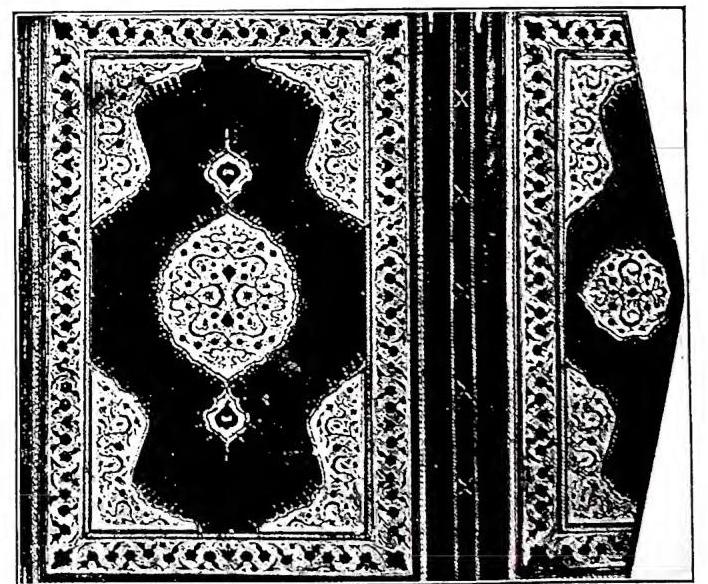
Italy came to know it through Venice, and thus its introduction into the West coincided with the power of that city; but it was much older. The oldest known binding is the Coptic one in the Berlin Library, dating from the 6th century; it covers a papyrus manuscript, but one cut into codex form, and is decorated with a geometric design traced with a point. Later Coptic bindings display, in addition to the lines executed with a point, incisions made with a knife that sometimes recall Muslim mosaics and architectural decorations. The use of the knife continued for a long time, even when the decoration began to be executed by means of impression and gold appeared. At that point the oriental binding assumed its definitive form, which remained unchanged for several centuries. It is chiefly characterized by a central mandorla and delicate floral ornamentation inside and outside the mandorla; the leather is hollowed out or impressed to a considerable depth with dies, while the lower surface is gilded or painted. The flap, an appendage of the second cover, is noteworthy: when folded over the front, it protects the book. Only in Persian bindings do animals appear. Persia also created a type of binding called “rustic”; over the entire surface of the covers and
the flap is illuminated with a scene, often of hunting, sometimes of everyday life with human figures, and then lacquered. This technique, which reached its greatest splendour in the 16th and 17th centuries, produces the charm of a genre painting. — Vedi tavv. LXVII-LXVIII.
BIBL.: P. Colombo, Il legatore di libri, Turin 1913; D. Cockerell, Boobbinding, London 1920; H. Loubier, Der Bucheinband, Leipzig 1926; G. Colombini, La rilegatura del libro, Sampierdarena 1926; G. Ricci, Dell'arte del libro, Bologna 1927; A. Del Vico, L'arte nella I., Rome 1931. Lamberto Donati
Cite this article
“LA L.” Enciclopedia Cattolica, vol. VII (1951), p. 631. Azione Romana digital edition, https://azioneromana.com/article/la-l.