
LEGATURA. — By l. is meant the art of sewing the gatherings of a book firmly together and enclosing them between two boards of solid material in order to preserve them longer; it therefore dates back to the period when the book changed its primitive form of the scroll into its modern one.
This change, generally assigned to the 4th century A.D., and caused by the abandonment of papyrus and the spread first of parchment and then of paper, wax tablets (v.) used by both the Greeks and the Romans. Enlarged in format, they were artistically carved on the exterior when, toward the end of the Empire, State officials began to give them to their friends as auspicious gifts. Since they consisted of two leaves, they are called consular diptychs; beautiful examples are found in the Vatican Library, in the cathedral of Monza, in the Medieval Museum of Brescia, and in many other parts of Europe. The consular diptychs cannot properly be called l.: they are merely a minor branch of late relief sculpture; but it is significant that some of them were used to decorate later books, being applied to wooden l. covered with fabric or leather. From this fictitious l., corresponding to the medieval practice of stripping ancient monuments in order to decorate new ones, there developed those embellished with metal friezes, carved ivory plaques, rare stones, and varicolored enamels. This art does not yet possess a character of its own, since it has the same style as sculpture, mosaic, and goldsmithing; it follows the same evolution as the great figurative and architectural art, from the 7th to the 14th century. Splendid examples are preserved in the church of S. Marco in Venice, in the National Library of Paris, and in those of Munich, Berlin, etc.
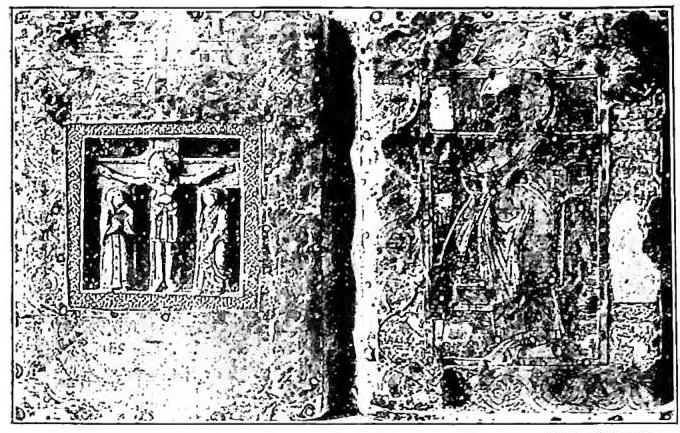
(phot. Orlandini)
LEGATURA – Binding in ivory and engraved silver (12th century) – Modena, Archivio del Duomo.
The most famous chained bindings are found in the Biblioteca Laurenziana of Florence. In the 15th century, medieval monastic binding came to an end, giving way to that of the Renaissance. Little by little, the primitive roughness was refined and softened; the field to be decorated was divided into compartments, and the designs became smaller and more varied. With Arab leathers, much better suited to receiving the impressions of finishing tools, the practice of gilding these impressions entered the West. In 14th-century Egyptian binding one can recognize the germ of the Italian and French Renaissance style; the so-called “coffered bindings” of Venice, in which the leather follows the recesses of the underlying board and is impressed in gold and painted with colors and liquid gold, derive directly from those Persian bindings. At the beginning of the 16th century, the use of wooden boards ceased, replaced by pasteboard; the book, no longer handwritten but printed, more convenient and manageable, entered every home; bibliophily was no longer the preserve of monasteries, and as it spread among private individuals it gave rise to the true modern art of binding, which throughout the Renaissance was like the noble coat of arms of bibliophiles. Among the earliest are the highly elegant bindings called “medallion bindings,” because in the center of their covers they bear a raised medallion, produced in various parts of Italy but especially in Rome and Venice; then came architectural bindings, in which the gold lines applied by hot tooling form an architectural façade of extraordinary effect, certainly influenced by the new vogue for Vitruvius; and finally the bindings erroneously believed to be those of Demetrio Canevari (v.). Italy, which created Renaissance binding by employing punches with vegetal designs, gradually made lighter, and which was the first to apply gilding, soon lost its primacy. In France, where Italian binders went, the bibliophile Tommaso Maieux (v. MAIOLO) first placed his name on architectural bindings, and then on harmonious bindings lightly covered with interlacings and hatched leaves. Still more beautiful are those Grolier (v.). By now France had acquired a primacy it would never relinquish; it immediately afterwards created the type called “à la fanfare,” in which the covers are covered with a myriad of delicate vegetal interlacings, small leaves, flowers, and dots. This type of binding prepared the way for that attributed to Le Gascon, who worked under Louis XIV and created the “mosaic” type by applying, within the compartments, inlays of morocco in various soft colors. Le Gascon binding, especially in its second manner, which takes the shape of an almond, is rightly judged the most elegant and pleasing of all. In subsequent centuries, the art of binding felt the influence of the prevailing taste more strongly: first through the ostentation of heraldic coats of arms, then by transferring onto the leather the ornate style of lace and fans, and, in the Napoleonic era, by adopting neoclassical elements, and so forth. In the present century it is characterized by two distinct tendencies: the first consists in imitating the finest examples of the past, made even colder by the use of the blocking press, which mechanically impresses the design and can repeat it indefinitely; the second, by contrast, is entirely free, often even asymmetrical, and consists in representing on the front cover, with gilt outlines and leather inlays of several colors, a truly symbolic illustration of the text. This style is highly pleasing to the eye and gives the bound work a charming individuality; but, both because of its high cost and because in many countries, such as England, the fragile and insignificant “publisher’s binding” is in use, it may unfortunately be said to be a rarity.