
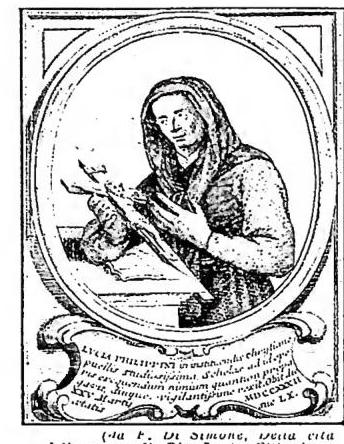
SAINT LUCIA FILIPPINI. — Born 23 Jan. 1672 at Corneto (now Tarquinia), died 25 March 1732 at Montefiascone.
Orphaned of both parents at the age of seven, she was taken in together with her sister and brother by her maternal uncle, Picci Falzacappa, and raised in a noble manner. As a young girl she attended the Benedictine monastery of S. Lucia, assisting in giving catechism to the girls in the parish. The new bishop of Montefiascone, Cardinal Marco Antonio Barbarigo (q.v.), in 1688 placed Lucia Filippini in the monastery of S. Chiara at Montefiascone, which had fallen into some decay, with the intention of using her to reform II. The cardinal then became convinced of the urgent need to provide for the religious and civil instruction of young girls; after several years of attempts, learning that as early as 1685 the Venerable Rosa Venerini had opened free schools for girls at Viterbo, he summoned her to Montefiascone to introduce this excellent work also into his diocese. Thus, between the years 1692–94, under Rosa’s direction, with personnel trained by her and with the cardinal’s strong support, there arose the founding of the girls’ schools at Montefiascone, Corneto (Tarquinia), Valentano, Gradoli, Latera, Cellere, Tessennano, Capodimonte, Marta, and Pianzano—i.e., in nearly all the towns of the diocese. When Rosa Venerini had to return to Viterbo to continue her own work, she proposed Lucia Filippini as director of the schools at Montefiascone, and Lucia continued to oversee the schools during the cardinal’s lifetime. After the death of Cardinal Barbarigo (1706), under his successor, Pompilio Bonaventura, the ties between the two Institutes of Viterbo and Montefiascone were severed: that of Viterbo remained under the direction of the Jesuits, while that of Montefiascone passed under the direction of the Pii Operai Fathers, taking on a somewhat different direction and spirit. This differentiation became evident when Lucia Filippini opened her first school in Rome (1707); compelled to withdraw from Rome, she called Venerini to take her place, but Venerini was unable to save the school (1708), which was closed. The brother of the bishop of Montefiascone, the papal almoner Alessandro Bonaventura, subsequently opened other schools in Rome and elsewhere following the method of Montefiascone, and from these developed the present Pontifical Institute of the Maestre Pie Filippine (q.v.), while at Montefiascone the diocesan Institute remained. Lucia, though residing at Montefiascone, continued to direct all the schools. A woman of great virtue, she was beatified by Pius XI in 1926 and canonized in 1930; her body is venerated in the cathedral of Montefiascone; her feast is kept on 25 March.