
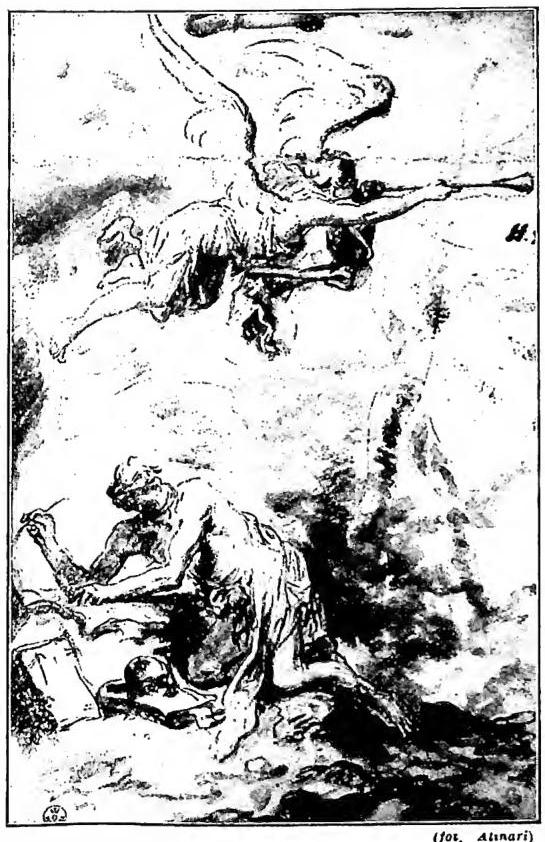
MAGNASCO, ALESSANDRO
**MAGNASCO, ALESSANDRO**, known as *il Lissandrino* — *Martyrdom of St Erasmus*. Milan, Viganò collection.
A lively mind is evident in his works, such as the two canvases with *Gypsy Visions* in the Lecchi collection at Calvisano near Brescia, or the *Scenes of the Inquisition* in the museums of Budapest and Vienna. A deeper expression of his sorrowful humanity is seen in *The Mad Cart* from the Bianchi collection in Sanremo, in *Penitent Friars* or in *Preaching to the Quakers* from the Brass collection in Venice. Later, his palette brightens somewhat, his chromatic paste gains greater fluidity, his touch becomes more vivid and lively: and he creates the four masterpieces, probably executed for Count Colloredo, Austrian governor of Lombardy, now in the Seitenstetten convent in Austria: *The Catechism*, *The Synagogue*, *Monks in the Library*, *Monks in the Refectory*. To a later period, in which exquisite ashen gray tones emerge, belong his final creations, such as *The Synagogue* in the Cleveland Museum (U.S.A.), *Gypsy Banquet* at the Louvre, *Entertainment in a Garden at Albaro* at the Palazzo Bianco in Genoa, and *Supper at Emmaus* in the convent of St Francis at Albaro in Genoa. The favorite themes of M., apart from portraits of youth and a few sacred subjects, were inspired by the life of his time, sometimes in its humblest and most wretched aspects: gypsy scenes, secret gatherings of witches, tempted friars, stormy seas, carts of madmen, highway robberies, sacrilegious thieves; in short, a living world, far removed from any academicism and any rhetoric. He also painted in fresco, namely the “little figures” in landscapes painted by another artist, which are preserved in the Villa di Brigano in Gera d'Adda. Often, especially in his early period, M. painted in collaboration with landscape painters, such as Clemente Spera, Carlo Antonio Tavella, Perugini, and Marco Ricci.
The figure of M. has come back to light in art criticism only in recent decades, when his visions have been seen as a singular premonition of contemporary “expressionist” painting.